Black teachers improve outcomes for all students, but the profession remains largely white
Many Black teachers were pushed out of classrooms from the 1950s through ‘70s. Despite new recruitment programs, the teacher workforce remains mostly white.

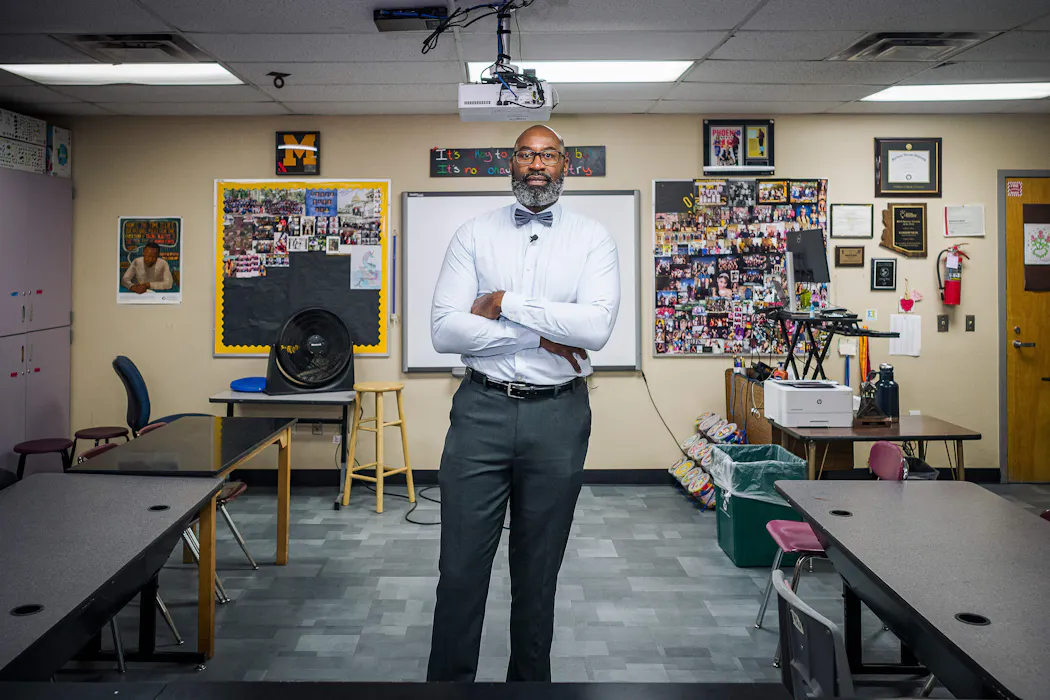
Having Black teachers and other educators of color improves students’ classroom experiences, research shows. They often serve as role models, set high academic expectations and teach material that connects to students’ lives outside of schools.
This can lead to higher standardized test scores, better school attendance and more classroom engagement – particularly when it comes to students who share their teacher’s racial or ethnic background, but also for all students.
Yet over the past four decades, the teacher workforce has barely become more diverse, even as the student population has changed.
In the late 1980s, about 70% of public school students and over 85% of teachers were white. Today, the public teacher workforce is still around 80% white, compared with fewer than 50% of students.
I am a scholar of education policy who studies policies affecting Black and other teachers of color, including strategies for diversifying the teacher workforce.
My colleagues and I recently published two studies that help explain why the teacher diversity gap is so difficult to close, despite programs designed to do so.
Even with local district and state-funded teacher recruitment programs that aim to bring in more teachers of color, it is not easy to reverse a workforce gap that took decades to create. Black teachers were pushed out of classrooms during school desegregation in the 1950s through 1970s, resulting in long-lasting effects that shape how a classroom looks today.
This legacy is rarely discussed in teacher recruitment policies that state they support diversity goals. As a result, they often fail to confront or address the racial inequalities that created the gap in the first place.

A history that still shapes the workforce
In 1954, the Supreme Court’s Brown v. Board of Education ruling struck down state-sanctioned segregation in public schools. The landmark decision opened school doors for students of color.
But desegregation also closed many doors for Black teachers.
Before this ruling, teaching was one of the most accessible and respected professions available to Black Americans, especially Black women, who taught in segregated Black schools. Most other fields, from law to medicine, were largely closed to Black workers by formal exclusion and discrimination.
Teaching became one of the few reliable paths to middle-class stability.
In the 1960s and 1970s, many segregated Black schools across the South and border states closed or merged with white ones.
As this happened, thousands of Black teachers and principals were dismissed or demoted. Some estimates put the number of educators pushed out of the profession as high as 100,000.
Desegregated schools in those same regions often kept white teachers and let Black teachers go, a pattern that education scholar Leslie Fenwick has called “Jim Crow’s pink slip.”
A common strategy
Today, all 50 states, in addition to Washington, have “Grow Your Own” programs – public initiatives to recruit local community members, including current students or school staff, into teaching positions.
Grow Your Own programs have roots as far back as the 1940s, led by the country’s largest teachers union and a network of high school clubs.
The basic idea is simple: Because teachers are more likely than other professionals to work near their hometowns, recruiting local community members into teaching may help grow the teacher workforce.
Educators raised near the schools they teach in often better reflect the demographics of the communities they serve than teachers who come from farther away.
In recent years, most of these teacher recruitment programs have focused on encouraging high school students to pursue a teaching career through elective courses that introduce students to teaching as a career.
Other types of Grow Your Own programs include college scholarships where recipients commit to teaching in the same geographic area or state following graduation. Some programs support classroom aides and other school staff who want to become full-time teachers by enrolling them in required university-level teacher-preparation coursework.
By definition, nearly every program intends to expand the teacher workforce. About half also list increasing diversity as an explicit goal.
While Grow York Own programs are gaining popularity at state and district levels, unfortunately there is no good national count of how many people participate in them.
The Teacher Academy of Maryland
Since 2004, nearly 2,000 high school students per year have enrolled in the Teacher Academy of Maryland, a program my colleagues and I study. These students take high-school-level classes on child development and teaching, alongside their regular coursework. They complete internships in nearby K-12 classrooms, and they can simultaneously earn college credits that transfer to a teacher-preparation program.
The hope is that more high school students will decide to become teachers – a possible solution to a declining teacher workforce. The Teacher Academy of Maryland also is part of a statewide policy push to diversify the teaching profession.
Against this backdrop, my colleagues and I asked three questions in one study published in 2026: Does the Teacher Academy of Maryland actually increase the number of new teachers? Does it diversify the teacher workforce? And what can other states and programs learn from a program like this?
We compared students who had the option to join the Teacher Academy of Maryland program with students just a couple of years older who attended the same high school, but graduated before the program began in that school.
Students enrolled in a school offering the program were about 45% more likely to become teachers than their older peers who did not have the option to join the program. We interpret this effect as large, especially since only 1.4% of Maryland high school students overall become teachers.
The program helped students finish high school and enroll in college. It also steered some students who might have become classroom aides toward full-time teaching positions.
However, over the period we studied, the effects on entry into teaching were over twice as large for white students compared with Black students. The program produced more new white teachers than new Black teachers. It expanded the teaching pipeline in proportion to the students who enrolled, most of whom were white.

Why the gap is not closing
Our follow-up study, also published in 2026, spells out what it would actually take to boost the number of teachers of color.
To fulfill Maryland’s goal of diversifying the teaching profession, recruitment programs would need to focus specifically on Black and other students of color. That could mean concentrating resources in majority-Black districts like Baltimore City.
So far, the Teacher Academy of Maryland has run in only a few of Baltimore’s 30-plus public high schools.
Race-conscious policies face serious headwinds today. Affirmative action is illegal in college admissions and is being challenged in K-12 teacher hiring.
That said, treating teacher diversity as a numbers problem alone will not close the gap. The roots run deeper: Segregation and exclusion have shaped who is in the classroom today.
Lessons for policymakers and program leaders
Our research points to a clear lesson: Programs to address teacher shortages and programs to diversify the workforce are not the same thing.
States, school systems and Grow Your Own programs that take teacher diversity seriously should design their work specifically with that goal in mind. In practice, that means recruiting Black and other students of color directly. And it means being honest that closing this gap will take decades, not a single grant cycle.
David Blazar received grant funding from the Institute of Education to conduct the analyses discussed in this piece.
Read These Next

Chiricahua is the nation’s newest national park – what does that mean?
What comes next for Chiricahua, now that is has been officially redesignated as America’s 64th national…

Offering cash for votes is quite common – but here’s why it doesn’t work
Money or other material benefits are often not enough to override a voter’s preferences and partisanship.

El Niño is threatening California’s fragile coast again – the 1982-83 El Niño opened eyes to the ser
The destructive 1982-83 El Niño, then the strongest on record, eroded cliffs, leaving homes hanging…