About half of young Americans can’t name a single Holocaust site, repeating a pattern of ignorance s
West Germany’s educational reforms in the 1960s and ‘70s show that gaps in knowledge can sometimes create opportunity for rethinking educational methods.

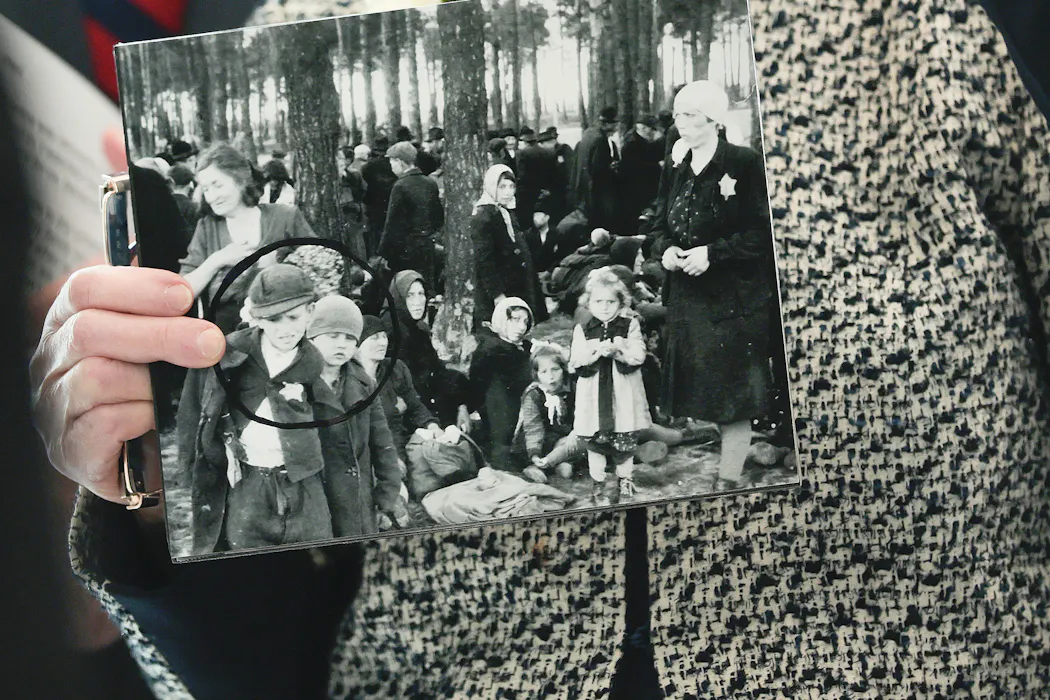
In 2025, 48% of Americans ages 18-29 could not name a single concentration or death camp, according to a survey by the nonprofit Conference on Jewish Material Claims Against Germany, which works to secure compensation and restitution for Holocaust survivors.
Another 53% of surveyed Americans said that they had encountered Holocaust “denial or distortion while on social media.”
Given their ages, approximately 70% of living Holocaust survivors will likely die by 2035. As they do, more and more people will never hear firsthand experiences about the atrocities Nazis perpetuated during the genocide of European Jews.
My research shows that Holocaust education and awareness, though, doesn’t always follow a linear path.

Teaching a dark chapter
In my 2024 book, “Teaching a Dark Chapter: History Books and the Holocaust in Italy and the Germanys”, I study how Holocaust education evolved in East Germany, West Germany and Italy from the 1940s through the 1980s. In particular, I focus on the content of history textbooks that schools used for middle school students.
I also explore how two antisemitic incidents, one in 1959-60 and then another in 1977, revealed West German students’ lack of Holocaust knowledge.
Both times, international and domestic West German news outlets expressed alarm about students’ ignorance.
These antisemitic incidents also led to a series of educational reforms, in which educational leaders affirmed the need for Holocaust education and specified how educators should teach about the Holocaust.
The ‘swastika epidemic’
All of the synagogues in Cologne, Germany, were either destroyed or badly damaged during the Nazi pogroms of 1938, sometimes called Kristallnacht, or the “Night of the Broken Glass.”
The prominent, historic Roonstrasse synagogue was among the badly damaged Jewish houses of worship and was one of the few synagogues in West Germany to be rebuilt following World War II. In September 1959, West German Chancellor Konrad Adenauer attended a high-profile ceremony when the synagogue’s reconstruction was complete.
But then on Christmas Day of that year, Roonstrasse was defaced with antisemitic graffiti.
Two 25-year-old men were arrested for the vandalism. They testified during their 1960 trial that they never learned about Nazism in school. At the time, West Germany had vague guidelines on how to teach students about the Nazis and the Holocaust.
Historian James Loeffler has challenged whether these arrested men were actually responsible for the vandalism. He argues that the Soviet KGB actually drew the swastikas in order to discredit West Germany.
Regardless, following the Roonstrasse defacement, a wave of additional antisemitic vandalism spread throughout West Germany and other places, including the United States. The press called this trend the “swastika epidemic.”
Many people attributed the rise in antisemitic activity to a lack of education about the Nazi period. They questioned what West German students were learning about their country’s recent past.
New guidelines on how to teach Nazism
The swastika epidemic wasn’t happening in isolation.
In April 1959, the TV documentary “Blick auf unsere Jugend,” meaning “Focus on Our Youth”, focused on a class of West German high school students. Very few of them knew how many Jews were killed by the Nazis.
The negative media coverage coincided with representatives of German and international Jewish organizations meeting with the West German federal president, Theodor Heuss, regarding the antisemitic vandalism and the failures of the West German education system to teach about Nazism.
A committee of West German state cultural representatives called the Kultusministerkonferenz, or KMK, began issuing new guidelines in 1960 and again in 1962 about how to teach about Nazism in schools.
The West German federal states were instructed to examine how Nazism and what we now know as the Holocaust – the term was not used at the time – was depicted in school textbooks. Feedback was then provided to the textbook publishers.
How books were revised
I analyzed many versions of the same middle school history textbook called “Kletts geschichtliches Unterrichtswerk Ausgabe B,” which translates into “Klett’s Historical Instructional Materials Version B.”
Between 1959 and 1960, the textbook authors completely revised a subsection on “Terror and Crimes,” which examined how the Nazis murdered disabled people, as well as how the Nazis persecuted and murdered Jews.
The subsection tripled in size between the 1959 and 1960 textbook editions. The new version also included important new information, such as that the Nazis murdered an estimated 6 million Jews.
Previous editions had used generalizations like “many million,” without providing actual numbers.
A second controversy
Seventeen years later, in 1977, a West German teacher named Dieter Bossmann published a widely publicized study that offered more detail on the widespread ignorance among West German students, at every level.
Some students admitted to knowing almost nothing about Hitler. Some said relatively positive things about Hitler. One student thought that the Nazis had killed tens of thousands of Jews. Another thought that 16 million Jews had been killed.
The West German news magazine Der Spiegel observed at the time that the issue was perhaps not so much what students were learning, but rather how they were being taught. Although West German textbooks had been revised in the 1960s, somehow there was a disconnect between the textbook page and students’ understanding.
The KMK issued a new resolution in April 1978 that called for new curricular material for schools.
After this, more West German teachers began to prioritize an active teaching model. They encouraged students to analyze primary sources and participate in experiential learning activities, such as visiting concentration camp memorials and conducting local history research.

Remembering history
Holocaust education in West Germany was not perfect after 1978 – or any time since.
For example, Deutsche Welle, Germany’s public news broadcaster, quoted a Berlin history teacher saying in 2023 that among his students, “Adolf Hitler is known by most; the term National Socialism too. Some of them also know about the Holocaust, but knowledge is selective and it contains many blank spots.”
An estimated 18% of German adults incorrectly said in 2025 that 2 million or fewer Jews were killed during the Holocaust.
My particular focus on textbooks and curricular guidelines, though, demonstrates that sometimes, knowledge gaps lead to leaps forward.
Today, in part because of these developments, it’s mandatory to teach about the Holocaust in all federal states in Germany.
In the U.S., Holocaust education requirements are determined at the state level, and not all states provide Holocaust education guidance or mandates. If the West German case shows anything, I think, it is that guidance on teaching history should be continuously updated and reiterated.
Daniela R. P. Weiner has received funding from the Jack, Joseph and Morton Mandel Center for Advanced Holocaust Studies at the United States Holocaust Memorial Museum, the German-American Fulbright Commission, the German Historical Institute, Washington, DC, the Leibniz Institute for Educational Media | Georg Eckert Institute, the Carolina Center for Jewish Studies, the Stanford Graduate School of Education, and the Department of History at the University of North Carolina at Chapel Hill. She is also affiliated with the Association for Jewish Studies.
Read These Next

Using light to control brain cells – neuroscientist Karl Deisseroth explains how he made his Nobel-w
Optogenetics, a field that started with an algae gene, is shedding light on new treatments for eye and…
Americans who go to church and trust science are also more likely to believe in ghosts and curses, n
Belief in science and belief in magic can coexist.

Do you think teachers are similar to coaches, pastors or something else? It depends on where you liv
Across three countries, people agree that teaching is centered on the teacher-student relationship.…