What an ancient Chinese philosopher can teach us about Americans’ obsession with college rankings
More than 2,000 years ago, Laozi was all too familiar with the pitfalls of comparing yourself to other people’s accomplishments.

Each March, many of the country’s most selective colleges and universities release their admissions decisions, reviving debates over the roles of race, wealth and privilege – and putting Americans’ cultural obsession with rankings back in the spotlight.
Meanwhile, a more personal set of questions will emerge in many homes and schools. Who got into a “better” school, and why? And for those who didn’t, what to do with a dream school deferred? What’s missing are more fundamental questions about the costs of striving for status and how to know when to stop.
From my former life as a college counselor to my current one as a psychology professor, I’ve spent more than two decades working with Asian American families, the demographic group that often finds itself at the center of college admissions debates. I listen as they grapple with questions of race, social status and who makes it in the U.S. and why. I’ve also seen firsthand, both inside and outside of the research lab, how some students’ never-ending quest for achievement takes a toll on their mental health.
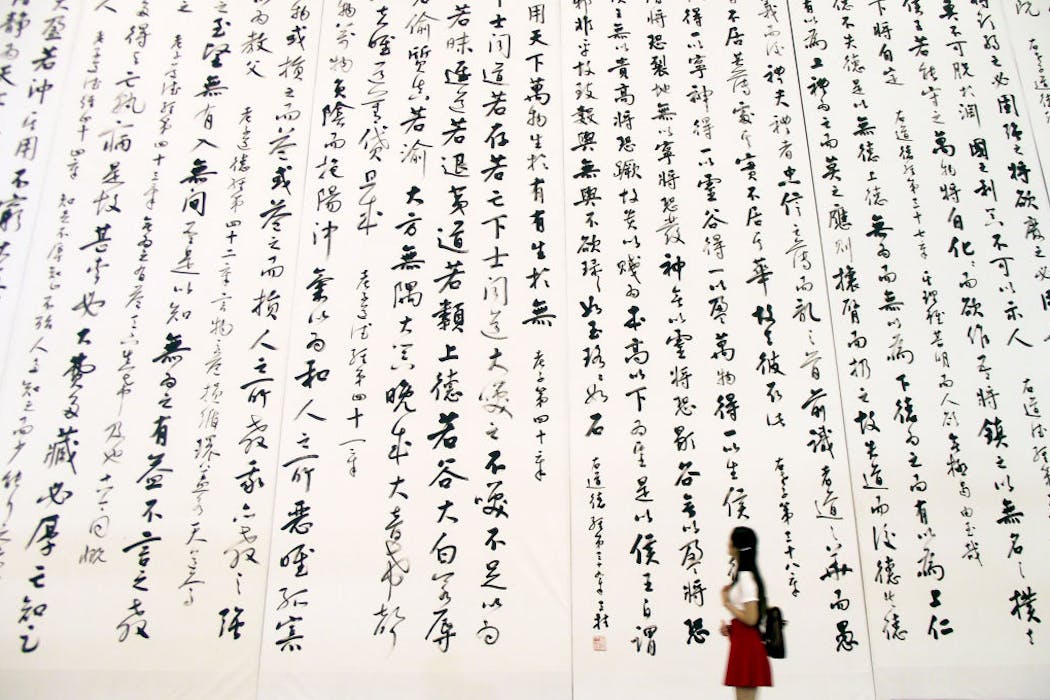
Americans’ frenzy over college admissions may be a relatively modern affliction, but striving for status is timeless and universal, and it can benefit from the wisdom of ancient texts. This is why, in my team’s research with Asian American families, we bring the Chinese philosopher Laozi into the conversation. Through the Daodejing, one of the central texts of Daoism, Laozi offers perspectives from a tumultuous period of status-striving in Chinese history – and shifts our focus from comparison and competition to contentment.
The ‘success frame’
In interviews with Asian American parents, children and teens over the past 10 years, I hear echoes of what sociologists Jennifer Lee and Min Zhou call the “Asian American success frame”: success defined by elite educational credentials, graduate degrees and select occupations. Their research shows how the success frame is endorsed by Asian Americans across different ethnic groups, generations and socioeconomic brackets.
My team’s ongoing interviews, in turn, provide a window into how that idea of success is promoted. One mother told her 11-year-old son her wish is for him not to pursue an M.D. or a Ph.D., but both. Another parent of a 16-year-old with college applications on the horizon discouraged her from applying to state schools, because she had heard that some job recruiters consider only Ivy League resumes.

These conversations rarely mention the toll of chasing these highly specific, highly ambitious benchmarks of success. Rather, it comes to light when we talk with parents one-on-one about their own experiences. One lamented being a doctor, but not the “right kind” of doctor; another mentioned getting a Ph.D., but not from the best school; yet another described landing the job they sought when they immigrated to the U.S., only to run up against “bamboo ceilings” in their career.
Each of these comparisons involves relative or subjective social status: not how much education, wealth or prestige people actually have, but how much they think they have, relative to others. Decades of research indicate that thinking you have lower relative status takes a unique toll on mental and physical health.
I see this in my lab’s studies, as well: Parents who perceive themselves as being lower in subjective social status report more depressive symptoms, and children who perceive themselves as having low relative status report more loneliness, even when accounting for families’ actual levels of income and education.
Likewise, scholars Zhou and Lee identify similar struggles among Asian Americans shouldering the weight of these social comparisons. A woman who attended a lower-ranked college than her family members told researchers she “feels like the ‘black sheep’ of the family”; a man rejected from elite Ph.D. programs considers himself a failure for “only having a B.A.”
The unending climb of status comparisons can be a crushing load – and this is where Laozi comes into the conversation.
Dangers of desire
By some accounts, Laozi was a contemporary of Confucius in the sixth century B.C.E. – though the details of his biography are more legendary than factual.
Traditionally, he has been venerated as the author of the Daodejing, a foundational text of Daoism: a Chinese philosophical and religious tradition centered around following the “dao,” or “the way” of nature. The general consensus of modern scholarship, however, is that the Daodejing reflects the work of generations of thinkers and editors, and that even the name “Laozi” embodies ideas developed over centuries.

Most scholars date the composition of the Daodejing to China’s Warring States period, from 475-221 B.C.E. It was a time of tremendous technological, economic and political change, when competitions for status played out on the battlefield. Given this historical context, it’s little surprise that much of the text’s musings are devoted to status-chasing and the dark side of human desire.
For example, the Daodejing criticizes the ruling class and its talent-recruitment system for dangling enticing status markers that could never be fully achieved. Dreaming of prestige could feel like a full assault on the senses, as captured in Ken Liu’s luminous translation:
A profusion of colors blinds the eye.
A cacophony of noises deafens the ear.
A flood of flavors numbs the tongue.
Rushing and chasing, the mind becomes unsettled.
Craving and desiring, the heart loses itself on crooked paths.
The Daodejing may be an ancient text, but part of its enduring appeal is its timelessness. Through Liu’s prose, we can easily imagine Laozi critiquing today’s profusion of college influencer videos, a cacaphony of Reddit threads trumpeting admissions strategies, and high school students rushing and chasing after a stacked resume.
Laozi sees plainly the Sisyphean nature of achieving: that it inevitably leads to desiring more. He offers a stark warning: “The more you desire, the more it costs. / The more you hoard, the more you’ll waste.”
Critically, as the philosopher Curie Virág argues, Laozi isn’t suggesting that people abandon desire altogether. Rather, our truest desires can only be uncovered when we’ve freed ourselves from those imposed by society. And it’s the satisfaction of these true desires that can lead to contentment.
Deeper questions
In my research team’s ongoing study with Chinese American parents and adolescents, we present a phrase encapsulating one of the core teachings of the Daodejing: that contentment – knowing or mastering satisfaction – leads to happiness. We then ask parents to explain to their child what they think it means and whether or not they agree.
Most parents are familiar with the phrase. Some endorse it, while others add caveats. Being content is different from being lazy, some emphasize; it’s not an excuse to stop striving. Many struggle to articulate the distinctions between contentment, laziness and healthy ambition – and as a psychologist, I admit that I’m right there with them.
I want Laozi to provide a clear definition for contentment, and even better, a formula for how to find it. But the Daodejing is more descriptive than prescriptive – less how-to and more what is. In Liu’s description, the text is Laozi’s invitation into a conversation, and it allows our deepest questions to come to the surface. Beneath the race for rank and status, what is it that we actually desire, and how do we find it?
These are difficult questions for any parent to answer. But if we’re willing to start the conversation, we can begin by asking them first of ourselves.
Preparation of this essay was supported in part by a grant from the Asian Pacific American Religions Research Initiative.
Read These Next

Offering cash for votes is quite common – but here’s why it doesn’t work
Money or other material benefits are often not enough to override a voter’s preferences and partisanship.

Horror’s monsters find new meaning with queer and trans audiences – how ‘Teenage Sex and Death at Ca
Horror as a genre has traditionally been rife with transphobia and homophobia. But LGBTQ+ fans love…

What the failed attack on an Illinois temple reveals about anti-Hindu hate in the United States
Hostility toward Hindu worship practices draws on a long history of prejudice portraying the faith’s…