Tiny house villages are increasingly responding to the homeless crisis in America’s fast-growing cit
As economic and demographic growth increasingly coexists with poverty and homelessness, resident-led alternatives to housing are supporting communities left behind.

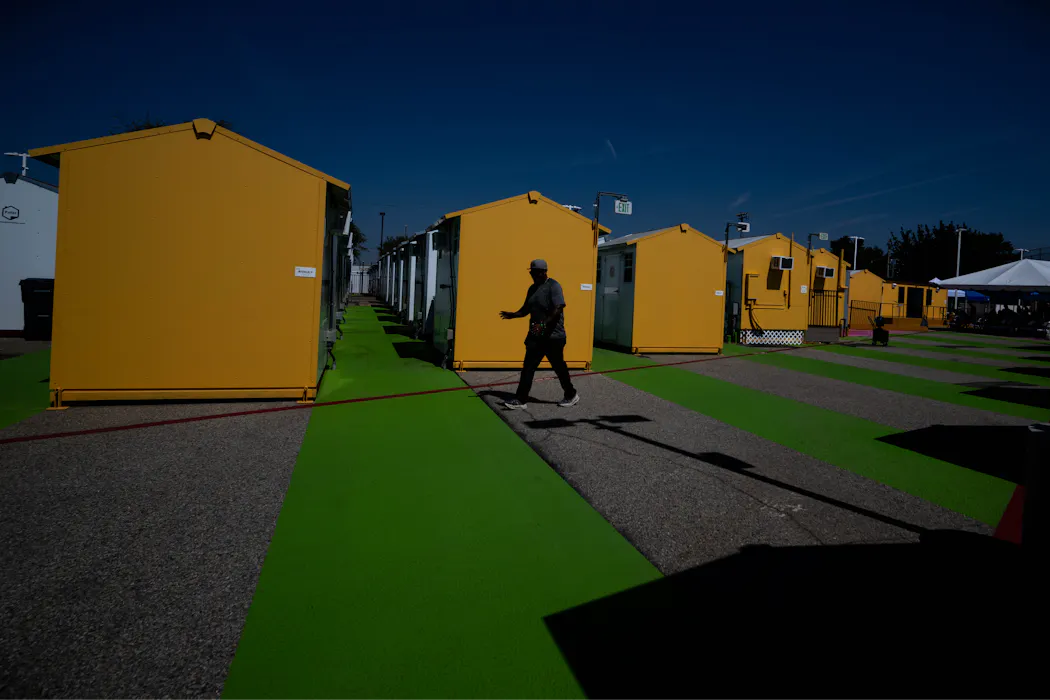
Recent population estimates show that Charlotte, North Carolina, is the fastest-growing large city in the United States. The city added more than 20,000 residents between 2024 and 2025 and is rapidly approaching a population of 1 million.
Charlotte has become a magnet for businesses and residents seeking opportunities and a lower cost of living.
But as Charlotte grows, its infrastructure is becoming increasingly strained. The pressures of population growth are evident in the city’s housing crisis. In 2026, 2,018 people were experiencing homelessness, up from 444 the previous year.
As urban researchers studying housing insecurity and urban development, our work examines what happens when rapid urban expansion outpaces cities’ ability to shelter their most vulnerable residents.
Charlotte’s housing pressures are not unique. They reflect a broader American urbanization in which rapid economic growth and concentrated wealth coexist with persistent housing inequality.
And we’ve found that communities across the U.S. are increasingly responding to this affordability crisis with resident-led alternatives.
The housing crisis
For Charlotte renters, housing costs have risen considerably. Median rent in the city increased from US$1,146 a month in 2019 to $1,627 in 2024.
Meanwhile, longtime residents in historically Black neighborhoods face mounting displacement pressures, as redevelopment and rising property values make it increasingly difficult for low-income residents to remain in their communities.
For households already living on the economic margins, these pressures can mean the difference between remaining housed and becoming homeless. The Charlotte-Mecklenburg area has about three extremely low-income households for every rental unit affordable to them. And for people already experiencing homelessness, finding a way out has become harder: The share of people leaving the homeless services system for permanent housing fell from 38% in 2020 to 25% in 2024.
The problem is not that Charlotte and many other American cities are growing. It’s that these cities often treat growth itself as the policy objective, while paying little attention to who benefits from it and who doesn’t.
Tiny house villages
Our research shows that when infrastructure and housing markets cannot accommodate unhoused populations, resident-led alternatives often fill the gap.
Tiny house villages, for example, represent a community-driven mechanism for people to find housing and community amid poverty and exclusion. These villages typically consist of clusters of small homes that provide people experiencing homelessness with shelter within a shared community.
Depending on the village, residents may also have access to shared facilities and services, such as bathrooms, kitchens and healthcare. These villages vary considerably in how they operate: Some provide temporary shelter, and others offer longer-term housing and pathways toward permanent housing.
A 2024 study that one of us conducted and that built on an earlier national study has allowed us to examine how tiny house villages across the country have increased over five years. The growth was striking: The number of villages nearly quadrupled, from 34 in 2019 to 123 in 2024.
This growth is particularly notable because the villages – often spurred by nonprofit and faith-based groups – have emerged outside conventional housing systems and are tailored to local circumstances. In the U.S, these models are increasingly supporting communities that are self-reliant out of necessity.

Portland’s Dignity Village
Dignity Village in Portland, Oregon, illustrates what this bottom-up response looks like. Housing some 60 residents, it grew out of an encampment established by homeless activists in 2000.
Dignity Village initially emerged as a tent city on vacant city land beneath a downtown bridge. Today, it has evolved into a self-governed community of tiny homes. Residents manage the village and maintain shared spaces.
People seeking to live at Dignity Village must be experiencing homelessness when they apply. Once admitted, residents become members of a community with its own rules and elected leadership. Residents are generally required to contribute at least 10 hours of work a week toward operating and maintaining the village. Exemptions are available for people who work, attend school or are unable to participate.
The City of Portland provides the land, but residents contribute to the costs of running the community through monthly program fees. Dignity Village also relies on private donations, grants and income from microbusinesses to pay expenses like electricity and waste removal.
Austin’s community and beyond
A very different tiny house model has emerged in Austin, Texas.
A nonprofit developed Community First Village to provide permanent, affordable housing for people coming out of chronic homelessness. Unlike Dignity Village’s relatively small, resident-governed community, Community First operates on a much larger scale.
As of June 2026, more than 500 people lived there. That included more than 455 people who had experienced chronic homelessness, and nearly 50 “intentional neighbors” who chose to live in the community alongside them.
The larger nonprofit model has attracted substantial private and public investment, including $35 million in federal COVID-19 pandemic-relief funds allocated by Travis County toward an additional Community First site.
Similar communities are emerging across the United States. Just a few examples include Seattle, Los Angeles and Springfield, Missouri.
Access to all
For much of the late 20th century, the dominant challenge facing American cities was managing population decline. Urban policy focused on attracting residents and investment back to places hollowed out by suburbanization and deindustrialization.
Today, many of the country’s fastest-growing metropolitan areas confront a different reality. The proliferation of tiny house villages across the U.S. is occurring at a time when many cities are attracting new residents and investment, while struggling to provide housing that remains accessible to all.
This is evident in Charlotte and in other fast-growing cities such as Austin and Phoenix, where population growth has occurred alongside persistent challenges around housing affordability and homelessness.
The authors do not work for, consult, own shares in or receive funding from any company or organization that would benefit from this article, and have disclosed no relevant affiliations beyond their academic appointment.
Read These Next

UN peacekeepers prepare to exit Lebanon after 70 years – leaving behind a worrying security vacuum
In August, the UN Security Council voted to end the decades-long peacekeeping mission in Lebanon. Blue…

PHP is in the foundation of 70% of websites – here’s what it is and why a flaw in the software is a
A cybersecurity researcher explains how a flaw in widespread software makes millions of websites vulnerable…

Why ultra-Orthodox parties hold so much sway in Israeli politics
Ultra-Orthodox Jews, often called Haredim, make up a small but growing percentage of Israel’s population.…