
How keeping down borrowing costs for mortgages and other loans is built into the Fed’s ‘dual mandate
Recent news reports highlighted how the Fed technically has a third mandate – moderate long-term interest rates. An economist explains how the objective is already baked into the other two.


What’s the point of monetary policy?
For most of us, the main impact tends to be how much we have to pay to borrow to buy a house or car. But for the Federal Reserve, the purpose of its monetary policy is mandated by Congress.
This is widely known as the Federal Reserve’s dual mandate: promoting maximum employment and stable prices. The Fed itself refers to these two objectives regularly in its Federal Open Market Committee statements announcing its monetary policy decisions.
A third objective of monetary policy, however, is less well-known: moderate long-term interest rates.
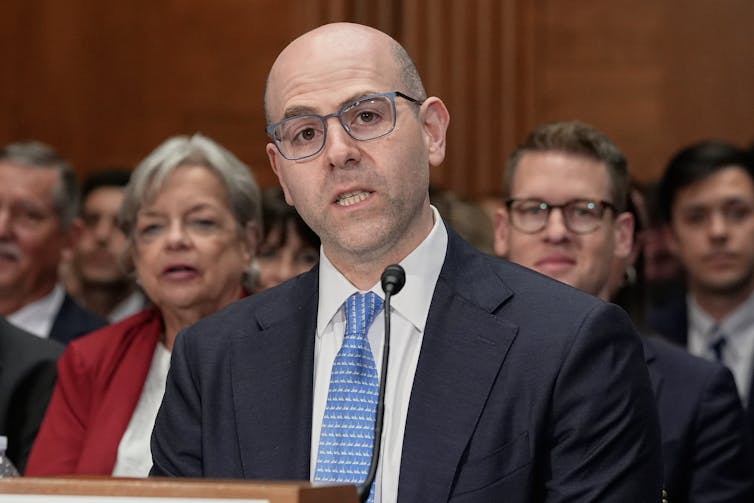
This “third mandate” was a big news story in September 2025, when the Trump administration’s newly appointed Fed governor, Stephen Miran, referred to it in his testimony before the Senate Banking Committee. Financial markets paid close attention to this aspect of the testimony because the comments suggested that Miran and other presidential appointees may focus on this third mandate – and on driving down long-term borrowing costs – more than the Fed has in the recent past.
I’ve been closely following how the Fed conducts monetary policy for many years. Miran is correct that Congress has tasked the U.S. central bank with all three of these objectives – but that’s not the whole story. In fact, none of these goals were originally spelled out in the act that set up the Fed over a century ago.
Since then, the Fed’s goals have been revised several times – typically in response to a crisis.
The Fed’s shifting goals
The original purpose of the Fed, as explained in the Federal Reserve Act of 1913, was to provide flexibility in the nation’s currency supply and to supervise the U.S. banking system. The current dual mandate was not part of the original goals of the Fed.
Instead, its core goal was to reduce the frequent banking panics that were costly to the economy and sharply increased interest rates.
The first big change in the goals, in response to the Great Depression, was the Employment Act of 1946 that stated the goal of federal government policy – and, therefore that of the Fed – is to “promote maximum employment, production and purchasing power.”
This is where the two goals of the dual mandate first began to emerge, with purchasing power implying the Fed needed to keep inflation low.
Following the macroeconomic instability of the 1970s with high unemployment and high inflation, Congress enacted the Federal Reserve Reform Act of 1977 that formalized the Fed mandate: “maintain long run growth of the monetary and credit aggregates commensurate with the economy’s long run potential to increase production, so as to promote the goals of maximum employment, stable prices, and moderate long-term interest rates.”
In other words, Congress gave the Fed three mandates to follow in monetary policy.
What happened to the third mandate?
So why doesn’t the Fed still talk about that third mandate?
Part of the answer is that moderate long-term interest rates are a natural by-product of successfully managing the other two.
In pursuit of low inflation and maximum employment, the Fed primarily uses a short-term interest rate, known as the Federal Funds rate. When journalists report that the Fed raised or lowered interest rates, this refers to the so-called target rate that the central bank uses to control the Fed Funds rate. For example, the current target rate is a range of 3.75% to 4%, while the effective Fed Funds rate is 3.89%. Banks use the funds rate as the cost other banks must pay to borrow reserve funds for one day.
However, most of the interest rates that matter to people, businesses and the economy at large have much longer terms – such as five, 10 or 30 years. Examples include mortgages, car loans and corporate bonds. The Fed does not directly control these longer-term interest rates, which are set by financial markets.
But studies have found that the Fed’s policy decisions can influence long-term rates, primarily due to “expectations theory.” That theory argues that long-term rates reflect financial markets’ expectations of future short-term rates.
So if markets believe the Fed has inflation under control, they tend to keep long-term rates on mortgages and everything else low because they don’t expect the Fed will increase its target rate. If inflation is running high, long-term rates tend to rise because markets expect the Fed to have to lift its short-term rate to deal with it. But if unemployment is running high, long-term rates tend to fall because markets expect the Fed to reduce its short-term rate to deal with that.
Longer-term rates are, therefore, not independent of the dual mandate of the Fed. They are often an outcome of how successfully the Fed is meeting the dual mandate of full employment and stable prices currently and in the future.
As a result, the Fed doesn’t typically talk about this third mandate.
Promoting economic stability
That said, the Fed has, at times, although very rarely, influenced long-term rates directly.
For example, in late 2010, following the Great Recession of 2007-2009, the Fed purchased billions of dollars’ worth of long-term Treasury bonds and other securities – a program known as “QE2” for quantitative easing – in an effort to lower the cost of borrowing for consumers and businesses. The Fed did something similar in 1961 with Operation Twist, similarly with an aim to support the U.S. economy by reducing long-term borrowing costs.
But even this phase of quantitative easing was primarily about meeting the Fed’s dual mandate. More specifically, since inflation was already low, the Fed was trying to boost hiring in the wake of the Great Recession.
The Fed is keenly aware that longer-term interest rates that are not aligned with its dual mandate can be an important source of instability in the economy. A modern central bank’s primary goal is to promote stability in the economy, so longer-term interest rates should be at levels that are appropriate to ensure current and future economic stability.
Arabinda Basistha does not work for, consult, own shares in or receive funding from any company or organization that would benefit from this article, and has disclosed no relevant affiliations beyond their academic appointment.
Read These Next

We studied 1,584 data centers – and found the buildings full of machines are tied to modest local jo
This employment boost took three to five years to show up, two researchers found after studying more…

How should AI be regulated? Follow the harm
Instead of trying to restrict AI technologies, regulations could focus on the harm the technology causes…

Where humans build, mosquitoes follow – bringing dengue, West Nile and other diseases with them
Disease-carrying mosquitoes are moving deeper into the US. Climate change is only part of the problem.