Travelers will refuse an upgrade to sit near a loved one -- new research into when people want to sh
New research on our desire to create shared memories with the people we care about offers insights for companies that want to improve their customer service.

The Research Brief is a short take about interesting academic work.
The big idea
People will often sacrifice a better experience and opt for one that’s less enjoyable if it means they can do it alongside a loved one – whether that’s a romantic partner, close friend or relative. That’s the main finding of our research published in the Journal of Consumer Psychology in April 2023.
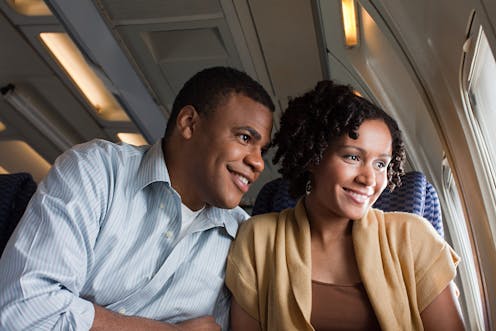
For example, when taking a flight, two friends might decide to sit in adjacent seats in coach rather than accept a free upgrade to nonadjacent seats in first class. Failing to choose togetherness can have consequences, as in the “Seinfeld” episode in which Elaine suffers the indignities of economy class, leading to rage against Jerry after he chooses to accept an upgrade.
We conducted five studies in a variety of settings and featuring different social bonds, including friendships and romantic relationships. In one study, just over half of people chose two adjacent seats far from the stage over two nonadjacent seats closer to the stage when imagining they were attending a Cirque du Soleil performance with a close friend, compared with only about one-third who chose the adjacent seats when imagining attending with an acquaintance.
In another study, we asked students whether they wanted to eat one chocolate with another person – either a new friend or a stranger – or two chocolates alone. Half the people chose the shared experience – but only if the other person was a friend. Fewer people – 38% – opted for the shared experience if the other person was a stranger.
Why it matters
One reason people prioritize physical proximity with close partners is because they want to create shared memories. Importantly, people believe that physical distance can disrupt the creation of shared memories, and so they forgo enjoyable experiences apart from their loved one.
This also matters for companies seeking to improve customer experience, such as an airline offering free upgrades or shorter wait times. Our findings suggest that, for example, consumers traveling with a companion might not take advantage of services like TSA PreCheck, an airline VIP lounge or a free upgrade if it is available only for themselves. It also helps explain why consumers do not like when airlines split up families in their seat assignments.
However, we also tested a few initiatives marketers can use to encourage people to choose a higher-quality experience that requires them to be apart from their companion. In another experiment, we described a train ride as either a fun part of an excursion or as a practical way to reach a final destination. More participants accepted a free upgrade – even though it required sitting apart from their romantic partner – when they perceived the train ride as utilitarian. That’s because they cared less about creating shared memories during the experience.
What still isn’t known
We still don’t know how this preference affects relationship quality.
For example, when can time apart from your partner actually strengthen the relationship? And how should couples split their time between lower-quality activities done together and higher-quality activities done alone? One option for separate activities, for example, might be when one partner’s desired activity does not interest the other.
Also, given that people believe physical proximity is a prerequisite for creating shared memories, how can partners who live in different places also cultivate shared memories? This question is especially important in light of how COVID-19 has enabled more people to work and study remotely.
The authors do not work for, consult, own shares in or receive funding from any company or organisation that would benefit from this article, and have disclosed no relevant affiliations beyond their academic appointment.
Read These Next

Mpox cases are on the rise again in Brazil – just as an antiviral drug fails in trials
The mpox curve has started to rise again, with cases concentrated in Rio and São Paulo. There is no…

What’s behind the bedazzling mania that’s taken over high school and college campuses?
Gen Zers see it as a form of ‘whimsymaxxing,’ or imbuing playfulness and joy into everyday life.
Whether it’s ‘Sister’ or your own sister, the burden that caring for aging parents puts on women is
About 1 in 4 US adults are family caregivers.