Americans can now see a famous portrait of the Pacific Islander who captivated 18th-century England
Joshua Reynolds’ 1776 ‘Portrait of Omai’ portrays a commoner from Tahiti as a nobleman, reflecting European fantasies and assumptions about Pacific cultures.

In 1774, a young man in his early 20s named Mai arrived in England.
The first Pacific Islander to visit Britain, Mai had joined Captain James Cook’s second expedition during its stop in the Society Islands, which include the islands of Tahiti and Raiatea and today are a part of French Polynesia.
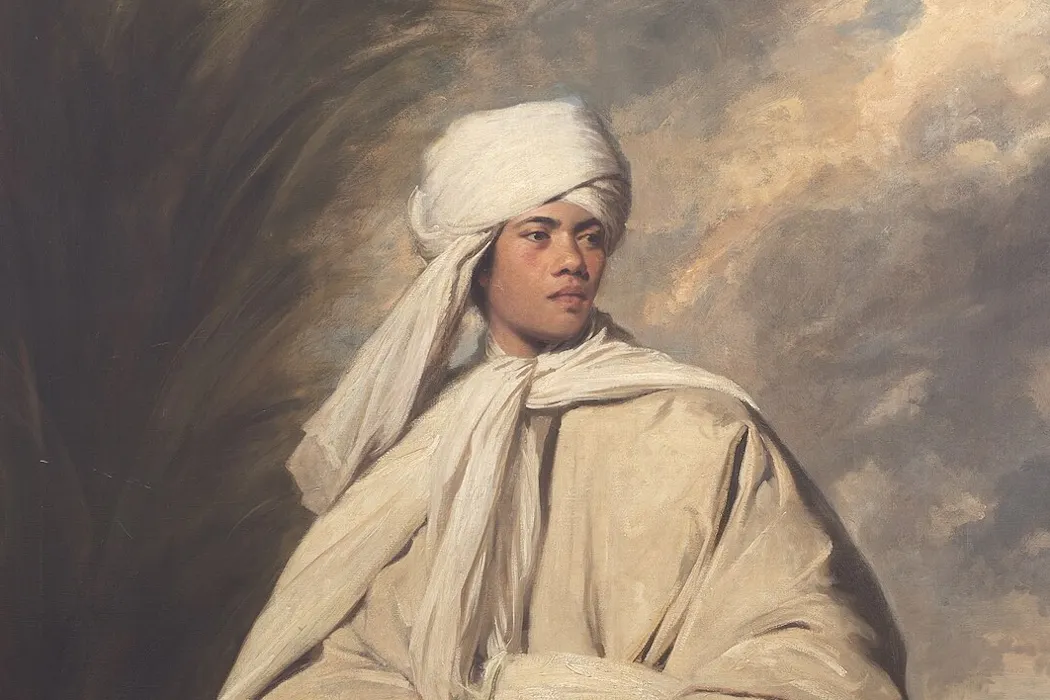
Two years after Mai’s landing in England, the painter and founding Royal Academy President Joshua Reynolds depicted Mai on a canvas nearly 8 feet tall.
Now, more than 250 years later, the painting has made its way to Los Angeles. The Getty Center and the National Portrait Gallery jointly acquired it in 2023 for US$61 million, and the painting went on display at the Getty on Sept. 15, 2026, where it will remain through March 2027.
Audiences in the U.S. might not appreciate just how remarkable – and strange – it was for 18th-century Britons to encounter this portrait.
Reynolds transformed a young Pacific Islander into a monumental figure of European portraiture, giving Mai the grandeur and authority normally reserved for the elite. The painting let 18th-century Britons project their ideas about people from distant lands, how they should be depicted and what could be learned from them.
Romanticizing the ‘savage’
Beginning in the late 1750s, English translations of the books of French philosopher Jean-Jacques Rousseau had helped to popularize the idea in England that “savages” merited closer study.
Rousseau argued that societies were happiest before agriculture and metal production corrupted them. “Savages,” he believed, had few desires and could easily satisfy them, unlike Europeans, who made themselves miserable pursuing unnecessary luxuries.
Rousseau lamented that accounts of these societies came mainly from merchants, sailors, soldiers and missionaries. He called for learned gentlemen to undertake “a serious Voyage round the world” to “study Men and Manners.”
The fabulously wealthy young naturalist and botanist Joseph Banks shared Rousseau’s interest in indigenous societies – and was willing to spend a fortune to study them.
Banks secured a place for himself on Cook’s first voyage, which took place from 1768 to 1771. Banks paid millions of dollars by today’s standards to bring along a botanist, artists, servants, his greyhound and scientific equipment. With Cook, he studied the flora, fauna and cultures of the Society Islands, New Zealand and Australia.
During the expedition, Banks encountered a priest Raiatea named Tupaia, who asked to join the voyage. Banks recognized an opportunity to continue studying Tupaia and his culture and offered to support the islander in England. But Tupaia died on the return voyage, possibly from malaria.
Banks didn’t join Cook for his second voyage, which took place between 1772 and 1775. But he would soon get an opportunity to host another Pacific islander.
Remaking Mai
Like Tupaia, Mai was from Raiatea, where he was born into a family of middling rank. When invaders from the neighboring island of Bora Bora conquered Mai’s homeland and killed his father, he fled to Tahiti, sinking to the status of a dispossessed refugee. He later went to the island of Huahine in order to assist a high-ranking priest. He was staying there when Cook’s expedition encountered him in 1773.
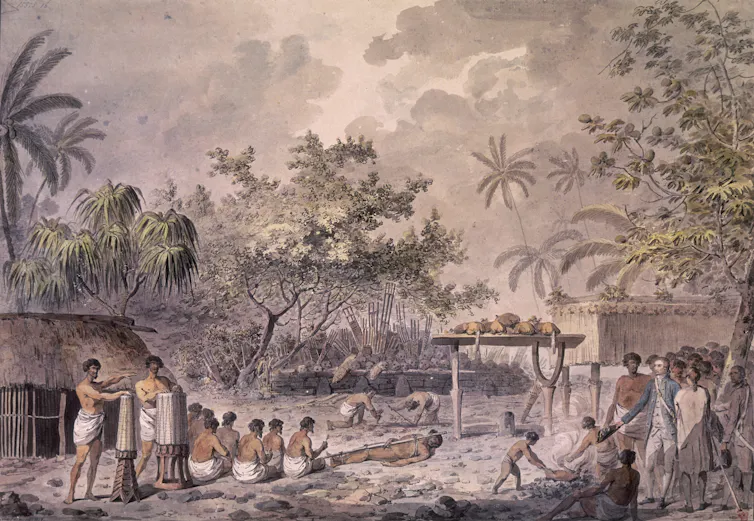
Though Cook later warmed to Mai, the navigator initially viewed the islander as too dark, too ugly and too lacking in “intelligence” and character. He was not a “proper sample” of the indigenous people of the South Pacific.
But Mai ingratiated himself, showing he could usefully perform a seaman’s tasks. Apparently, he also charmed Cook’s men, who affectionately nicknamed him “Jack.” So Cook eventually agreed to let Tobias Furneaux, the captain of Cook’s consort ship, the Adventure, to transport Mai back to England. On the Adventure and in England, Europeans conflated the Tahitian “o,” which means “it is,” with “Mai,” calling their visitor “Omai.”
While Furneaux likely intuited that Banks and other naturalists would value Mai as a specimen for study, Mai had a plan of his own: He wanted to obtain British firepower to retake his homeland.
Mai was no more than a commoner in the Society Islands, and aboard the Adventure, he preferred the company “of the armourer and the common seamen,” according to the memoirs of midshipman John Elliot. Yet Elliot went on to explain how Furneaux refashioned Mai into a “priest of the sun.”
Furneaux appears to have understood that marketing Mai as a prominent figure would smooth his British reception. Rather than welcoming a landless nobody, the British public would receive a man of the highest caliber.
When the voyage docked at the Cape of Good Hope in South Africa, Furneaux dressed up Mai “in his own clothes,” introducing him to the “best companies,” wrote George Forster, one of the expedition’s naturalists. Forster noted how Mai himself began declaring that he was “not a towtòw, which is the denomination of the lowest class,” but “a hòa, or attendant upon the king.”
Fit for a king
Mai’s arrival in England coincided with a fad for Pacific cultures that had risen to new heights in 1773, when a blockbuster compilation of accounts of Pacific expeditions, which included Cook’s first voyage, was published. The collection portrayed Tahiti as a tropical paradise that knew neither sexual shame nor the drudgeries of labor, popularizing European fantasies of Tahiti as a “New Cythera,” or Aphrodite’s island.
The wealthy Banks quickly agreed to become one of Mai’s key handlers. Though he knew Mai was a commoner, Banks nonetheless promoted the idea of him as a noble, introducing Mai to luminaries at parties, dinners and theater performances.
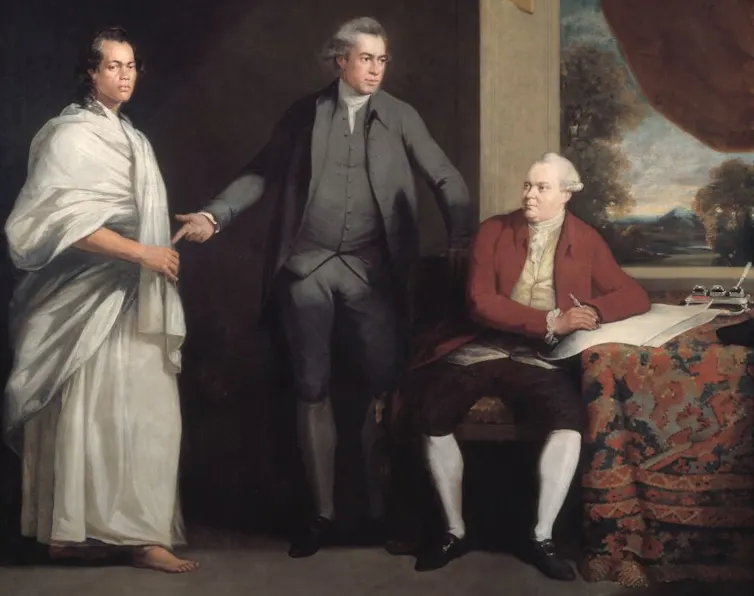
Yet the reactions to Mai were not uniformly positive, and reflected debates over the value of voyages like Cook’s. The critic Samuel Johnson, for example, refused to read Cook’s account, declaring, “There can be little entertainment in such books; one set of savages is like another.”
Nonetheless, King George III and Queen Charlotte agreed to meet Mai at Kew Palace, where Banks presented him to the royal couple.
Westminster Magazine lampooned the encounter: The royal and public fascination with Mai reflected a broader pattern of cultural decay, in which meaningless entertainment sapped England’s vigor, a sure sign that “the glory of this Nation will sink with the luxury and dissipation of the times.”
Others tried to make Mai a more palatable object of study by emphasizing his purported royal lineage. London Magazine praised Mai’s “genteel” manners and pointed out that he came from a family of “great consequence” with “large possessions” in Tahiti. This, it seemed, made him an apt subject for “persons of curiosity and taste.”
Mai’s Legacy
During Mai’s last year in England, Reynolds debuted his portrait.
To Reynolds, Mai was an embodiment of the universal nobility of humanity – a far cry from Westminster Magazine’s depiction of the islander as no more than a cheap amusement.

Reynolds modeled Mai on ancient Roman senators and military leaders, dressing him in robes reminiscent of Tahitian tapa cloth but with a Roman flair. The portrait debuted alongside Reynolds’ full-length portrait of the Duchess of Devonshire.
The politician Horace Walpole, who had earlier dismissed Cook’s travel narrative as “at best an account of the fishermen on the coasts of forty islands,” was nonetheless impressed by the portrait, describing it as “very good.”
When Cook departed with Mai for the Tahitian archipelago in 1776, the naturalist Forster expressed popular disappointment that Mai had not learned anything useful during his stay, but merely enjoyed an endless round of “splendid entertainments.”
Perhaps the visit disappointed Mai, too. Though he received some firearms, Cook refused to drop him off on Raiatea, fearing an outbreak of violence. Instead, Cook deposited Mai on Huahine in 1777.
Two years later, Hawaiians killed Cook on the Big Island of Hawaii. Not long after that, Mai died, succumbing to a fever. Before his death, he did get one chance to use his acquired firearms in a skirmish with Bora Borans, a victorious battle during which Mai killed many of his enemies and became one of the first Pacific Islanders to successfully obtain and employ British firepower toward his own ends.
As cultural icons, Mai and Cook lived on. Mai had returned to Huahine with a horse, and tattoos of horsemen appeared on islanders years after Mai’s death. In England, poet William Cowper portrayed Mai as an innocent corrupted by European society.
And then there was the lavish, blockbuster 1785 stage show “Omai: or, a Trip Around the World.”
Employing vibrantly painted scenes based on sketches from Cook’s third-voyage artist, it wowed the public.
In the performance, Mai’s image as a noble endures: He is depicted as a visiting prince who falls in love with an Englishwoman whose name, fittingly, is Londina.
Saar Shahar's research on Mai has been supported by the Early Modern Studies Institute, the American Society for Eighteenth Century Studies, and the Center for Transpacific Studies at the University of Southern California.
Read These Next

Pardoning of Israeli soldier evokes a long history of clemency for those who kill Palestinians
Elor Azaria, who killed a wounded Palestinian assailant, had his criminal record cleared. It follows…

Democrats distance themselves from trans rights – close midterm races may show whether that pays off
A scholar of LGBTQ+ politics looks at how Democratic campaigns in Texas and Ohio are shifting on trans…

How much rain can a hurricane make, and does the storm size matter?
Storms big and small can produce a lot of rain. What matters most is how fast they’re moving, as an…