How libraries in Philadelphia, Pittsburgh and other Pennsylvania communities evolved from subscripti
The nation’s first successful circulating library was established almost 300 years ago by Benjamin Franklin in Philadelphia.

As a librarian who researches and writes about library history in Pennsylvania, I was delighted to see the American Library Association’s efforts to celebrate its 150th anniversary this year, while making several mentions of Pennsylvania.
The ALA highlighted its 1876 founding in Philadelphia; how Pittsburgh philanthropist Andrew Carnegie funded the construction of more than 1,600 library buildings throughout the United States; and Scranton’s Henry and Edith Carr, who attended and maintained records about the ALA’s early conferences for nearly 50 years.
But these stories just scratch the surface of how Pennsylvanians have contributed to American libraries and librarianship.
I published a book on Pennsylvania libraries from the 1700s through the 1940s, and I’m working on a sequel that extends the story to the early 2000s. Many scholars connect the beginning of public librarianship in the United States to ALA’s 1876 founding, but libraries’ roots go back much further.
America’s first ‘public’ library
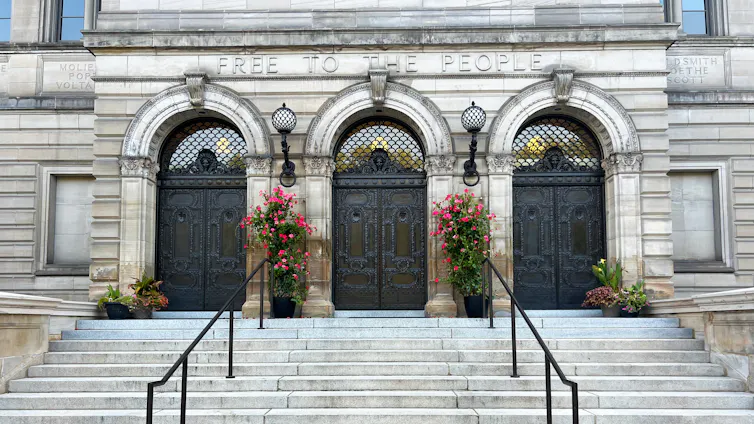
The Library Company of Philadelphia, established in 1731 by Benjamin Franklin, was the nation’s first successful circulating library and was a model for many others.
These early “public” libraries – so called because they did not require users to affiliate with churches, colleges or other organizations – were run by stockholders who pooled funds to purchase books. The owners charged annual membership fees to others who wanted to join.
In the 19th century there was widespread desire among U.S. educators, women’s clubs, local government leaders and public-spirited citizens to provide libraries to everyone, whether or not they could afford to subscribe.
Today, some people incorrectly believe that steel magnate Carnegie was the first philanthropist to donate money for library buildings. However, a number of other Pennsylvanians preceded him.
In 1883, for example, Thomas Struthers, a lawyer and land developer, constructed a multipurpose building in Warren, Penn., that contained a theater and storefronts. Those spaces were to support a public library that was also in the building. The business plan didn’t work, however, and users had to purchase “tickets” to borrow books.
Given such situations, Carnegie’s philanthropy was especially impactful because it shifted some financial responsibility to local governments.
While some of the lavish libraries Carnegie first erected in the Pittsburgh area came with endowments – the Homestead library is one that still exists – he later developed a formula to ensure that other communities would not rely on his continuous generosity. As a condition of most of his grants, Carnegie insisted that municipalities provide land plus annual operating funds equivalent to at least 10% of the buildings’ costs. This effectively committed municipalities to finance libraries with public dollars.
Federal and state support for public libraries
In Pennsylvania, rural residents received a library boost with the passage of Act 329 in 1931. The legislation offered partial matching funds to counties that provided library services.
Notably, the law excluded the state’s two largest counties – Philadelphia and Allegheny.
The federal Library Services Act of 1956-1962, a forerunner of the current Grants to States program, further aided libraries in communities with fewer than 10,000 inhabitants. The funds supported book purchases and projects such as bookmobile services.
Until the 1960s, though, there were no parallel funding streams for larger communities. This may have compounded other inequities.
Pennsylvania libraries did not practice de jure racial discrimination as Southern libraries did. Nor did they deliberately exclude senior citizens or people with disabilities. But how they allocated resources, designed spaces, developed collections, recruited staff and engaged local residents through specialized programming favored some constituents over others.
Just a few weeks ago I uncovered a November 1969 article in the Pennsylvania Library Association bulletin that was written by Augusta A. “Gussie” Clark, once a librarian and later a member of Philadelphia’s City Council. Clark wrote about how she believed white librarians in the City of Brotherly Love were failing Black children. She described the librarians’ lack of respect for Black communities, their “pained tolerance” of Black people in their midst, and an unwillingness to render extra help – all of which, she said, prevented Black children from feeling “at home” in public libraries.
Using libraries’ records, I have also found many requests from both individuals and advocacy groups asking for ramps, elevators and other alterations to century-old libraries, and for additional listening and viewing equipment. In at least one case, a complaint reached the U.S. Department of Education’s Office for Civil Rights; it was investigated and ultimately dismissed.
Libraries strive to be more inclusive
Libraries in urban areas of Pennsylvania began to receive state support after the passage of Act 188 of 1961, which created a state aid program for municipal as well as county libraries. It also provided additional funding to the Free Library of Philadelphia and Carnegie Library of Pittsburgh, which became Statewide Library Resource Centers. As such, they received extra funding to provide services to other libraries and customers in the state.
On the national level, the Library Services and Construction Act, which replaced the Library Services Act in 1964, did not exclude urban and populous suburban areas as the Library Services Act had. In administering the new funds, the State Library of Pennsylvania approved many proposals that extended services to underserved residents, such as Montgomery County-Norristown Public Library’s outreach to public housing complexes and prisons, Altoona Area Public Library’s L.I.F.E. program for people with intellectual disabilities, and Cumberland County Library System’s STAR service for homebound senior citizens.
In the following decades, libraries continued to strive to become more accessible. In the 1990s the Library Services and Technology Act and state efforts such as Gov. Tom Ridge’s Link-to-Learn initiative addressed the digital divide between communities that had computers and internet connections and those that did not. It provided grants for libraries to acquire needed upgrades.
Thirty years later, there are still some places in Pennsylvania, especially in rural and mountainous areas, that don’t have broadband. However, that number shrinks each year thanks to federal and state efforts to build infrastructure in communities that corporate entities have neglected.
Role of librarians today
Some commentators argue that the internet, online databases and AI have replaced the need for public libraries and professional librarians. But a lot of information and recreational reading material is locked behind paywalls that Google and chatbots cannot circumvent.
Librarians today continue to play a crucial role in ensuring that resources remain available to the “largest number, at the least cost,” as American librarian Melvil Dewey articulated more than a century ago.
The Pennsylvania Library Association has found that for every $1 in tax investment, libraries return $5.50 in benefits. This is largely by acquiring materials at discounts and enabling library customers to share and reuse them.
Working in today’s libraries can require substantial courage, too, given current censorship trends in public libraries, including book bans. Requests to remove titles, or reshelve them in less-accessible areas, is nothing new. For example, I documented an example in Scranton in 1898 in which Catholic citizens urged the removal of Augusta Jane Evans-Wilson’s novel “Inez: A Tale of the Alamo,” due to its negative portrayal of a priest and inaccurate descriptions of Catholic sacraments. However, current activists’ tactics are becoming more broad-stroke, aggressive and even violent.
The American Library Association and EveryLibrary, a library advocacy group, have noted bills in various states that propose jailing library employees for the materials their institutions contain. There do not seem to be any bills presently of concern in Pennsylvania. But news reports about other book challenges and bans in Pennsylvania, especially in school libraries, regularly show up in my inbox and social media feeds.

When you view the centuries-long history of American librarianship through a Pennsylvania lens, it’s more complex, nuanced and fascinating than many people realize. And while today’s libraries face various challenges, I believe they continue to contribute enormously to residents across the entire state.
Read more of our stories about Philadelphia and Pennsylvania, or sign up for our Philadelphia newsletter on Substack.
Bernadette A. Lear is a member of the American Library Association and the Pennsylvania Library Association.
Read These Next
US migrant flights to Liberia evoke troubling history of sending people deemed unwanted to the West
In the 1800s, West Africa became a focal point for efforts to remove Black people from America. The…

Fewer Americans are getting help buying groceries from SNAP benefits as states grapple with the prog
Some of these changes have already taken effect. Others that are a year or more away could make it hard…
2026 midterms could be the end of Pennsylvania’s split legislature, with effects on affordability, e
Pennsylvania has a split legislature, and both chambers are up for grabs in the 2026 midterms.