The real reason many Americans are cutting ties with their parents and siblings
Estrangement is rarely caused by childhood abuse or a pushy therapist. Instead, it reveals a collision between two ideas of what family should be.

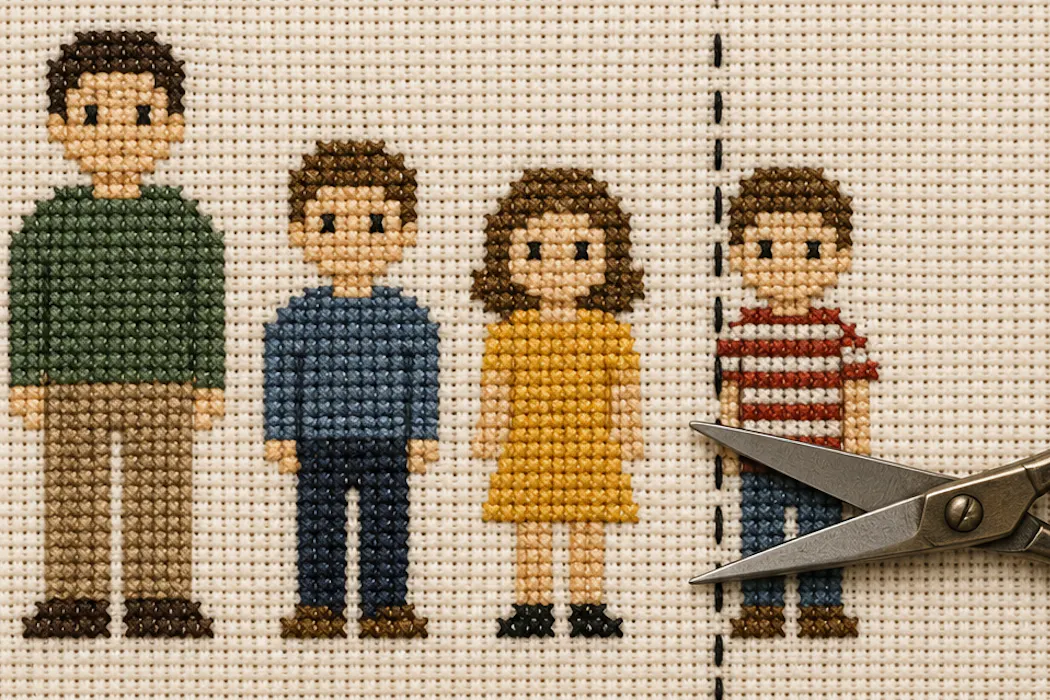
Luna, 26, no longer speaks to her father. There was no single betrayal, no dramatic rupture. What ended the relationship was his insistence on obedience and dominance.
“In his head it’s like, ‘I’m the father, you’re the daughters, we do things my way,’” she told me. Luna explained to him that she was “not willing to have a relationship like that,” and her terms for contact were simple: “We could only have a relationship where you understand that I’m a person, and I’m not just gonna do whatever you want me to do whenever you want me to.”
He refused to accept those terms. So after numerous attempts to make it work, she walked away.
Family estrangement has become a fixture of talk shows, advice columns and social media. It’s also the subject of my new book, “Families We Lose.”
Much of the current media coverage on estrangement tends to frame it as an epidemic that is the product of therapy culture.
My research suggests that this framing misses what is actually happening. I conducted 68 in-depth interviews with adults who went no-contact with a parent, sibling, grandparent or other relative. (All participant names, including Luna’s, are pseudonyms used to protect their privacy.)
I found that estrangement is less a story of trauma or selfishness, and more a clash between competing expectations: an insistence on loyalty, duty and forgiveness on one hand, and the longing for respect, emotional safety and personal growth on the other.
Falling birth rates raise the stakes
Estrangement is fairly common.
In a 2022 study, my colleagues and I used national survey data that followed parent-child relationships over several decades. In that period, 26% of adult children in the U.S. experienced a period of estrangement from their fathers, and 6% reported a period of estrangement with their mothers. Our findings were consistent with what sociologist Karl Pillemer found in his 2020 national survey, which showed that 27% of Americans were estranged from a relative, or roughly 67 million people.
Headlines often treat numbers like these as evidence of a sudden crisis. But no study has tracked estrangement rates over time, and nothing in the existing data shows that it is skyrocketing.
Yet estrangement can have different consequences today. People have far fewer children than in most of human history, so the loss of one relationship may carry greater weight. Two generations ago, a parent might have had several other children with whom to maintain close ties; today, many parents have only one or two.
Smartphones, meanwhile, have created expectations of constant contact and connection within families. Even adult children who have quietly distanced themselves by moving away or limiting contact may still find themselves fielding regular requests for connection through texts, phone calls and social media. This can be stressful, emotionally taxing and make it difficult to establish boundaries.
Those I interviewed often had difficult childhoods, and some had experienced abuse. But they rarely pointed to childhood as the proximate cause of the estrangement, instead citing the poor quality of their relationships with parents and other relatives in adulthood.
‘Kinship culture clash’
For them, the path to estrangement was usually gradual, marked by mounting tensions and unresolved conflicts. It emerged out of the recognition that a parent or sibling would not, or could not, treat them the way they desired. For most, this looked like accountability and growth, intentional connection, mutual respect and safety.
Molly, 36, described a lack of accountability as motivation for her estrangement from her mom, Cindy, a decade ago.
Molly told Cindy: “You’ve done all these horrible things. I just need you to acknowledge it. I feel like I’m owed an apology.”
Molly felt that her desire for accountability was a basic need of any relationship, noting, “I didn’t feel like that was asking too much, but apparently it was. I put the ball back in her court, and she’s just sitting on it.”
Most of the people I interviewed recognized that they had different definitions of what family should look like and feel like. In my book, I call this a “kinship culture clash.”
Divorce offers a familiar example of this kind of shift.
For most of American history, marriage was an institution shaped by economics, law, religion and social pressure. You stayed married because that was what one did, and there were few alternatives that didn’t leave one spouse – usually the woman – socially ostracized and financially destitute.
Then, as sociologists Andrew Cherlin, Anthony Giddens and Stephanie Coontz have argued, marriage transformed into a relationship judged by its ability to provide love and support, promote ideals like fairness and lead to personal growth. Once a marriage started being thought of as an arrangement that needed to work for each spouse, divorce became thinkable, then ordinary.
Should family ties always bind?
The family you are born into can carry the same tension.
Ties to parents and siblings are often expected to be permanent and unconditional, reinforced by cultural norms and laws that bind parents and children to one another, even when children become adults. For example, in adulthood, 27 states have filial piety laws that require adult children to bear financial and, in some cases, direct caregiving responsibility for aging parents. This is part of what I term “compulsory kinship.”
Under this framework, you show up at Thanksgiving no matter what was said last year, because your family is your family. You take your dad into your home to care for him when he gets sick, because he’s your father.
This model does help many Americans. It can ensure aging parents have adult children to care for them, while adult children may have a place to call “home,” no questions asked.
In contrast, the estranged people I talked to for my book adhere to what I call “democratized kinship,” and it generally reflects views of contemporary marriage.
Family bonds require mutual respect, reciprocity and support in order to continue. Under this model, genetics take a back seat: Anyone can become family, just like anyone can become a spouse, but no one is automatically family.
Neither family framework is new, and neither belongs to a single generation. Some people have always held family of origin relatives to distinct standards of care. Queer people have been building chosen families for generations.
But what I chart in this book is the conflict between these two ways of thinking.
Estrangement often happens when these two ideas of family collide and cannot be reconciled – when one member insists that biological or origin ties and hierarchies reinforce the family unit, and another insists that behavior does. That is Luna’s story. Her father drew on the logic of age and hierarchy – “Because I’m your father and I said so” – and she demanded to be treated as a person first and a daughter second.
A family that works for you
People who leave their families of origin are not rejecting family altogether.
In a recent study drawing on these same interviews, I show that estrangement operates as a catalyst for what I call “redoing family.”
After cutting off contact with a family member or multiple relatives, people commonly went on to rebuild kinship networks, drawing friends, partners, in-laws and neighbors into roles once reserved for blood relatives, and constructing new family units organized around support and reciprocity.
Luna is not on her own because she no longer talks to her father. Her family today includes her sister, whom she talks to multiple times a day, and a large group of friends.
“I think you can have your chosen family, and whoever in your biological family you connect to,” she told me. “Everybody just gets to choose who they feel they have a real, intimate, deep connection with. And that’s your family.”
She didn’t want less family. She simply wanted a family that works.
Rin Reczek does not work for, consult, own shares in or receive funding from any company or organization that would benefit from this article, and has disclosed no relevant affiliations beyond their academic appointment.
Read These Next

Chiricahua is the nation’s newest national park – what does that mean?
What comes next for Chiricahua, now that is has been officially redesignated as America’s 64th national…

An AI model’s false tip to Philadelphia police reveals how digital agents can do as they’re told and
An expert on AI governance explains why these rare mistakes may soon be common, and with much higher…

Offering cash for votes is quite common – but here’s why it doesn’t work
Money or other material benefits are often not enough to override a voter’s preferences and partisanship.