Lower East Side street named for ‘King of Comics’ Jack Kirby, a nod to one of the countless kids of
New York City played a starring role in the golden age of comics. And like Kirby, many of the genre’s most famous artists were Jewish.


The gesture may lack the explosive drama of a rooftop fight or the tension of a car chase, but on May 11, 2026, a street sign honoring a legendary comics creator will be unveiled in Manhattan’s Lower East Side.
After a lobbying effort by comics expert Roy Schwartz, the New York City Council in December 2025 approved the naming of a block of Essex Street between Delancey and Rivington streets in honor of Jack Kirby.

Kirby, born Jacob Kurtzberg in 1917 to Jewish immigrants, spent roughly the first 40 years of his life in New York, aside from a stint serving in the military during World War II. Before enlisting, he’d already embarked on a career as a comics artist. He went on to become a key figure during the medium’s golden age, a period that most scholars and fans agree began with the creation of Superman in 1938 and ended with the implementation of the Comics Code Authority in 1956, which heavily restricted content until enforcement weakened in the 1970s.
Though you may not have heard of Kirby, you’d have to deliberately avoid pop culture to miss his most influential creations: Captain America, the Fantastic Four, X-Men, Thor, Hulk, Iron Man and Black Panther.
For my part, however, as a scholar of American Jewish immigration history – and as a lifelong comic book fan – I hold a place of reverence for the man known as the “King of Comics.”
Jewish American history, immigration history, the history of New York City and the origins of the comics industry are inextricably linked. New York played a starring role in the golden age of comics. And like Kirby, many of the genre’s most famous artists were Jewish.
Jewish immigrants put pen and ink to paper
Comics found a wide audience in New York City during their early years in the late 19th and early 20th centuries, from early newspaper strips like “The Yellow Kid” and “Abie the Agent” to later ones like “Little Orphan Annie.”
As World War II drew to a close in the summer of 1945, there was a citywide newspaper delivery strike, leaving many New Yorkers desperate for news and entertainment – so much so that Mayor Fiorello LaGuardia took it upon himself to read the Sunday comic strips over the radio, performing them with characteristic vigor and enthusiasm.
Among the first publications that would today be recognizable as “comic books” were compilations of these early newspaper strips, assembled by newsprint salesman and Jewish New Yorker Max Gaines. Gaines, born Maxwell Ginzburg, compiled various comic strips into neatly packaged, inexpensive entertainment for the masses, helping pioneer the saddle-stitched comic book – thin, stapled magazines that would become the primary format for superhero stories.
As the superhero genre took off in the late 1930s, other publishers emerged from Jewish New York. Harry Donenfeld and Jack Leibowitz, in partnership with Malcolm Wheeler-Nicholson, created Detective Comics and Action Comics, which helped establish the company later known as DC Comics.
In addition to early publishers, many pioneering comics artists were raised in New York City as the children of Jewish immigrants, including Marvel Universe architect Stan Lee and his brother, Larry Lieber; Will Eisner, creator of “The Spirit” and co-creator of “Sheena: Queen of the Jungle”; and Al Jaffee, a longtime contributor to Mad Magazine.
An ode to the Lower East Side
In Jack Kirby’s comics, the city shines through.
The Fantastic Four – the superhero squad that Kirby created with Stan Lee – operates out of midtown Manhattan’s fictional Baxter Building, which Kirby modeled after the city’s mid-century skyscrapers.
Kirby also based the character of Ben Grimm – The Thing – on himself, mining his own life to write Grimm’s backstory. Grimm’s home is on the fictional Yancy Street, a tribute to Kirby’s own working-class upbringing on the Lower East Side’s Delancey Street. The thoroughfare is rich with Jewish history and in close proximity to iconic businesses like Katz’s Deli and Russ and Daughters.
Another of Kirby’s most iconic characters was Steve Rogers – Captain America – which he co-created with Joe Simon.
A poor orphan from Brooklyn, Rogers attempts to enlist in the U.S. Army to fight the Axis powers during World War II, but is rejected as unfit for duty. He is later recruited into Project Rebirth, where he is transformed into a super-soldier after being injected with a serum designed to maximize human physical and mental abilities.
Captain America attracted legions of fans among American youth, many of whom saw themselves in the superhero. Though Rogers is Christian, his story of transformation from weakling to hero certainly spoke to young Jewish boys and men, who were often inaccurately portrayed in the media and press as intellectually superior but physically inferior.
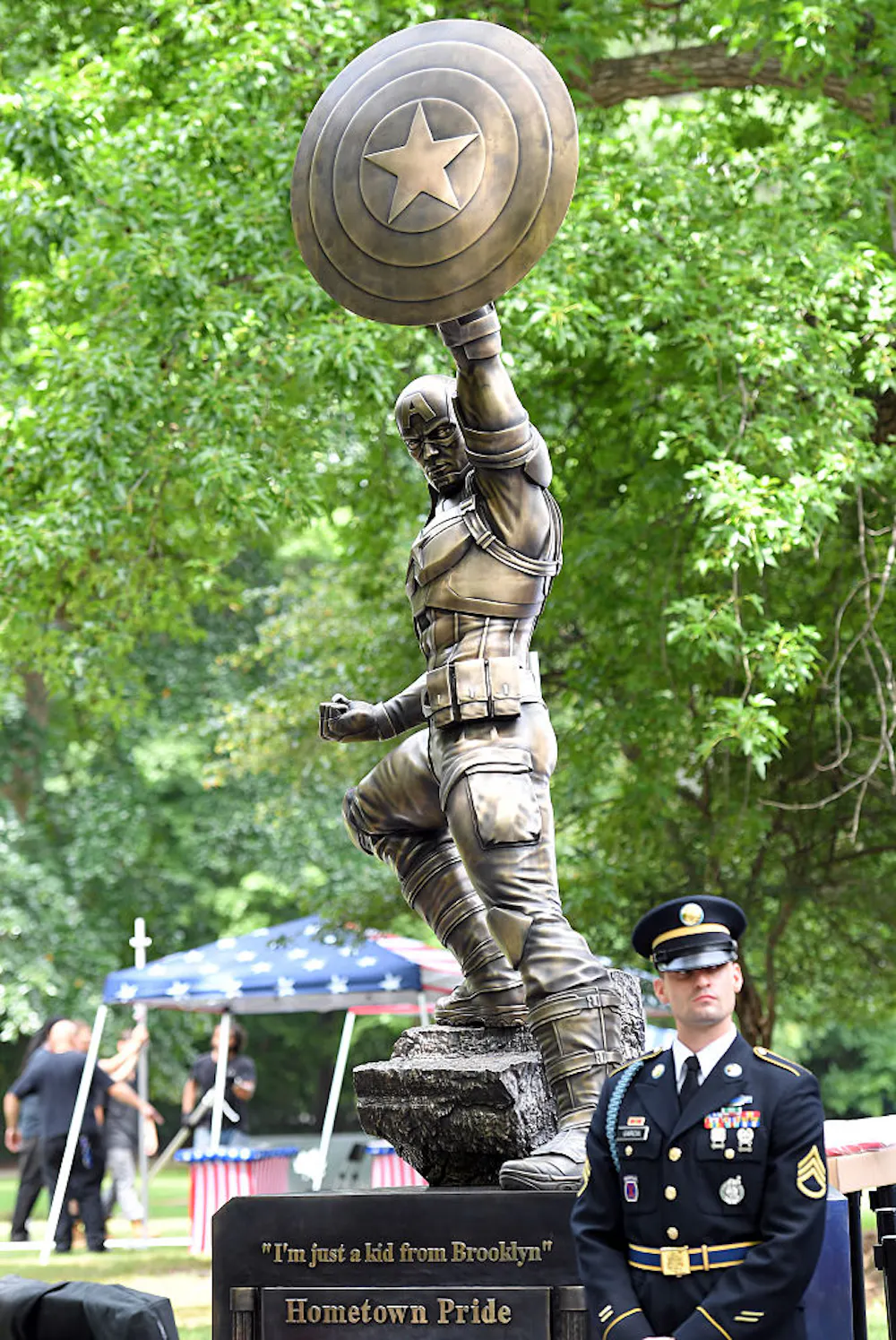
Captain America, though fictional, is already recognized as a part of New York City history, and has a statue in Brooklyn, which was unveiled in 2016 with the inscription “I’m just a kid from Brooklyn.”
The city as a muse
Even comics created by artists outside New York City – like Ohio natives and Superman co-creators Jerry Siegel and Joe Shuster – are, by virtue of their content, still in many ways New York comics.
The glittering Metropolis in “Superman” is widely understood as a stand-in for New York; for example, in the April 1950 issue of Action Comics, the Statue of Liberty is said to appear in “Metropolis Harbor.”
If Metropolis is the bright, shining, optimistic view of the city, then Gotham, the home of Batman, reprises the city through a grittier lens.
Writer Washington Irving had first described New York as Gotham in the early 1800s. But by the time Batman came on the scene, the term had become less common in everyday speech, and DC Comics repurposed the name for the fictional Gotham City. Beyond the name, Gotham City’s architecture, bridges, boroughs and neighborhoods are an homage to New York.
By officially recognizing Jack Kirby, the city adds the artist to a distinguished roster of politicians, community activists and celebrities honored with street names.
Jack Kirby Way celebrates a legendary comics artist while also acknowledging the immigrant creators who helped shape the genre. It’s a fitting tribute: As much as the comics industry is indebted to the city, the city is indebted to the comics industry.
Miriam Eve Mora does not work for, consult, own shares in or receive funding from any company or organization that would benefit from this article, and has disclosed no relevant affiliations beyond their academic appointment.
Read These Next

These state supreme court races could decide abortion access and trans rights
Ohio, North Carolina and Michigan have open seats on their state supreme court, and these hotly contested…
Armed poll watchers: New Jersey’s 1981 racist voter intimidation campaign is a cautionary tale ahead
An armed voter suppression campaign in New Jersey in 1981 finds echoes today in the Trump administration’s…
Missing ambassadors, inexperienced appointees – is Washington dropping the diplomatic ball?
Almost half of US ambassador jobs remain vacant. Meanwhile, political appointees are outnumbering career…