‘Right to race’ laws and the battle over America’s local racetracks
State lawmakers are trying to shield tracks from nuisance lawsuits − but the larger threat may be rising land values and redevelopment pressures.

Across the United States, the local auto racing tracks that have anchored rural and working-class communities for generations are disappearing.
Some have lost out to real estate developers when suburban sprawl makes the land beneath them too valuable to ignore. Others are strangled, slowly, by noise complaints and nuisance lawsuits filed by residents who moved to the area long after the track had been built.
Now, state legislatures are pushing back. From Georgia to Wisconsin, lawmakers have been introducing so-called “right to race” bills.
Over the past year, at least 13 state legislatures have put forward bills shielding racetracks from nuisance lawsuits filed by property owners who moved into the area after the track was built. These follow the passage of similar legislation in Iowa and North Carolina in 2025.
As a historian and analyst of American stock car racing, I’ve been watching this legislation closely.
The argument being made inside these statehouses is a legal one. But what’s really being contested is something older and harder to legislate: whose idea of a place is preserved, and whose vision is pushed to its margins.
What these laws do
For nearby residents, the impacts of a racetrack can be difficult to ignore. Events are often loud and sometimes unpredictable, and they can run for hours. And the surrounding roads can be clogged with traffic before and after events.
That said, there is a long-standing legal principle known as “coming to the nuisance.” This holds that someone who moves next to existing businesses or infrastructure – whether they’re factories, racetracks, train tracks or airports – cannot then sue over disturbances from their regular operation.
In practice, however, that principle has frequently failed to protect tracks.
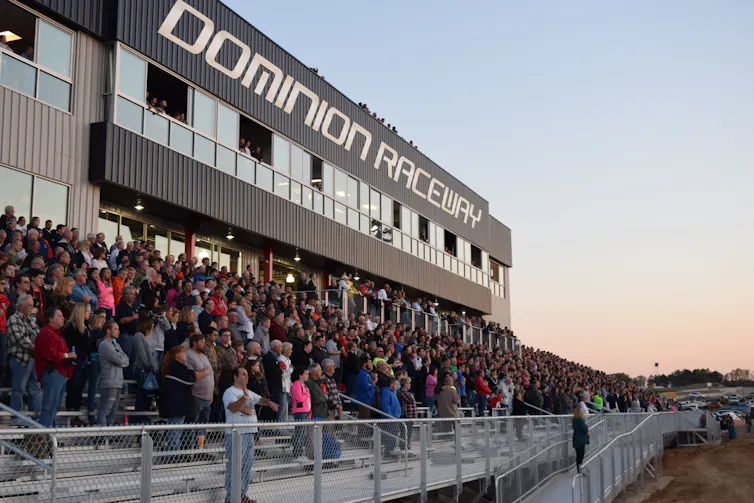
Old Dominion Speedway in northern Virginia, opened in the 1950s, was ultimately relocated south to Thornburg, where a new facility opened in 2016, after noise complaints from a nearby townhouse development proved impossible to satisfy.
In Asheville, North Carolina, an environmental nonprofit channeled the opposition of newer residents into a campaign against the New Asheville Speedway. The city ultimately purchased the track’s land in 1998 and converted it into a public park.
Onondaga Dragway in Ingham County, Michigan, which had reopened in 2013 after an earlier closure, spent the next 12 years locked in legal proceedings with neighboring residents before a judge finally ordered it shuttered in 2025. Onondaga’s closure directly prompted Michigan’s right to race legislation.
At their core, right to race bills establish that if a racetrack was lawfully built and operating before a neighboring property owner purchased or developed their land, that owner cannot bring nuisance claims against the facility.
Iowa’s law, signed in May 2025, passed unanimously in both chambers – 45-0 in the Senate and 92-0 in the House. North Carolina’s followed in September 2025, and Kansas enacted similar legislation in April 2026.
The Specialty Equipment Market Association has lobbied for the bills, arguing that they address the same problem that spurred a spate of “right to farm” legislation in the 1970s and ’80s. These laws shielded farmers from nuisance complaints due to odors, noise, dust and slow-moving farm vehicles on local roads.
Right to race legislation hasn’t been politically controversial, in part because it is often framed as a matter of common sense.
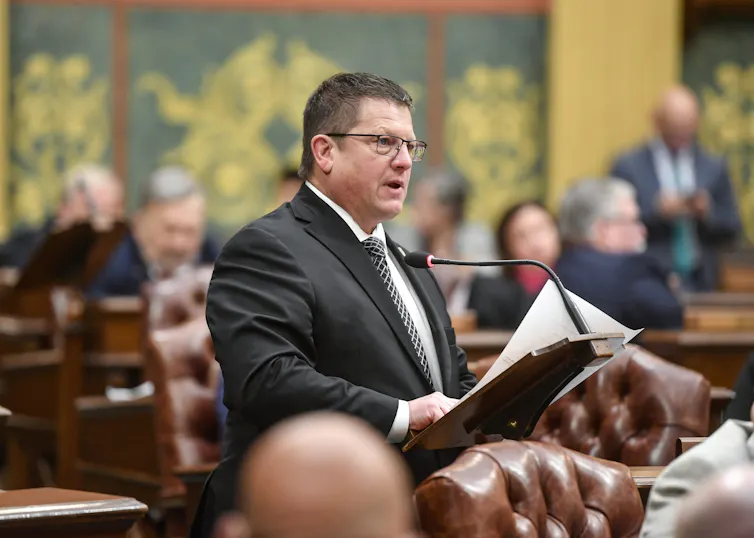
As Michigan state Sen. Roger Hauck put it, “I don’t think it’s fair to a business that’s been zoned to be there legally by the township to have someone start complaining about the noise of the racetrack when it’s been there since before the person has been there.”
Still, the bills are not identical, and the differences matter.
Michigan’s bills and Kentucky’s bill extend immunity regardless of any future changes to a facility, meaning a track that dramatically expands its operations would still be shielded.
A more limited approach was proposed in Georgia – though the bill ultimately failed to advance before the April 2026 deadline – which would have preserved the right to sue if an existing track expanded its footprint.
More expansive versions of these bills have drawn concern in some cases. In Wisconsin, for example, Gov. Tony Evers vetoed a similar bill after it passed the Legislature, arguing it would create “unfair and unnecessary hurdles for people pursuing legal avenues to vindicate the use and enjoyment of their land.”
Land value, not noise, is the real threat
While noise complaints and nuisance suits are the immediate trigger of many track closures, they are often symptoms of a deeper economic pressure: land value.
The land that racetracks sit on – large, often flat, typically in areas that were once rural but no longer are – has become extraordinarily attractive to developers. And while housing has been the traditional threat, new ones have emerged.
Warehouses and logistics facilities have taken up land on the outskirts of American cities over the past decade. More recently, the explosion of aritificial intelligence infrastructure investment has compelled developers of data centers to seek out vast tracts of land.
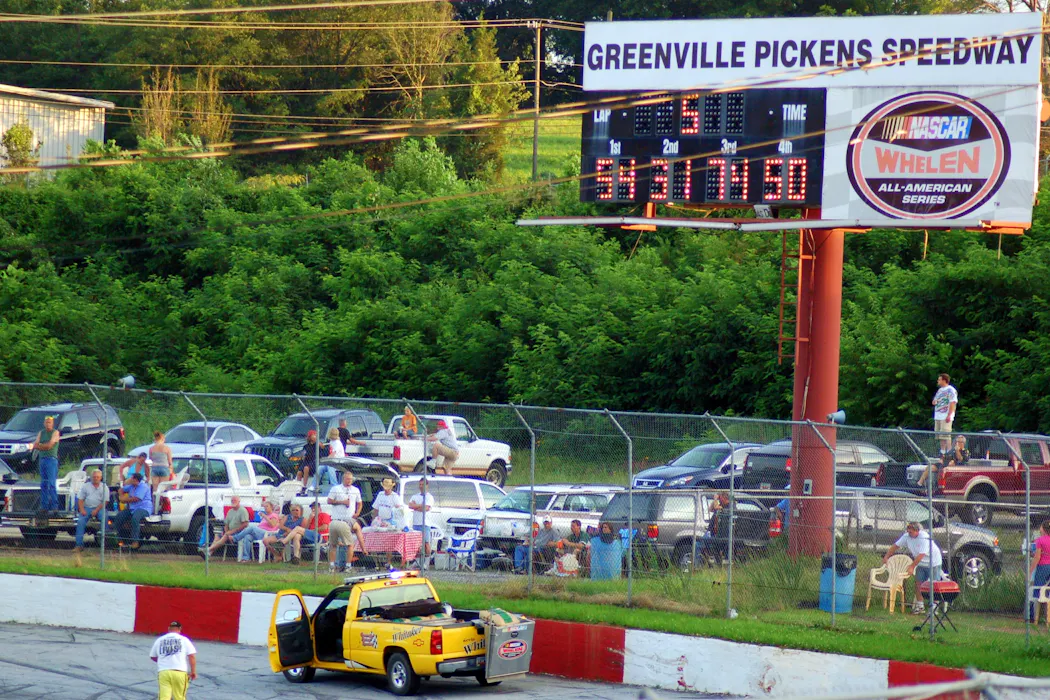
Greenville-Pickens Speedway in South Carolina, the site of NASCAR’s first live televised race in 1971, has been dormant since 2022 as its future became entangled in a potential sale. It’s facing conversion into an industrial park, led by a prospective buyer rather than pressure from nuisance lawsuits. Local supporters have rallied to preserve the site, and county officials have taken steps toward recognizing it as a historic property, but those efforts don’t prevent a private sale or redevelopment. South Carolina’s HB 4706 targets nuisance lawsuits, not private sales or redevelopment, meaning it offers no protection in cases like this.
Nashville’s Fairgrounds Speedway, which has hosted racing since 1904 on city-owned property, isn’t being threatened by a private nuisance suit. Instead, its future is in doubt due to a charter amendment campaign – a ballot-driven effort that would eliminate the site’s designation for auto racing, potentially opening the door to redevelopment.
What communities stand to lose
In my view, most of the bills – even if they don’t say it explicitly – are about whether communities that have grown up around local racetracks have any legitimate claim on the continued existence of those tracks.
As one supporter in the ongoing Greenville-Pickens debate put it, the track is “more than just a racetrack to us. It’s a place where we can actually go and actually talk to others that have the same interests and passion about racing.”
Another supporter plainly said that Greenville-Pickens “is far more than a racetrack. It is the center of our world.”
Research shows that when shared social spaces disappear, the community life built around them does not simply find a new home. And in my ongoing research on grassroots racing, I’ve explored how local tracks function as some of the last spaces in American working-class life where people gather not as passive consumers but as active participants – as drivers, crew members, track workers and fans.
Owosso Speedway Operations Lead Dennis Wheeler, speaking in support of Michigan’s right to race legislation, described his track as not just a racetrack but a “small business … an employer, a tourism driver and a gathering place for families across mid-Michigan.”
These bills address the nuisance lawsuit problem, which is real. But rarely do they address land value, which is often the bigger driver of track closures. Nor do they create any funding mechanism to help tracks modernize or survive economically. And finally, they do not require that developers notify homebuyers of nearby racing facilities.
For now, it’s clear that pressure from real estate developers is threatening something that took generations to build. The bills moving through statehouses this year represent an attempt to fight back.
Some of them are well crafted and appropriately limited. Others are blunt instruments that could create their own problems. But all of them are arriving late, after many tracks have already closed and after many communities have already lost something they cannot get back.
Joshua Vadeboncoeur does not work for, consult, own shares in or receive funding from any company or organization that would benefit from this article, and has disclosed no relevant affiliations beyond their academic appointment.
Read These Next
We studied 1,584 data centers – and found the buildings full of machines are tied to modest local jo
This employment boost took three to five years to show up, two researchers found after studying more…

Leave home with a plan: What to pack in your medical kit and when to seek care for symptoms abroad
Here’s what to talk to your doctor about before traveling abroad.

Where humans build, mosquitoes follow – bringing dengue, West Nile and other diseases with them
Disease-carrying mosquitoes are moving deeper into the US. Climate change is only part of the problem.