Brazilian jiu-jitsu is having its #MeToo moment
With legend Andre Galvao accused of sexual misconduct, gyms and athletes have been forced to confront a culture of silence, hierarchy and gender blindness in the sport.

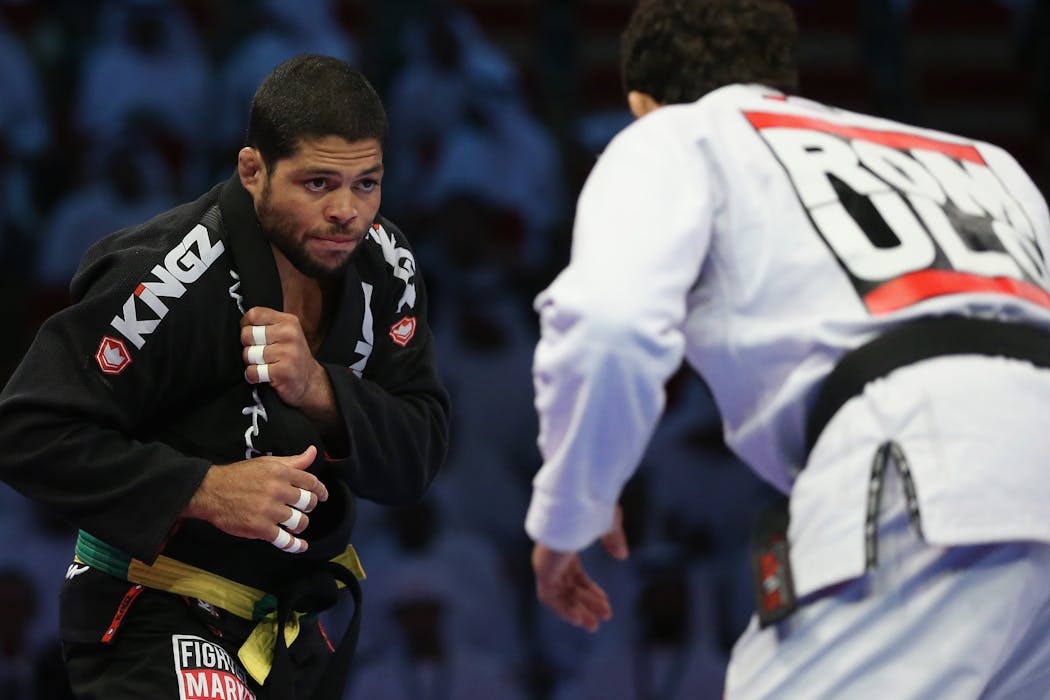
A #MeToo-style reckoning appears to be unfolding within Brazilian jiu-jitsu.
In February 2026, Brazilian jiu-jitsu legend Andre Galvao was accused of sexual misconduct by multiple women, including a teenager who had trained at Atos Jiu Jitsu, the school Galvao co-founded in San Diego in 2008 that now boasts academies around the world.
The backlash was swift: Multiple gyms and high-profile athletes affiliated with Atos severed ties with the school.
Galvao dismissed the accusations as “false rumors” and stated he is “taking the proper legal steps to protect the integrity” of Atos.
On Feb. 6, 2026, however, Atos Jiu Jitsu announced it had removed Galvao from his leadership posts. Many other gyms and athletes without a direct connection to Galvao or Atos nonetheless took the news as an opportunity to post messages about their commitment to safety for their gym members.
In a sport that has long struggled with addressing sexual harassment and misconduct, we see the widespread condemnation of Galvao as a watershed moment. And it comes on the heels of research we conducted to better understand the unique challenges that female martial artists face.
A sport built on trust
For those unfamiliar with the sport, Brazilian jiu-jitsu is a martial art focused on grappling and ground fighting – think wrestling, but with submission techniques like arm bars, shoulder locks and chokeholds. It’s essentially the grappling on the ground part of UFC, minus the punches and knee strikes.
Although almost all Brazilian jiu-jitsu competitions are split by gender, sparring and drilling routinely happen between men and women. It typically involves physical contact, usually between two people with different levels of strength and experience.
For these reasons, trust, restraint and respect are essential.
When your opponent successfully applies a technique that limits your movement and from which you cannot escape, you “tap out” to signal that you have accepted defeat. When you submit, your opponent is obligated to let go immediately to avoid causing injury or unconsciousness.

Much of the attention on sexual harassment in the sport has historically focused on incidents of assault. And a review of news coverage between 1989 and 2018 identified 177 incidents of martial arts coaches being convicted of sexual offenses.
But the kind of harassment that may not rise to the level of a crime in most countries – more pervasive and more subtle, but nonetheless insidious – has largely remained unacknowledged in Brazilian jiu-jitsu.
Blissful ignorance or something more insidious?
Whether it’s through inappropriate or sexualized comments both on and off the mat – or through unsolicited remarks about their bodies or appearance – women encounter a far different training environment than their male counterparts.
This is what we wanted to explore in our own research.
In 2021, we conducted a survey on martial arts participation that generated responses from 289 martial artists – 209 men, 77 women and 2 nonbinary people – in the U.S. and around the world. Most of them listed Brazilian jiu-jitsu as their primary art.
In the analysis, 43% of our survey respondents – 51% of women and 40% of men – indicated that they were aware of harassment in their martial arts community, which ranged from bullying to sexual harassment, to sexual assault.
But harassment was just one issue raised. The survey revealed a wider problem of “gender blindness” in martial arts, which involves simply ignoring or overlooking the impact that gender can have on participation, practice and performance.
When asked, “What does it mean to be a woman in martial arts?” 62% of men responded with statements that actively downplayed or ignored the ways gender shapes the sport. For example, one man noted that “the beauty of martial arts” is that “anyone can do it,” regardless of age, ability, “gender, shape or size.”
By contrast, nearly two-thirds of women in our survey indicated that being a woman in martial arts does, in fact, matter. They said they had fewer training opportunities, revealed that they felt they needed to work twice as hard to prove themselves, and highlighted safety concerns.

It isn’t clear whether the gender blindness among male martial artists reflected optimism, ignorance or something else. But the impact is the same: Women see gender as central to their experience. Men generally perceive gender to be irrelevant to the sport, and they don’t realize what women deal with on a day-to-day basis.
Unfortunately, gender blindness isn’t just relegated to Brazilian jiu-jitsu. Long studied by sociologists and gender scholars, it’s a pattern that lays the groundwork for abuse across all types of sports. And where gender blindness exists in combination with rigid hierarchies, it enables abuses of power and a culture of silence.
When people refuse or fail to recognize how gender shapes the experiences of women in sports, it becomes much harder to address conditions that allow for harassment and assault to occur. For example, when inappropriate contact or groping during training is dismissed as merely “accidental” or minimized as someone being “handsy,” it signals that this behavior is trivial rather than harmful. And it creates an environment where women – and men – may feel uncomfortable coming forward or speaking out.
Some prominent figures in the Brazilian jiu-jistu community are making this connection.
In a recent postmatch victory speech, Brazilian jiu-jitsu champion and coach Adele Fornarino issued a call to action. Criticizing the hierarchical structure of the sport, she emphasized that people in positions of power are taking advantage of the vulnerable and called for “no more blissful ignorance.”
What comes next?
In jiu-jitsu, men have traditionally held positions of power. By and large, they’ve been the owners of gyms, the instructors leading classes, the holders of black belts.

But this has been changing: The adult black belt women’s division at the 2025 International Brazilian Jiu-Jitsu Federation World Championships saw a 40% increase in participants over the previous year. By contrast, participation in the men’s division decreased by 18%.
More women are standing side by side with men at the front of the class as leaders and experts. As a result, it’s possible that many male martial artists are more likely to respect, trust and see their female peers as equals.
When they live up to what they can be, the martial arts are a place where men and women struggle together and protect each other. They can develop unique friendships, cultivate empathy and practice mutual support.
Men and women having the opportunity to train together in the same gym can lead to what German sociologist Max Weber called “verstehen”: the kind of understanding that comes from working closely enough with someone to grasp the fears, aspirations and experiences that drive them. Spaces that allow for that depth of connection are all too rare.
We see the swift denunciation of Galvao, a legend in the sport, as a sign that Brazilian jiu-jitsu may be progressing toward a culture centered on care, concern and restraint instead of dominance and power.
The authors do not work for, consult, own shares in or receive funding from any company or organization that would benefit from this article, and have disclosed no relevant affiliations beyond their academic appointment.
Read These Next

Horror’s monsters find new meaning with queer and trans audiences – how ‘Teenage Sex and Death at Ca
Horror as a genre has traditionally been rife with transphobia and homophobia. But LGBTQ+ fans love…

Horror films exploit how human vision works to deliver movies’ best scares
Scary movies create tension in that space between perception and recognition, as your brain tries to…
A scuff on your bag, a dent in your mug – and suddenly it feels like time for a new one
While perfectionists hold themselves to high or even impossible standards, people who want perfect stuff…