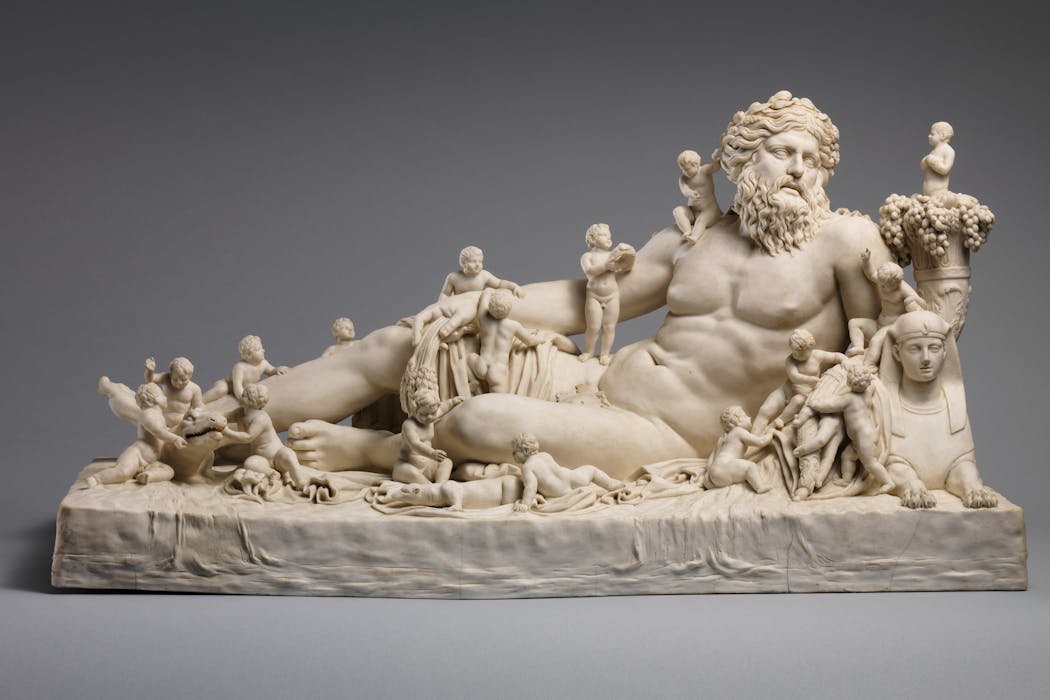
Why are so many statues naked? An art historian explains this tradition’s ancient roots
Nudity can express everything from innocence to sexual desire, from triumph to defeat.

Curious Kids is a series for children of all ages. If you have a question you’d like an expert to answer, send it to CuriousKidsUS@theconversation.com.
Why are so many statues naked? – Artie, age 12, Astoria, New York
We are all born naked, and sculptures of the human body in its natural state are as old as humankind.
In the history of art, nudity does not have just one meaning; it can express everything from innocence to sexual desire, from triumph to defeat. The 20th-century art historian Kenneth Clark made a distinction between the “naked,” meaning unclothed and ashamed, and the “nude,” meaning the body in its most beautiful form. Most people today use the two words interchangeably, though.
The most influential male nude statues come from ancient Greece, starting in the sixth century B.C.E. There were a number of reasons for this cultural focus on the nude male body – in fact, the classics scholar Larissa Bonfante encouraged thinking of Greek nudity not just as a lack of clothing but as a “costume” in and of itself. In other words, nudity was something you wore in particular situations.

Artists portrayed many of the valued figures in Greek society – including gods, athletes, warriors and heroes – naked. Nudity was a feature of public life in certain settings: For example, athletes exercised and competed in the nude, and statues of the brawny nude demigod Herakles might adorn a temple. Nude, striding statues of young men called kouroi were used both as offerings to the gods and as grave markers.
Having a fine, athletic, youthful body, whether honed for athletic competition or for fighting wars, was not only a sign of being “kalos,” or beautiful, but also could prove your “arete,” or excellence.
Embodying ideals of beauty and excellence

These abstract ideals are exemplified in a famous statue called the “Spear Bearer,” made by the sculptor Polykleitos about 2,400 years ago. He believed that beauty was achieved through a harmony of parts. In addition to its symmetry, the “Spear Bearer” stands balanced in a “counterpoised” pose, with one supporting and one resting leg.
The “Spear Bearer” inspired many copies, including when it provided the model for the portrait of the first Roman emperor Augustus five centuries later.

The emperor is shown with the same athletic build and “counterpoised” stance, but he has been transformed into a specific portrait via his aristocratic toga clothing and elaborately detailed armor.
Here, the body of the emperor projects an overall message of confident heroism, while his garments fill in details about his status and achievements. This statue illustrates how clothing can be very specific to a moment, place or role, while classical nudity may look more timeless.
The classics reborn

Classical revivals such as the European Renaissance, around 1400-1600 C.E., and neoclassicism, around 1750-1900 C.E., brought back “heroic nudity,” each time helping it become even more a part of Western culture.
The rediscovery of ancient statues that had been buried in rubble after the fall of the Roman Empire excited artists of those eras, and they created many copies and adaptations of those models. Sketching and creating while studying nude live models became an important part of how artists trained, starting with the rise of art academies in the 1500s.
But like clothing, the nude “costume” could change over time.
For example, Michelangelo’s “David,” completed in 1504, imagines the Biblical hero as a pensive nude sporting only the rock and sling that will kill Goliath. The narrow-hipped body of “David” is a very different type from the “Spear Bearer” and does not fit Polykleitos’ ideal proportions.

Nudity continued to be associated with godlike beauty and power. Michelangelo’s “Risen Christ,” for instance, shows Jesus standing heroically nude, divine and resurrected.

And while an emperor would not usually have a nude portrait, French emperor Napoleon Bonaparte asked in 1802 to be sculpted as Mars, connecting him metaphorically to the Roman god of war and visually to the “Spear Bearer” and “Apollo Belvedere.”
A different standard for women
Female nudity in sculpture has its own history. Some of the earliest sculptures ever depict naked women with unnaturally exaggerated breasts, hips and pubic triangles, but scholars still disagree about how to interpret them.

For example, the 30,000-year-old Paleolithic “Woman from Willendorf,” discovered in 1908, was often called the “Venus of Willendorf,” associating her with the Roman goddess of love from tens of thousands of years later. But the figurine’s nakedness could have been more practical than erotic – to show bodily changes during pregnancy, for instance.
In ancient Mesopotamia 5,000 years ago, beautiful nudes depict both ideal women and goddesses. But in Greece, female nudity was considered inappropriate and did not become popular in statues until the fourth century B.C.E.

The best-known Greek female nude, the “Aphrodite of Knidos” by the sculptor Praxiteles, was revolutionary for its time and has inspired countless copies, particularly for her modest gesture covering her genitals. A Roman adaptation of this gesture covering both breasts and genitals is known as the Venus pudica type and is still seen frequently today.

In Egypt, the first female pharaoh Hatshepsut presents a fascinating case of artists figuring out how to treat a female body in a traditionally male role. Topless and wearing a kilt and false beard like other pharaohs, her body is sexually ambiguous – that of a ruler rather than a woman.
Artists work in tradition – or not
Artists of every culture have explored the human body as a subject, so artists today are following in a very, very long tradition when they sculpt or paint the human figure without clothes.
They can be aiming for something that doesn’t seem as tied to one specific time or place, the way using clothes from a particular moment would. Or they could be trying to express some of the same ideals the ancient sculptors were, such as perfection, immortality or divinity.

But many modern artists challenge these long traditions, creating statues of figures that are fully clothed. Consider Thomas J. Price’s “Grounded in the Stars”: a 12-foot, monumental sculpture of a woman standing in heroic counterpoise, wearing a T-shirt, leggings and comfortable shoes!
Hello, curious kids! Do you have a question you’d like an expert to answer? Ask an adult to send your question to CuriousKidsUS@theconversation.com. Please tell us your name, age and the city where you live.
And since curiosity has no age limit – adults, let us know what you’re wondering, too. We won’t be able to answer every question, but we will do our best.
Anna Swartwood House does not work for, consult, own shares in or receive funding from any company or organization that would benefit from this article, and has disclosed no relevant affiliations beyond their academic appointment.
Read These Next

An AI model’s false tip to Philadelphia police reveals how digital agents can do as they’re told and
An expert on AI governance explains why these rare mistakes may soon be common, and with much higher…

Offering cash for votes is quite common – but here’s why it doesn’t work
Money or other material benefits are often not enough to override a voter’s preferences and partisanship.

El Niño is threatening California’s fragile coast again – the 1982-83 El Niño opened eyes to the ser
The destructive 1982-83 El Niño, then the strongest on record, eroded cliffs, leaving homes hanging…