Michelangelo hated painting the Sistine Chapel – and never aspired to be a painter to begin with
A red chalk sketch for the Sistine ceiling fetched an eye-popping sum at auction, reflecting the artist’s lifelong belief that drawing and design – not painting – were the wellspring of all great art.

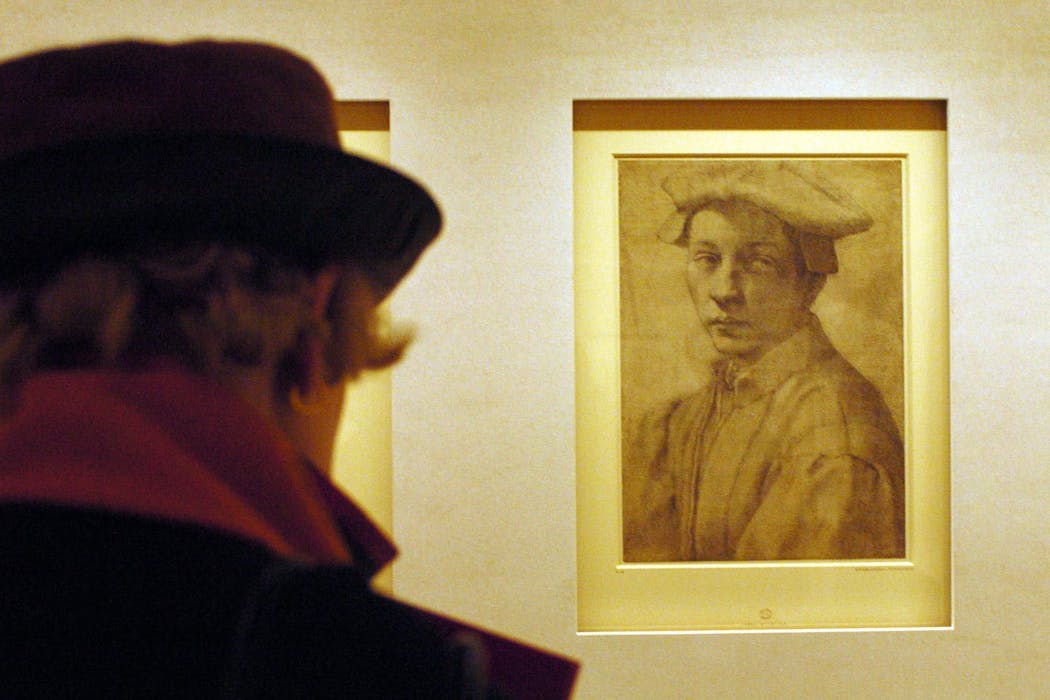
When a 5-inch-by-4-inch red chalk drawing of a woman’s foot by Michelangelo sold at auction for US$27.2 million on Feb. 5, 2026, it blew past the $1.5 million to $2 million it was expected to receive.
Experts believe it to be a study for the figure of the Libyan Sibyl, a female prophet who appears on the ceiling of the Sistine Chapel in Rome. Michelangelo painted the iconic frescoes from 1508 to 1512, but he first sketched out the overall composition and details in a series of preparatory drawings. Only around 50 of these drawings survive today.
This was an exciting sale for reasons outside that eye-popping sum. Held in private collections for centuries, the drawing only came to light after the owner sent an unsolicited photo to Christie’s auction house. There, a drawings expert recognized it as one of the relatively few remaining studies for the Sistine frescoes.
As an art historian who specializes in the Italian Renaissance, I’m excited about the sale not because of the money it fetched, but because of the attention it has brought to Michelangelo’s lifelong devotion to drawing, a medium he prized over painting.
‘Not my art’
Art historians know a lot about Michelangelo through the letters and poems he penned, along with two biographies written in his lifetime by intimates Giorgio Vasari and Ascanio Condivi.
In 1506, Pope Julius II put Michelangelo’s sculpting work on a papal tomb at St. Peter’s Basilica on hold, redirecting the funds intended for the tomb to the renovation of the basilica itself.
Michelangelo responded by closing his studio. He ordered his workshop assistants to sell off its contents, abandoned 90 wagonloads’ worth of marble and left Rome in disgust.
In 1508, Julius and his intermediary, Cardinal Francesco Alidosi, were able to lure Michelangelo back to Rome with the promise of a 500-ducat payment and a contract to paint the Sistine. Despite accepting, the artist went on to complain relentlessly about his new commission. He wrote to his father that painting “is not my profession” and told the pope that painting “is not my art.”
Sculpture, not painting, was central to Michelangelo’s identity.
In the Condivi biography, which Michelangelo approved and helped shape, the artist is said to have abandoned painter Domenico Ghirlandaio’s workshop around 1490 to train in the Florence sculpture garden of powerful arts patron Lorenzo de’ Medici. Michelangelo would later joke that he became a sculptor as an infant, thanks to the breast milk of his wet nurse, who was the daughter of stonemasons.
Beyond his enthusiastic embrace of sculpture and resentment over the Sistine – what he called the “tragedy of the tomb” – Michelangelo found painting in fresco to be backbreaking work.

“I’ve grown a goiter from this torture,” he wrote to his friend Giovanni da Pistoia in an illustrated poem. “My stomach’s squashed under my chin, my beard’s pointing at heaven, my brain’s crushed in a casket, my breast twists like a harpy’s. My brush, above me all the time, dribbles paint so my face makes a fine floor for droppings!”
“My painting is dead,” he concludes. “I am not in the right place – I am not a painter.”
A grand design
The caricature that accompanies Michelangelo’s poem shows not only a cantankerous and restless mind, but also his use of drawing to reflect its inner workings.
The early 16th century witnessed a rise of drawing, with Michelangelo leading the way. Rather than simply copying or providing models for painting, drawing became understood as an important intellectual, exploratory and creative exercise
Michelangelo’s biographer Vasari famously used the term “disegno” to mean both a physical drawing and a work’s overall “design” or concept, giving the artist an almost godlike creative power.
This double meaning is reflected in the title of the hugely popular 2017 exhibition of Michelangelo’s drawings at the Metropolitan Museum of Art in New York": “Michelangelo: Divine Draftsman and Designer.”
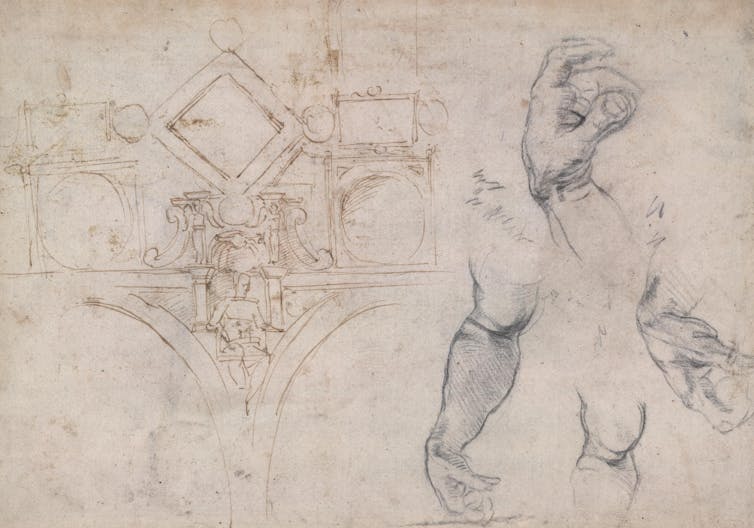
Michelangelo created many drawings for the Sistine that reflected the different meanings of “disegno.” There were his sketches of models, along with his architectural renderings and schemes to organize the huge space. Then there were the full-size “cartoons” he drew to transfer his designs directly onto the ceiling itself.
The good foot
Michelangelo also made many studies of individual body parts and gestures for the Sistine, including eyes, hands and feet.
In a drawing for the Sistine ceiling that’s now in the British Museum, various hands – perhaps modeled after his own – repeat across the right side of the page. Feet were especially important to the overall design of the human figure, and they stand at the intersection of Michelangelo’s interests in Classical art and human anatomy.
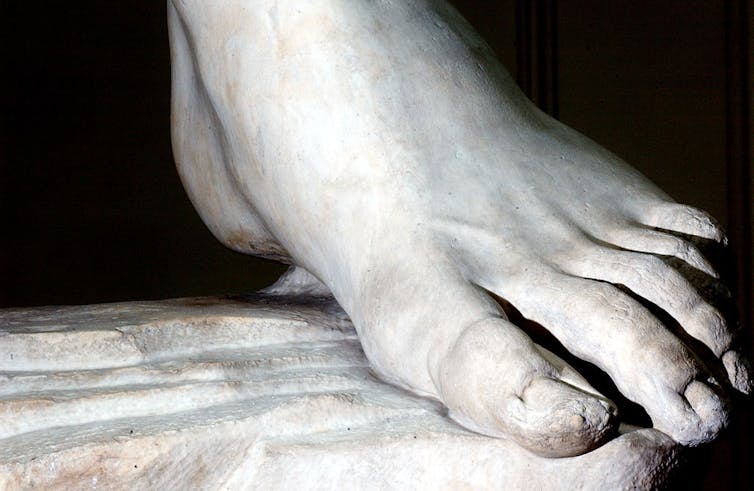
Contrapposto, or the Classical “counter-poise,” was the iconic stance for standing figures in paintings and sculptures. It features the trunk of the body centered over one leg with its foot planted, and the other bent with the foot perched on the toe. Michelangelo’s “David” stands in contrapposto, and even doctors today are impressed by the anatomical precision of the muscles and veins of each foot.
The Christie’s red chalk drawing of the foot was likely done from a live model, with Michelangelo showing the elegance of the Libyan Sibyl prophetess through her dramatically arched foot.
In the finished fresco, Sibyl’s body is a kind of elegant machine. The musculature of her extended arms, her coiled torso and her pointed toe all work in concert. This small drawing shows how the charged energy of a single body part could contribute to the overall “disegno” of the massive fresco.
While the process of painting the ceiling was arduous, the process of conceiving it through drawing was obviously rewarding for Michelangelo.

Drawing as the linchpin
Despite the popularity of the Sistine frescoes, Michelangelo rarely returned to painting after completing them. In 1534, Pope Clement VII commissioned him to paint the “The Last Judgment” on the altar wall of the Sistine Chapel. But only after Clement died later that year – and Clement’s successor, Pope Paul III, gave Michelangelo the extraordinary title of Chief Architect, Sculptor, and Painter to the Vatican Palace – did the artist begin work on the altar wall.
While many people today may think of the Sistine frescoes or Leonardo da Vinci’s “Mona Lisa” when they think of the Italian Renaissance, those artists did not think of themselves primarily as painters.
In a famous letter of introduction to the Duke of Milan, Ludovico Sforza, Leonardo elaborates on his many skills in creating fortifications, infrastructure and weaponry. He boasts about his ability to build bridges, canals, tunnels and catapults. Only after 10 paragraphs does he include a single sentence admitting that he, in addition, “can carry out sculpture in marble, bronze, or clay, and in painting can do any kind of work as well as any man.”
Like Michelangelo’s, Leonardo’s drawings show a voracious mind at work. They explore, rather than simply observe, everything from military machines to human anatomy. In 1563, Michelangelo would go on to be named master of the Accademia del Disegno in Florence, which aimed to teach drawing and design as the underlying skills necessary for sculpture, architecture and painting.
Drawing, it turns out, was the art that unified the many pursuits of the “Renaissance Man.”
Anna Swartwood House does not work for, consult, own shares in or receive funding from any company or organization that would benefit from this article, and has disclosed no relevant affiliations beyond their academic appointment.
Read These Next
Columbus’ own writings reveal how tightly religion and conquest were intertwined from the start
The ‘Book of Prophecies’ shows how Columbus recast brutal colonization as a divine mission.
Why people keep looking for Noah’s Ark in a natural rock formation in Turkey: A scholar of early Chr
A formation known as Durupınar, just a few miles from the Iranian border in Turkey, has been associated…
Why older lawmakers may wait too long to step aside
Many older incumbents are on the ballot for the 2026 midterms, adding to America’s debate over the…