Clergy protests against ICE turned to a classic – and powerful – American playlist
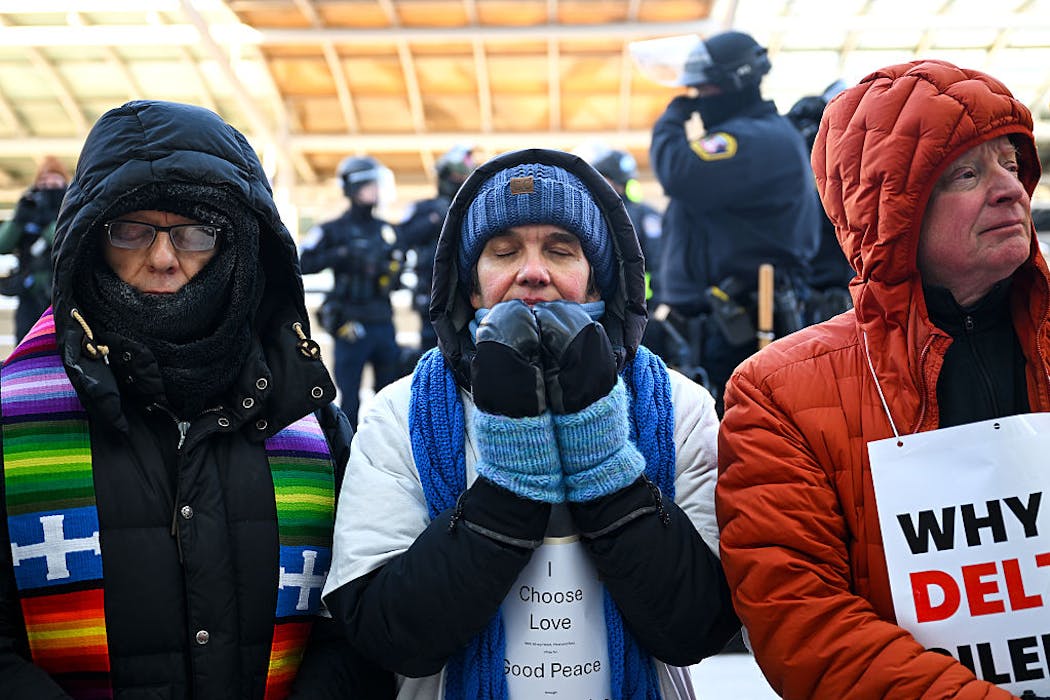
Clergy demonstrating against ICE in Minneapolis have turned to classic ‘freedom songs’ – the music associated with protests ever since the Civil Rights Movement.

On Jan. 28, 2026, Bruce Springsteen released “Streets of Minneapolis,” a hard-hitting protest against the immigration enforcement surge in the city, including the killings of Renee Good and Alex Pretti. The song is all over social media, and the official video has already been streamed more than 5 million times. It’s hard to remember a time when a major artist has released a song in the midst of a specific political crisis.
Yet some of the most powerful music coming out of Minneapolis is of a much older vintage. Hundreds of clergy from around the country converged on the city in late January to take part in faith-based protests. Many were arrested while blocking a road near the airport. And they have been singing easily recognizable religious songs used during the Civil Rights movement of the 1950s and ‘60s, like “Amazing Grace,” “We Shall Overcome, and ”This Little Light of Mine.“
I have been studying the politics of music and religion for more than 25 years, and I wrote about songs I called "secular spirituals” in my 2004 book, “How Sweet the Sound: Music in the Spiritual Lives of Americans.” Sometimes called “freedom songs,” they were galvanizing more than 60 years ago, and are still in use today.
But why these older songs, and why do they usually come out of the church? There have been many protest movements since the mid-20th century, and they have all produced new music. The freedom songs, though, have a unique staying power in American culture – partly because of their historical associations and partly because of the songs themselves.
Stronger together
Some of protest music’s power has to do with singing itself. Making music in a group creates a tangible sense of community and collective purpose. Singing is a physical activity; it comes out of our core and helps foster solidarity with fellow singers.
Young activists working in the Deep South during the most violent years of the Civil Rights Movement spoke of the courage that came from singing freedom songs like “We Shall Overcome” in moments of physical danger. In addition to helping quell fear, the songs were unnerving to authorities trying to maintain segregation. “If you have to sing, do you have to sing so loud?” one activist recalled an armed deputy saying.
And when locked up for days in a foul jail, there wasn’t much else to do but sing. When a Birmingham, Alabama, police commissioner released young demonstrators he’d arrested, they recalled him complaining that their singing “made him sick.”
Test of time
Sometimes I ask students if they can think of more recent protest songs that occupy the same place as the freedom songs of the 1960s. There are some well-known candidates: Bob Marley’s “Get Up, Stand Up,” Green Day’s “American Idiot” and Public Enemy’s “Fight the Power,” to name a few. The Black Lives Matter movement alone helped produce several notable songs, including Beyonce’s “Freedom,” Kendrick Lamar’s “Alright and Childish Gambino’s ”This Is America.“
But the older religious songs have advantages for on-the-ground protests. They have been around for a long time, meaning that more people have had more chances to learn them. Protesters typically don’t struggle to learn or remember the tune. As iconic church songs that have crossed over into secular spirituals, they were written to be memorable and singable, crowd-tested for at least a couple of generations. They are easily adaptable, so protesters can craft new verses for their cause – as when civil rights activists added "We are not afraid” to the lyrics of “We shall overcome.”

And freedom songs link the current protesters to one of the best-known – and by some measures, most successful – protest movements of the past century. They create bonds of solidarity not just among those singing them in Minneapolis, but with protesters and activists of generations past.
These religious songs are associated with nonviolence, an important value in a citizen movement protesting violence committed by federal law enforcement. And for many activists, including the clergy who poured into Minneapolis, religious values are central to their willingness to stand up for citizens targeted by ICE.
Deep roots
The best-known secular spirituals actually predate the Civil Rights Movement. “We Shall Overcome” first appeared in written form in 1900 as “I’ll Overcome Some Day,” by the Methodist minister Charles Tindley, though the words and tunes are different. It was sung by striking Black tobacco workers in South Carolina in 1945 and made its way to the Highlander Folk School in Tennessee, an integrated training center for labor organizers and social justice activists.
It then came to the attention of iconic folk singer Pete Seeger, who changed some words and gave it wide exposure. “We Shall Overcome” has been sung everywhere from the 1963 March on Washington and anti-apartheid rallies in South Africa to South Korea, Lebanon and Northern Ireland.
“Amazing Grace” has an even longer history, dating back to a hymn written by John Newton: an 18th-century ship captain in the slave trade who later became an Anglican clergyman and penned an essay against slavery. Pioneering American gospel singer Mahalia Jackson recorded it in 1947 and sang it regularly during the 1960s.
Firmly rooted in Protestant Christian theology, the song crossed over into a more secular audience through a 1970 cover version by folk singer Judy Collins, which reached No. 15 on the Billboard charts. During Mississippi Freedom Summer of 1964, an initiative to register Black voters, Collins heard the legendary organizer Fannie Lou Hamer singing “Amazing Grace,” a song she remembered from her Methodist childhood.
Opera star Jessye Norman sang it at Nelson Mandela’s 70th birthday tribute in London, and bagpipers played it at a 2002 interfaith service near Ground Zero to commemorate victims of 9/11.
‘This little light’
Another gospel song used in protests against ICE – “This little light of mine, I’m gonna let it shine” – has similarly murky historical origins and also passed through the Highlander Folk School into the Civil Rights Movement.
It expresses the impulse to be seen and heard, standing up for human rights and contributing to a movement much larger than each individual. But it could also mean letting a light shine on the truth – for example, demonstrators’ phones documenting what happened in the two killings in Minneapolis, contradicting some officials’ claims.
Like the Civil Rights Movement, the protests in Minneapolis involve protecting people of color from violence – as well as, more broadly, protecting immigrants’ and refugees’ legal right to due process. A big difference is that in the 1950s and 1960s, the federal government sometimes intervened to protect people subjected to violence by states and localities. Now, many Minnesotans are trying to protect people in their communities from agents of the federal government.
David W. Stowe does not work for, consult, own shares in or receive funding from any company or organization that would benefit from this article, and has disclosed no relevant affiliations beyond their academic appointment.
Read These Next

These state supreme court races could decide abortion access and trans rights
Ohio, North Carolina and Michigan have open seats on their state supreme court, and these hotly contested…

Why your boss matters more than remote or hybrid work when it comes to burnout and job satisfaction
A return to the office can mean very different things to different workers, which is why this debate…
Armed poll watchers: New Jersey’s 1981 racist voter intimidation campaign is a cautionary tale ahead
An armed voter suppression campaign in New Jersey in 1981 finds echoes today in the Trump administration’s…