Sabrina Carpenter’s and Chapelle Roan’s sexy pop hits have roots in the bedroom ballads of Teddy Pen
The soul singer-turned-R&B sex symbol Teddy Pendergrass helped defined the Sound of Philadelphia in the 1970s.


When Sabrina Carpenter’s provocative 2024 pop single “Bed Chem” plays on the radio, and I hear the lyrics
“But I bet we’d have really good bed chem / How you pick me up, pull ‘em down, turn me 'round / Oh, it just makes sense / How you talk so sweet when you’re doing bad things”
it reminds me of a song released 45 years earlier:
“Let’s take a shower, said a shower together, yes / I’ll wash your body and you’ll wash mine, yeah / Rub me down in some, some hot oils, baby / And I’ll do the same thing to you” —“Turn Off the Lights” by Teddy Pendergrass
Growing up in Philadelphia in the 1990s, I listened to soul singer-turned-R&B sex symbol Teddy Pendergrass and other artists who defined the Sound of Philadelphia. Now, as a professor of ethnic studies, I teach students about the influence of Black artists on modern pop culture.
Pendergrass would have turned 75 this year. Although he died in 2010, he helped usher in an era of music that brought both disco and more mature, sensual music to the mainstream – and I see his influence in a number of pop and R&B hits today.
The Philadelphia sound
Theodore DeReese Pendergrass was born in South Carolina in 1950, but he grew up in North Philadelphia, where he sang and played drums in church and became an ordained minister at age 10.
He dropped out of Thomas Edison High School in the 11th grade to pursue a music career, and he recorded “Angel With Muddy Feet” in 1967. The song was not a commercial success, so he focused on playing drums for a number of local bands.
In 1970, Pendergrass was invited by Philly soul and R&B singer Harold Melvin to play drums with his group, the Blue Notes. During a performance, Pendergrass sang along, leading Melvin to invite him to take over as lead vocalist after John Atkins left the group. The following year, Harold Melvin and the Blue Notes signed a record deal with the newly created Philadelphia International Records, forging a partnership between Pendergrass and label founders and legendary producers Kenny Gamble and Leon Huff that would last over a decade.
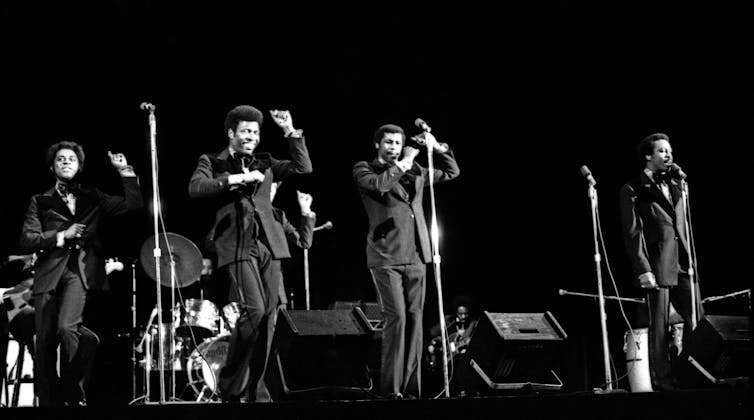
Philadelphia International’s influence was felt throughout the music industry, with Gamble and Huff producing many of the hits performed by the label’s artists. Gamble and Huff blended soul and funk with complex horn and string arrangements to create the Philly soul sound.
This sound became key in the development of disco, smooth jazz and neo-soul. Slower, more intimate R&B and smooth jazz also formed the foundation for the “quiet storm” radio format that Pendergrass helped foster as a solo artist on stations like WDAS in Philadelphia.
Marvin Gaye’s 1973 album “Let’s Get It On” was Motown’s response to the emergence of Philly Soul, and helped popularize more explicitly sensual R&B and soul.
Harold Melvin and the Blue Notes had their first No. 1 hit with 1972’s “If You Don’t Know Me by Now.” While on the Philadelphia International label, the group recorded four gold records between 1972 and 1976. One of their biggest hits, “Don’t Leave Me This Way” in 1975, was not released until November 1976. It charted after R&B and disco singer Thelma Houston’s cover of the song hit No. 1 on the Billboard Hot 100 chart in 1977.
Going solo
Pendergrass left the Blue Notes in 1976 after disputes with Melvin over money, but he stayed on with Philadelphia International and began a solo career. His self-titled album was released in 1977, and the first single, “I Don’t Love You Anymore,” reached No. 5 on the R&B charts, helping to push the album into the top 20.
The following year, his “Life Is a Song Worth Singing” hit No. 1 on the Soul LP chart behind the sensual single “Close the Door.”
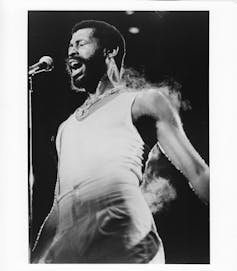
Pendergrass, with his stylish good looks, quickly became not just a heartthrob, but a top R&B artist with five consecutive platinum albums between 1977 and 1981. He was selling out concerts, and legendary producer Shep Gordon recognized that the vast majority of the attendees were women. This led to Pendergrass’ “Ladies Only” tour in 1978, which became a template for future soul and R&B tours by contemporaries like Luther Vandross and later artists like Ginuwine, whose tours were also marketed specifically to women.
The 1979 erotic hit “Turn Off the Lights” strengthened Pendergrass’ reputation as a sex symbol. While Marvin Gaye was dealing with both financial and personal issues, Pendergrass became the top performer of soul “bedroom ballads.”
Pendergrass and Gaye, along with other contemporaries like Barry White, Minnie Riperton and Donna Summer, included more explicitly erotic themes and lyrics than earlier artists.
For example, in Gaye’s “Let’s Get it On,” he implores to his lover:
“There’s nothin’ wrong with me / Lovin’ you, baby love, love / And givin’ yourself to me can never be wrong / If the love is true, oh baby.”
In “Close the Door,” Pendergrass similarly tells his lover:
“Close the door / Let me give you what you’ve been waiting for / Baby I got so much love to give / And I wanna give it all … to you …”
One challenge for the songwriters like Gamble and Huff was to balance the sensuality that fans loved with Federal Communication Commission rules regarding profane language. Songs like “Turn Down the Lights,” written by Gamble and Huff for Pendergrass, describe a detailed night of romance without language that would be considered obscene by the FCC.
Slow jams and sex positivity
R&B and soul slow jams by artists like Freddie Jackson and Vandross dominated bedroom music through the 1980s, although derivative genres like neo-soul and quiet storm continued to produce bedroom ballads like Gaye’s “Sexual Healing” in 1982.
Madonna and Cyndi Lauper helped bring a female perspective to more sex-positive pop music with songs including “Like a Virgin” and “She Bop.” Janet Jackson and Salt-N-Pepa did the same in R&B and hip-hop. Other groups embraced their sex symbol status through the 1990s, exemplified by TLC’s “Ain’t 2 Proud 2 Beg” and “Creep,” and Next’s “Too Close.” The artists of the 1980s and 1990s were also boosted by MTV, bringing a visual element to their sensual lyrics.
The emergence of new jack swing, a term coined in 1987 to define a new style that combined dance, hip-hop and R&B, ushered in higher-tempo erotic songs like “Do Me!” by Bel Biv Devoe along with slower bedroom ballads like “I’ll Make Love to You” by Philadelphia’s Boyz II Men.
Bedroom ballads with disco-synth makeover
Philadelphia International’s sound and sensual lyrics have reemerged in recent years through artists Sabrina Carpenter and Chapelle Roan, whose synth-pop and disco sound can be traced back to Gamble and Huff, and the label’s stable of artists.
Proto-disco songs like “The Love I Lost” and “Don’t Leave Me This Way” by Harold Melvin and the Blue Notes, and Pendergrass’ disco hit “Get Up, Get Down, Get Funky, Get Loose” – or his later synthesizer-heavy album “Joy” – would influence current synth-pop hits like Roan’s disco-influenced “Pink Pony Club” and Carpenter’s synth-pop “Manchild.”
Carpenter in particular has seemingly struck that balance between mainstream success and sensual lyrics. Her past three albums have been certified platinum and embrace increasingly mature themes such as female arousal.
“Man’s Best Friend,” released in August 2025, sparked controversy with a sexually suggestive album cover that further cemented her Carpenter’s symbol image. This image is reinforced by her stage presence, like dancing in her underwear on “Saturday Night Live” and mature songs like “Tears,”
Pendergrass’ career was derailed when he lost control of his car on Lincoln Drive in the East Falls neighborhood of Philadelphia in 1982. The accident left him a tetraplegic. He later continued his music career, but the “Black Elvis” moved away from bedroom ballads.
Although Pendergrass’ meteoric rise was cut short, his influence is still seen and heard across music genres today, especially as empowered female artists utilize disco and synth-pop sounds while embracing their sexuality through their songs and performances.
Read more of our stories about Philadelphia, or sign up for our Philadelphia newsletter on Substack.
Jared Bahir Browsh does not work for, consult, own shares in or receive funding from any company or organization that would benefit from this article, and has disclosed no relevant affiliations beyond their academic appointment.
Read These Next

Leap seconds have helped keep clocks synchronized with Earth’s rotation, but their time may be over
If you think about leap years, it may seem like humans have a very odd way of measuring time. Sometimes,…

From jargon to impact: Teaching undergraduates the art of public communication
Teaching public storytelling to students can help them communicate better in the world.

Why your boss matters more than remote or hybrid work when it comes to burnout and job satisfaction
A return to the office can mean very different things to different workers, which is why this debate…