A Feejee Mermaid on display in Colorado may shock and intrigue – but it’s no longer considered a ‘mi
All hoax – no science – the Feejee Mermaid startled American audiences that imagined it a real sea creature.

Mermaids have inhabited world folklore and mythology for centuries. Ancient Babylonians worshipped Oannes, a human-fish hybrid; sirens populated Greek mythology; and fairy tales such as “The Little Mermaid” have made this figure a pop culture icon.
During the 1800s, American showman P.T. Barnum brought the Feejee Mermaid to the American public. Presented at the American Museum, run by Barnum in Manhattan from 1841 to 1865, as “The Greatest Curiosity in the World” and said to have originated in the “Feejee Islands,” the creature inspired debates about science and evolution. Some people believed it was a missing link in the evolutionary chain between aquatic and terrestrial life.
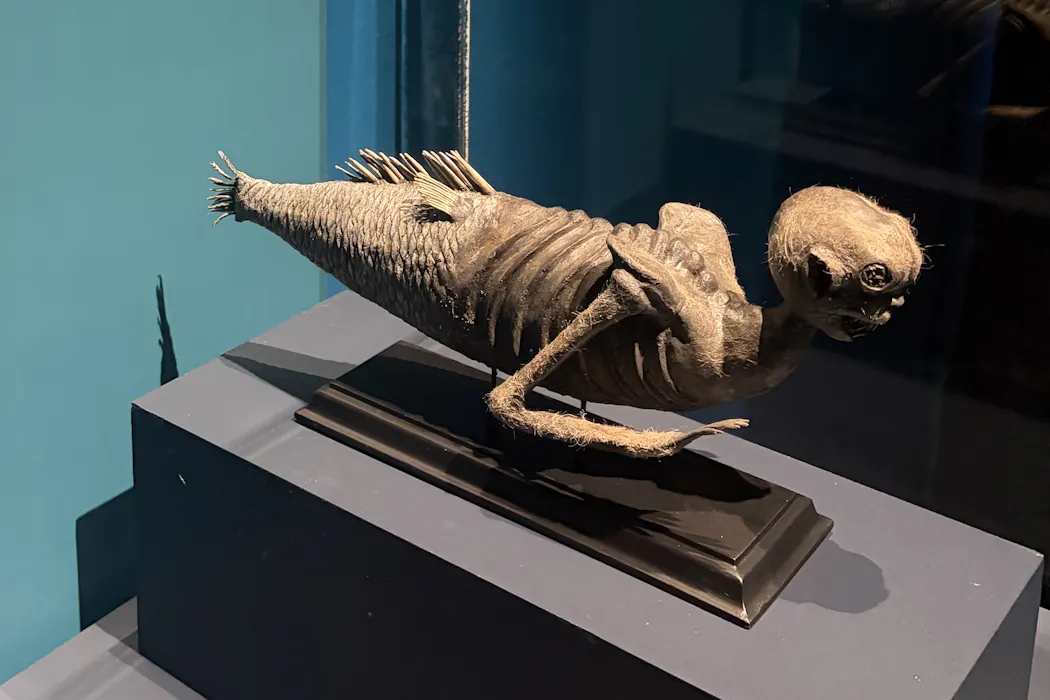
I recently viewed a Feejee Mermaid replica on display at the Denver Museum of Nature and Science as part of the “Mythic Creatures: Dragons, Unicorns and Mermaids” temporary exhibit. As a folklorist, I’m intrigued by how this mermaid subverted Americans’ expectations that mermaids are alluring and how it sparked an interplay between science and myth.
Origins of the Feejee Mermaid
A Feejee Mermaid is a type of traditional art form that originated in Japan and the East Indies more than 400 years ago. It came to Americans in 1842, when Barnum claimed to display a “specimen” at the American Museum in New York City.
In the Japanese version, the lower half was a fish attached to an upper half of a monkey or made of papier-mâché. Barnum’s was a mixture of a monkey and a fish, but the replica on display at the Denver Museum of Nature and Science has a papier-mâché upper half. Feejee Mermaids were often preserved by being coated in clay.
Mammalian-fish hybrid creatures have a role in Japanese folklore through the ningyo, which are a mermaidlike yokai, a supernatural being thought to have the power to either curse or grant eternal life. Unlike Western mermaids, ningyo were grotesque.
The Feejee Mermaid that became part of Barnum’s exhibition was created by a Japanese fisherman in the early 19th century. He claimed to have caught the specimen and said it prophesied a sterility epidemic. The only cure for the townsfolk, the fisherman said, came through owning a picture of the mermaid.
Samuel Barrett Eades, an American sailor, purchased the Feejee Mermaid and willed it to his son, who then sold it to Moses Kimball, a curator at the Boston Museum, in 1842.
In his autobiography, Barnum details the scheme he devised after Kimball showed him the Feejee Mermaid.
Barnum sent letters to newspapers, describing how a “Dr. Griffin,” who was really his hoaxing accomplice Levi Lyman, was in possession of the mermaid skeleton. He further spread the word by distributing thousands of pamphlets throughout New York City that detailed when the mermaid would be on display and highlighted the seductive nature of mermaids.
However, when the public arrived at the American Museum, much to their surprise, they found Barnum’s grotesque version.
Barnum himself described it as “an ugly dried-up, black-looking diminutive specimen, about three feet long. Its mouth was open, its tail turned over and its arms thrown up, giving it the appearance of having died in great agony.”

Sideshow gaffs and American folklore
The Feejee Mermaid on display at the Denver Museum of Nature and Science, and owned by the Peabody Museum of Archaeology and Ethnology, may or may not be the one shown by Barnum. The museum says it is a replica.
The original was likely destroyed or disfigured in a fire at Barnum’s museum or the Boston Museum. The object on display looks quite different compared to original descriptions of the Feejee Mermaid. As originally shown, it was said to be much more monkeylike, and artistic renderings of it from the period matched Barnum’s descriptions.
Feejee Mermaids, as displayed in America, are characteristic of a “sideshow gaff” that interested Victorian audiences due to debates about evolution and science. In fact, 18th-century Swedish naturalist Carl Linnaeus had left space for mermaids in the evolutionary tree. The Feejee Mermaid, as it blended human and animal characteristics, folklore and science, spectacle and empiricism, displays how a monstrous hoax inspired fierce intellectual debates in 19th-century America.
Jack Daly does not work for, consult, own shares in or receive funding from any company or organization that would benefit from this article, and has disclosed no relevant affiliations beyond their academic appointment.
Read These Next
How space weather powers auroras in the sky and threatens power grids on the ground
When an aurora lights up the sky, electric currents can also flow through the ground beneath your feet.

Short supplies of crucial equipment stymie changes to US electricity grid
Whether you want renewable energy, fossil fuel power plants, data centers or reduced storm vulnerability,…

‘Epic’ blue wave helps Democrats take Congress in overwhelming rebuke to President Trump
Election Day turned into a massive rebuke of President Donald Trump: a blue wave not seen in 20 years…