Up-and-down progress of voting rights in America has been shaped by these 10 key moments
The history of voting and elections in America doesn’t follow a steady path toward progress or retreat. It is marked by intense struggles, monumental victories and devastating losses.

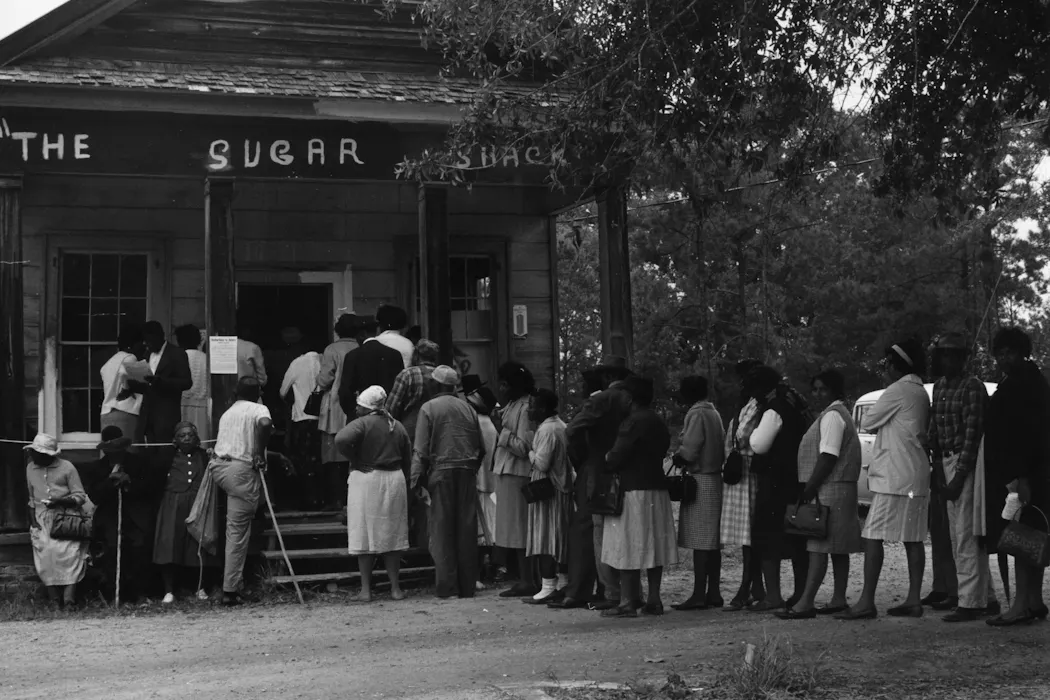
As the 2026 midterm elections approach, the U.S. Supreme Court has been busy with voting rights cases.
In mid-September, the court barred the Trump administration from carrying out its proposed restrictions on mail-in voting for the midterm elections.
In late September, the court ruled that the Trump administration could continue with a plan for various federal agencies to use a controversial database to identify and cull ineligible voters on the voter rolls.
These decisions highlight the long history of struggles in the United States over who can vote, how votes are counted and who sets the rules that govern elections.
As scholars of elections and Southern politics, we have selected 10 important moments in U.S. voting history. The point is not to identify the definitive 10, but rather to underscore that battles over the franchise are long-standing and do not move in a single direction.
The 15th Amendment
Passed by Congress in 1869, the 15th Amendment was the final Reconstruction-era amendment. It said that “the right of citizens of the United States to vote shall not be denied or abridged by the United States or by any State on account of race, color, or previous condition of servitude.”
This amendment helped bring about widespread participation by Black men and the election of many Black candidates to key positions in Southern states. In South Carolina, over 250 African American men were elected during Reconstruction, and South Carolina’s Joseph H. Rainey became the first African American to serve in the U.S. House.

The amendment’s language was clear and permanent, but much of the progress that followed was short-lived. During the Jim Crow era, Southern states used literacy tests, grandfather clauses and other barriers to deny Black citizens the vote.
The 17th Amendment
Aiming to provide a check on the popular will, the framers of the U.S. Constitution specified that U.S. senators should be elected by state legislatures. But problems with this system emerged. Disputes within legislatures sometimes led to deadlocks, and many states opted to select senators in partisan primaries or a general election.
As a result, Congress sent the 17th Amendment to the states in 1912. Ratified in 1913, it transferred the selection of senators from state legislatures to direct election by the people.
The 19th Amendment
The result of a long struggle for women’s suffrage, the 19th Amendment was first introduced in Congress in 1878 but did not pass over many years and subsequent introductions. Support increased after President Woodrow Wilson changed his position in 1917 to support it. Congress passed the amendment in 1919, and the states ratified it in 1920. It dramatically expanded the potential electorate.
Because of the lingering effects of Jim Crow laws and racial discrimination, however, many Black women were still denied the franchise.
Voting Rights Act
The Voting Rights Act of 1965 dramatically reduced barriers to voting and created a process under which localities with a history of discrimination were required to obtain federal approval, known as “preclearance,” before making changes to voting rules.
The results were immediate and substantial, resulting in increased Black political participation and representation, particularly in the South.
According to one analysis, “Prior to the adoption of the Voting Rights Act, the median proportion of Blacks who had registered (in the southern states) stood at 39.4 percent. Just a couple of years after adoption of the legislation the median figure had increased to 58.9 percent.” The law was reauthorized in 1970, 1975, 1982 and 2006, transforming Southern politics and altering representation by increasing the voice and representation of African Americans in the region.
McGovern-Fraser Commission
The tumultuous 1968 Democratic National Convention, marked by riots, violence against protesters and dissent over the Vietnam War, led to the establishment of the McGovern-Fraser Commission by the Democratic Party, which proposed new procedures for selecting delegates to the national convention. Most notably, the changes opened the process to greater public participation and reduced the power of party leaders to choose delegates behind closed doors.
McGovern-Fraser helped produce the modern primary system by changing the way presidential candidates are selected and shifting power from party leaders to primary voters.
The 26th Amendment
This amendment, ratified in July 1971, lowered the voting age from 21 to 18. The argument was simple — a person who is old enough to be drafted for military service is also old enough to vote. Support for lowering the voting age emerged during World War II, but the amendment was passed and ratified in 1971 in record time as support for the Vietnam War declined. It was the last constitutional amendment to expand the franchise.
The National Voter Registration Act
Also called the “motor voter bill,” the National Voter Registration Act of 1993 marked an important step in moving elections in America toward greater standardization by requiring state driver’s license offices to provide a way for people to register to vote. It also mandated other rules about how states must implement voter registration and how they must maintain voter registration databases.
Bush v. Gore
Following a closely contested 2000 presidential election in Florida, the Florida Supreme Court ordered a hand recount of contested ballots from Miami-Dade County. In the legal case Bush v. Gore, the U.S. Supreme Court stopped the recount, leaving Republican George W. Bush ahead of Democrat Al Gore in Florida and securing his election as president.
The case focused attention on the administration of elections, as problems with what were known as “hanging chads” on the ballots as well as voting equipment and the “butterfly” ballots themselves became central to discussion of elections in America. It also led to the passage of the Help America Vote Act in 2002 that set federal requirements for polling place accessibility, voting systems and voter registration.

Shelby County v. Holder
In this 2013 case, the U.S. Supreme Court ruled that the formula used to determine which localities were required to have their voting policies reviewed and approved by the Department of Justice no longer reflected current conditions and therefore was unconstitutional.
Although Congress could create a new formula, it has not done so, and as a result the Shelby County decision effectively gutted the preclearance process created by the Voting Rights Act.
Recent research shows that this decision has resulted in several racially discriminatory voting policies.
Louisiana v. Callais
In late April 2026, the U.S. Supreme Court issued a 6-3 ruling that a Louisiana congressional map devised to create a majority Black voting district was an unconstitutional racial gerrymander and that the Voting Rights Act did not require the state to draw it.
In addition to affecting the specifics of the Louisiana map, Louisiana v. Callais made it much more difficult for plaintiffs to prove racial vote dilution claims under the Voting Rights Act. Many analysts believe that this may result in far fewer minority members of Congress.
Not a straight line
As is clear in this abbreviated tour of history, as well as in more extended treatises of the subject, the history of voting and elections in America doesn’t follow a steady path toward progress or retreat. It is marked by intense struggles, monumental victories and devastating losses. And many of the events on this timeline may represent all three, depending on a person’s experience and perspective.
Another set of 10 events might provide different examples, but they would be unlikely to bring us to a different conclusion.
The authors do not work for, consult, own shares in or receive funding from any company or organization that would benefit from this article, and have disclosed no relevant affiliations beyond their academic appointment.
Read These Next

Chiricahua is the nation’s newest national park – what does that mean?
What comes next for Chiricahua, now that is has been officially redesignated as America’s 64th national…
Offering cash for votes is quite common – but here’s why it doesn’t work
Money or other material benefits are often not enough to override a voter’s preferences and partisanship.

El Niño is threatening California’s fragile coast again – the 1982-83 El Niño opened eyes to the ser
The destructive 1982-83 El Niño, then the strongest on record, eroded cliffs, leaving homes hanging…