Middle East is the latest arena of political recalibration for Italy’s right-wing but pragmatic Melo
The Italian leader has positioned Italy as a geopolitical hinge between competing power centers. The Middle East has just given that strategy a new environment.

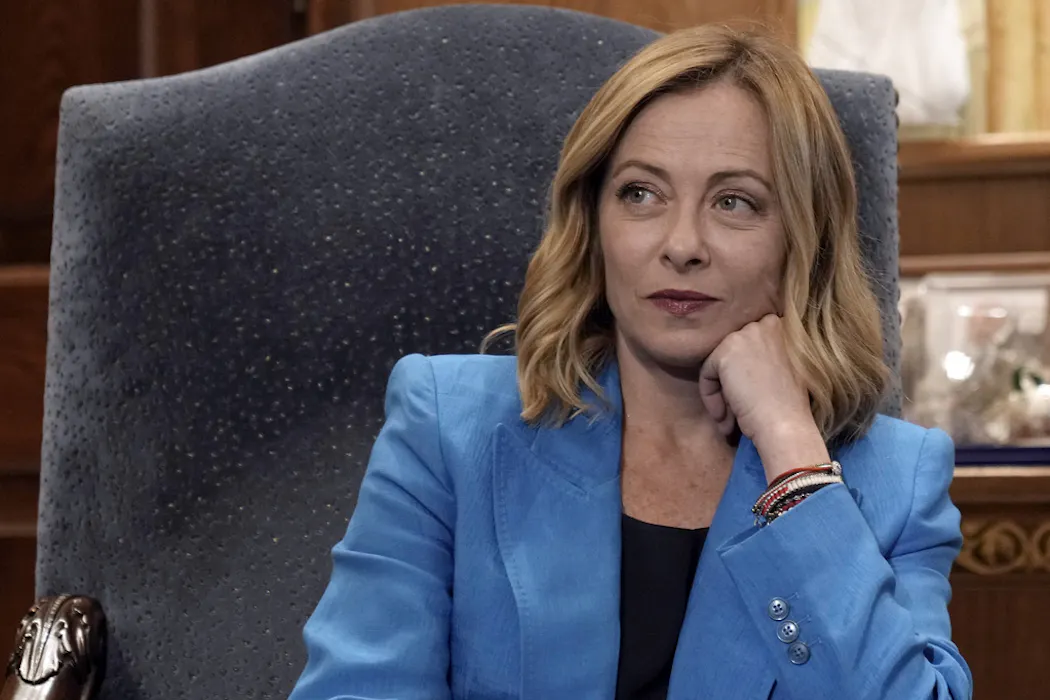
Italian Prime Minister Giorgia Meloni has made a political art of being many things at once.
Since coming to power in 2022, she has become the leader of Italy’s longest-serving postwar government. Meloni has also transformed herself from a politician once viewed as a radical outsider into one of Europe’s most consequential conservative leaders. Her political strength has always rested on adaptability: whether speaking the culture war language of MAGA politics in Washington, European pragmatism in Brussels or nationalism in Rome.
Nowhere is that adaptability more visible than in her dealings in the Middle East.
Her government has long cultivated close relations with Israel and presented itself as one of Israel’s strongest political supporters in Europe. This position was in part self-serving for Meloni: As a leader of a party with roots in Italy’s post-fascist right, the approach to Israel – alongside repeated condemnations of anti-Semitism and the racial laws of the fascist regime – signaled a break with the past.
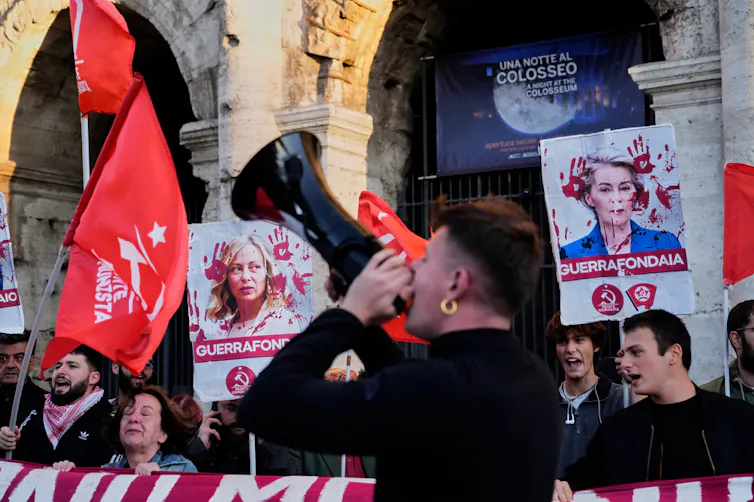
Yet her strong support for Israel was increasingly at odds with public opinion at home, which moved sharply against Israel as the war in Gaza ground on. Some 75% of Italians hold an unfavorable view of Israel, up from 66% in 2025, according to a June 2026 Pew Research Center survey.
Perhaps recognizing the yearslong shift, Meloni subtly changed course. In April 2026, Italy suspended the automatic renewal of its defense cooperation agreement with Israel. That followed growing public criticism of Israeli military actions in Gaza and Lebanon, including an incident in which Israeli forces fired warning shots at a clearly marked Italian U.N. convoy in southern Lebanon, damaging one vehicle but causing no injuries.
It was the kind of symbolic recalibration that Meloni has increasingly used to position Italy as a geopolitical hinge between competing power centers in order to maximize Rome’s room for maneuver on the world stage. The Middle East has just given that strategy a new environment.
From Jerusalem to Beirut
None of that is to suggest that Meloni has in any way become an anti-Israel leader.
Diplomatically symbolic as it might have been, suspending the renewal of the defense cooperation agreement had almost no practical effect on Israel. Notwithstanding that and other occasional disagreements over things such Israeli settlement activity, the two countries maintain close diplomatic and economic relations.
Italy, moreover, has been a reliable backer of Israel in international forums in the course of the war in Gaza. And notably, Italy declined to join the U.K. and France in banning goods from the occupied West Bank – an issue that has driven a wedge between EU members and Israel – though Italian Foreign Minister Antonio Tajani has said Rome is considering such measures.
Instead, Meloni’s rhetoric on Israel appears to represent primarily a form of political and reputational management rather than a substantive policy shift. Yet it shows how Meloni is particularly receptive to political realities and looking for ways to make the case for Italy as a useful diplomatic partner that talks to all sides.
And here, Lebanon offers another clear example of her approach.
In August 2026, Meloni hosted Lebanese President Joseph Aoun for discussions largely focused on the political and military situation in southern Lebanon, continuing Israeli attacks and the future of UNIFIL, the U.N. peacekeeping mission in which Italy has the second-largest contingent – and the most of any European country. Rome likewise hosted the latest rounds of direct talks between the Israeli and Lebanese delegations.
The diplomacy is part of a yearslong Italian involvement in Lebanon. Beyond its support for UNIFIL, Italy also trains Lebanese security forces and has maintained a significant diplomatic presence in the country. As UNIFIL’s mandate approaches its scheduled end on Dec. 31, 2026, Italy is also working with France and other partners on what might replace it and how to avoid a security vacuum.
In Lebanon, Italy has an established presence on the ground dating back years, a relationship with Israel, and the ability to speak to Washington and European allies.
Aoun’s government has a reason to want Italy involved, but that role also creates a dilemma for Meloni.
On Sept. 6, 2026, Israeli strikes in southern Lebanon killed several people, according to Lebanese authorities, prompting Aoun to condemn what he called a dangerous escalation and appeal for international intervention. Israel said it was responding to Hezbollah attacks and was targeting the militant group’s infrastructure.
Lebanese leaders won’t see Italy as a credible interlocutor if it ignores Israeli violations of a June 2026 ceasefire. At the same time, Meloni cannot simply abandon Israel without damaging a relationship that she has spent years cultivating.
Yet for Meloni, Italy’s ability to maintain relationships with opposing sides provides diplomatic value, even if the process ultimately does not lead anywhere. Her approach is therefore best understood as one of political calibration: acknowledging concerns over Lebanese and Palestinian suffering, while preserving Italy’s relationship with Israel and maintaining diplomatic access to competing sides.
The business of stability
There is another reason Italy is becoming more active in the region: economics.
The Mediterranean is not simply Italy’s geographical neighborhood. It is a strategic economic space involving energy, trade, infrastructure, investment, migration and security.
Italy’s ties with the Gulf are not new, but Meloni’s government has stepped them up, giving economic and strategic interests a more prominent role.
The previous government was already seeking closer ties with Saudi Arabia. Under Meloni, the relationship has gone further. In January 2025, Italy and Saudi Arabia upgraded their ties to a strategic partnership and signed agreements worth around US$10 billion.
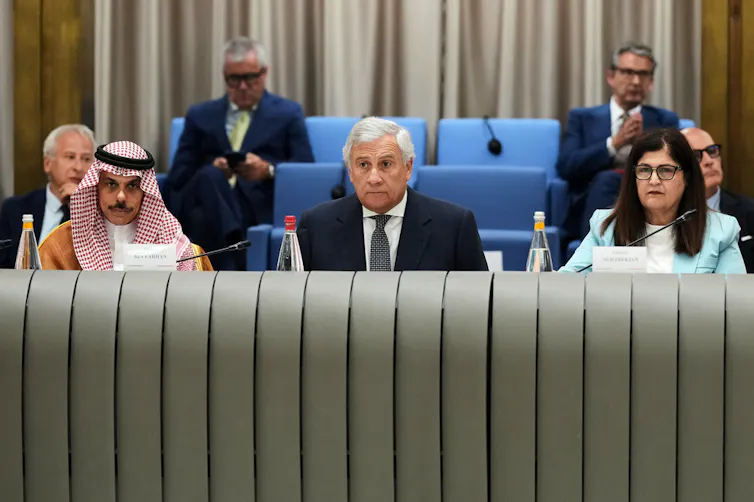
By 2026, Foreign Minister Tajani was describing the Saudi relationship as “one of the pillars” of Italy’s regional engagement. He has explicitly linked it to political, economic and security interests, including the protection of maritime routes through the Strait of Hormuz and the Red Sea.
The scale of this economic relationship is also becoming clearer. Italian exports to Saudi Arabia reached around $7.2 billion in 2024, up 28% from the previous year, with Italian companies looking to take part in Saudi Arabia’s Vision 2030 projects in areas such as infrastructure, transport, technology, energy and tourism.
The United Arab Emirates is another important market: Italian exports reached about $9.2 billion in 2024, up 21%. And during Meloni’s February 2025 visit, the UAE announced plans to invest $40 billion in Italy and signed more than 40 agreements covering areas including investment, energy, defense, space and technology.
The Gulf is therefore becoming more than an energy supplier or diplomatic partner for Italy. It is an increasingly important market for Italian exports, investment and business.
The balancing act of diplomacy
This economic dimension helps explain why Italy’s regional activism under Meloni is best understood not as a wholesale departure from previous governments but as a pragmatic intensification of a long-standing strategy of diversification, commercial diplomacy and strategic flexibility.
For Rome, stability in places such as Lebanon matters not only because of humanitarian and security concerns. Even though Italy’s direct economic exposure to Lebanon is comparatively limited, the Meloni government views Lebanese stability within a wider regional framework in which conflict can affect maritime security, energy markets, trade and investment.
Meloni has sought to convert Italy’s geographical position and existing relationships into economic and diplomatic leverage, while preserving room to engage with a wide range of regional actors.
This is consistent with a broader pattern in Italian foreign policy under Meloni: less a commitment to fixed ideological positions than a persistent effort to preserve room for maneuver. The Middle East now offers a particularly revealing test of that strategy.
Julia Khrebtan-Hörhager does not work for, consult, own shares in or receive funding from any company or organization that would benefit from this article, and has disclosed no relevant affiliations beyond their academic appointment.
Read These Next

These state supreme court races could decide abortion access and trans rights
Ohio, North Carolina and Michigan have open seats on their state supreme court, and these hotly contested…
Missing ambassadors, inexperienced appointees – is Washington dropping the diplomatic ball?
Almost half of US ambassador jobs remain vacant. Meanwhile, political appointees are outnumbering career…

Your cells keep a record of every workout you’ve ever done – and those gains persist even after a br
‘Use it or lose it’ isn’t quite true when it comes to the health benefits of exercise. Cells across…