
Why French officials placed a Muslim war memorial in the intellectual heart of Paris in the 20th cen
The Grand Mosque of Paris has stood for a century as a memorial to Muslim soldiers and a nuanced symbol of French colonialism.

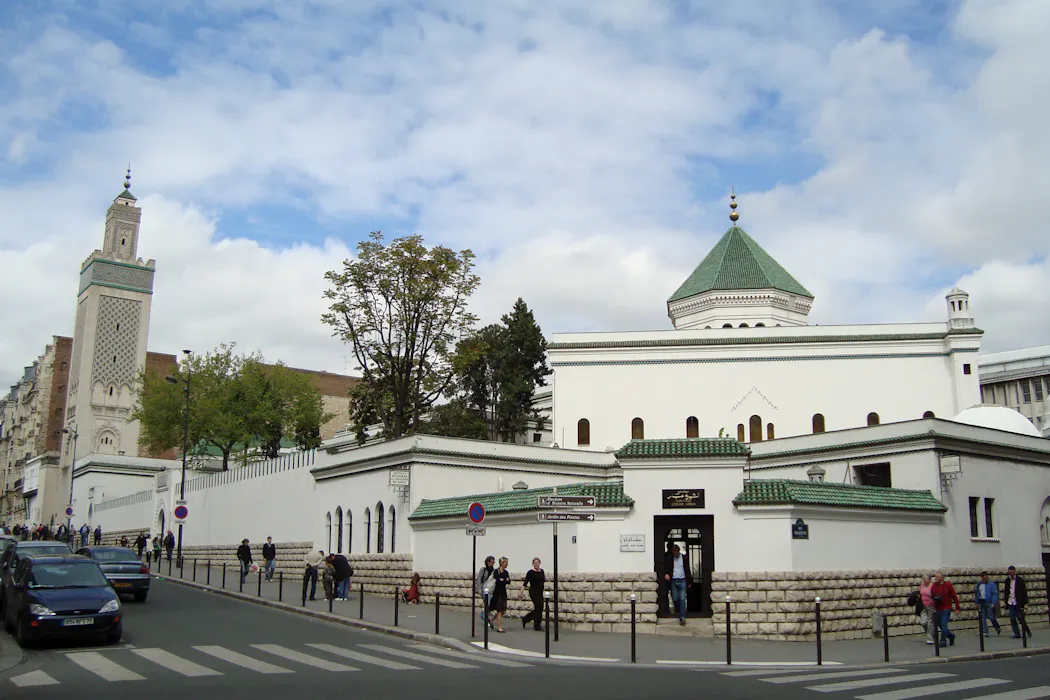
The Paris Grand Mosque, an iconic cultural landmark located in the heart of the city, is celebrating its centenary. Built as a war memorial to honor Muslim soldiers killed during World War I, it was the first permanent mosque in the French capital and remains its only mosque built with a minaret and a dome. The story behind its construction reflects the politics of colonialism in interwar Paris.
While estimates vary, scholars generally agree that more than 500,000 men from the French empire, including North African, West African and Southeast Asian countries, fought for France between 1914 and 1918. These troops were deployed in critical areas and suffered high casualty rates. Muslims represented approximately 70% of the 100,000 colonial soldiers killed in battle. During and after the war, France sought ways to recognize the sacrifices of its Muslim subjects.
As a professor of French history, I regularly offer classes on war and society in 20th-century Europe. I teach my students how to “read” the war memorials that appeared across the world in the 1920s and ’30s to mourn the dead. Their symbolic messages often tell us more about politics and society than they reveal about the soldiers killed in battle. The Paris Grand Mosque is no exception.
Origins of the Grand Mosque
During the war, a former colonial agronomy school on the outskirts of Paris was converted to a temporary hospital for soldiers from the empire. A wooden mosque, known as the Nogent Mosque, was added to the site in 1916 to serve the large number of Muslim patients at the hospital.

The French minister of foreign affairs described the mosque as a way to recognize the sacrifices made by Muslim soldiers, but it was not meant to be permanent. It closed in 1919 after colonial soldiers returned home and was demolished in the 1920s. By then, construction of the Grand Mosque had begun with support from the French government and African colonial administrations.
On paper, a North African religious association would be responsible for building and managing the Grand Mosque as well as an attached Muslim educational institute. The Society of Habous and Sacred Lands of Islam was founded in 1917 to facilitate North African Muslims’ annual pilgrimage to Mecca and Medina during the war. By 1920, the private society headed the state-supported project of creating a new monument in Paris.
French politicians supported this arrangement for several reasons. First, it created legitimacy for the mosque. Supporters emphasized that it was designed for and by Muslims with little government intervention. Second, it allowed officials to avoid violating the law separating church and state.
The law of Dec. 9, 1905, recognized freedom of religion, but it prohibited using public funds to support religious entities. Instead, French politicians provided 500,000 francs to the Society of Habous for construction costs to protect the appearance of religious neutrality.
Building the mosque
With partial funding in place, the Society of Habous needed a building site. Original proposals placed the Grand Mosque near Les Invalides, a set of buildings that serve as a shrine to France’s military heroes. But rather than building it near the existing complex, it was constructed on vacant land in the Latin Quarter, the intellectual heart of the city.
This new location was chosen for its availability, but it provided supporters with additional talking points. French politicians claimed that the prime location in central Paris reflected France’s deep respect for Islam. Additionally, its proximity to the Sorbonne, the country’s oldest and most prestigious university, further underlined the educational and secular nature of the endeavor.
The locale also reflected French colonial thinking. A book published after the mosque’s inauguration by a French civil servant named René Weiss argued that Muslims visiting Paris would benefit from “the benevolent virtues of French civilization” through its location in the neighborhood “from which French thought shines.” In other words, French culture, he hoped, would positively influence Islam.
Built between 1922 and 1926, the Grand Mosque housed a prayer room, a library, a hammam – or public bath – a hostel and a restaurant. It was both a religious and secular site that was open to Muslims, the Parisian public and tourists. As author and journalist Moustafa Bayoumi argues, it put Islam on display. But the recognition of Muslim soldiers’ sacrifices was less visible.

A war memorial
Government officials regularly described the Grand Mosque as a war memorial. In 1921, Albert Sarraut, the minister of colonies, called the mosque a symbol of “Franco-Muslim fraternity … sealed on the battlefields.” At the groundbreaking ceremony in 1922, Paris municipal councilor Paul Fleurot said the new Muslim institute “will exist as a commemorative monument raised to the memory of those Muslim soldiers who died for France.”
After the war, monuments to war dead appeared across France. More than 35,000 war monuments reinforced the secular values of the French Third Republic in public spaces by focusing on equality of sacrifice and drawing on republican symbols. These monuments did not include religious symbols and were built outside of cemeteries and churches. Hundreds of similar monuments were built in colonial Algeria during the interwar period.
Historian Jan C. Jansen argues that the colonial monuments were meant to symbolize the continued unity between France and her empire after the war through similar forms of commemoration. But he also explains how the monuments deliberately marked the differences between French citizens and colonial subjects: Monuments erected in Algeria, for example, featured statues of French soldiers and listed the names of European soldiers separately from indigenous soldiers.
The building of a North African mosque in the French capital was also a way to recognize Muslim soldiers, but this message is often hidden to visitors. The Paris history marker located outside the entrance does not mention World War I. There is no list of soldiers’ names on display, a common postwar commemorative practice.

It was not until 2014 that French President François Hollande dedicated two wall plaques inside the Grand Mosque recognizing the Muslim soldiers who fought for France in each of the world wars.
One hundred years after its inauguration, the Grand Mosque of Paris still tells a story of politics and society – as a Muslim war memorial built in the context of a secular, colonial state.
Shannon Fogg does not work for, consult, own shares in or receive funding from any company or organization that would benefit from this article, and has disclosed no relevant affiliations beyond their academic appointment.
Read These Next

Fentanyl is fueling overdose deaths in Colorado – what voters need to know about Proposition 132’s a
In November, Colorado voters will decide whether to further criminalize the use of illicit fentanyl.
Pennsylvania’s aging prisons weren’t built for today’s extreme weather – leaving women and seniors e
Extreme hot and cold temperatures are associated with higher rates of deaths, infirmary admissions and…

Why the 26 secretary of state races this November matter more than they did before Trump’s drive to
Secretaries of state are at the center of growing conflict over how election authority should be divided…