The ‘navalization’ of economic warfare sees trade routes become zones of force rather than rules
With the declining power of financial sanctions, many countries are now physically boarding ships to enforce scattershot rules of trade, conflict and commerce.

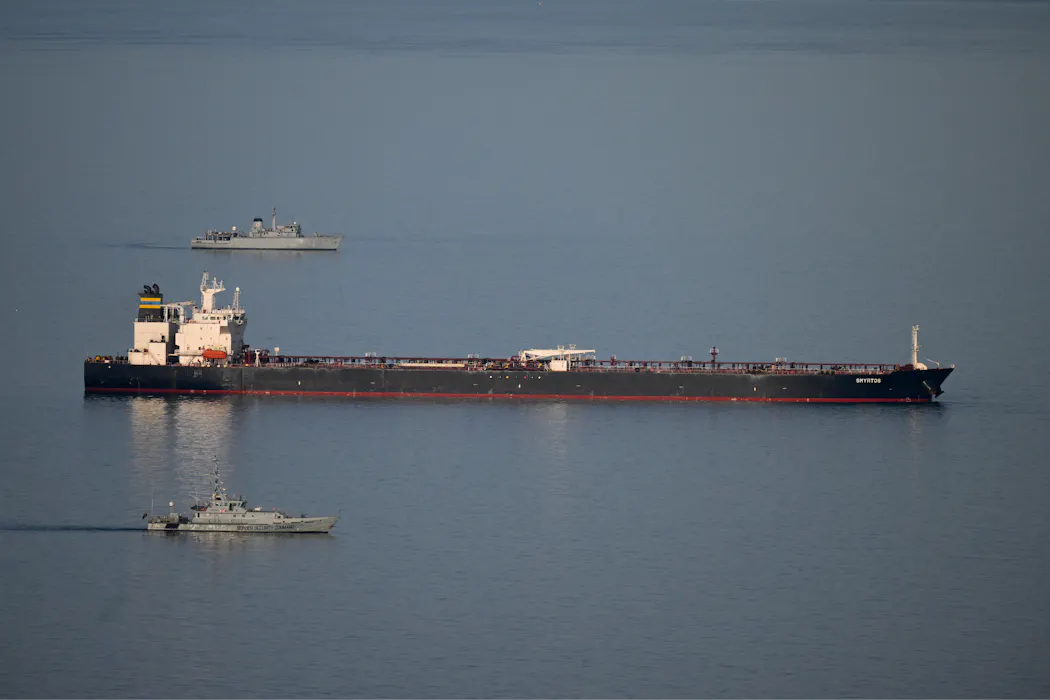
With more than 80% of global trade by volume being transported by sea, maritime shipping lanes are indispensable to the world economy. That fact was starkly illustrated by the war in Iran, which saw Tehran effectively close the Strait of Hormuz to commercial traffic and Washington respond with a blockade of Iranian ports.
Yet such recent events are an aberration from much of the post-Cold War period, during which economic sanctions were enforced far from the sea. Governments relied on financial infrastructure – bank messaging systems, insurance markets, shipping registries and port access rules – to restrict trade without physically stopping ships.
But that system is now under strain. As the United States and its partners have relied more heavily on sanctions as a tool of geopolitical conflict, targeted countries have developed effective evasion networks. In response, the U.S. and its partners are increasingly returning to a more direct form of economic pressure: boarding ships at sea.
Since late 2024, naval forces in Europe and among NATO partners have detained or inspected numerous vessels suspected of carrying sanctioned cargo. These operations have focused on so-called shadow fleet tankers transporting Russian oil. Since the U.S. blockade of Venezuelan oil began in late 2025, interdiction has spread beyond Russian-linked tankers to Iranian and Venezuelan vessels, and now European and Indian authorities have joined in that effort. These ships often operate in legal gray zones, using opaque ownership structures, frequent flag changes and alternative insurance arrangements to avoid sanctions enforcement.
As a longtime observer of international security and geopolitical risk, I believe this trend suggests not a coordinated global policy but a broader shift in practice: Sanctions enforcement is moving from financial systems back into physical space.
Why financial sanctions are losing leverage
Modern sanctions have long relied on control over key nodes in global commerce. U.S. and European sanctions on Iran and Russia show how restrictions on dollar clearing, the SWIFT banking network and maritime insurance can severely disrupt trade without physically intercepting cargo. If banks cannot process payments, ships cannot be insured and ports cannot legally receive cargo, then trade can be effectively halted without direct enforcement.
But that leverage depends on visibility and compliance. Over time, sanctioned states have become more effective at bypassing these channels.
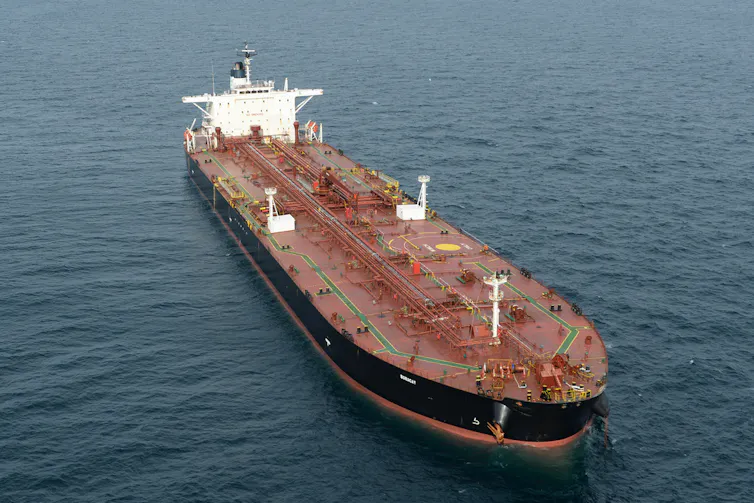
Russia’s shadow fleet is the clearest example. Hundreds of tankers now operate outside Western insurance and registry systems, moving oil through complex ownership chains that obscure responsibility and destination.
Iran provides a parallel case. Under sustained U.S. and European sanctions – targeting dollar clearing, SWIFT and maritime services – Tehran has developed evasive shipping networks using ship-to-ship transfers, flag-hopping and opaque intermediaries to sustain oil exports, largely to Asia and especially China.
At nearly 1,000 tankers, the global shadow fleet amounts to roughly between 17% and 18.5% of global tanker capacity, according to a 2025 S&P Global estimate.
As financial enforcement becomes less reliable, states face a familiar problem: how to enforce sanctions when financial systems no longer provide full visibility or control.
The return of maritime interdiction
Increasingly, many countries feel the answer to declining sanctions leverage is physical interdiction at sea.
While boarding ships is not new, how often it is now used as a tool of sanctions enforcement is. A number of cases since late 2024 have illustrated this broader pattern of European and U.S. interdictions targeting shadow fleet vessels across the Baltic and Mediterranean. They include Finland’s boarding of the Eagle S, Germany’s seizure of the Eventin, and Estonia’s detention of the stateless Kiwala.
Most recently, the EU expanded a naval operation launched in 2020 meant to enforce a United Nations embargo against Libya. By June 2026, the so-named Operation IRINI was conducting shadow fleet inspections and had boarded the Oneiroi, the Nelsa and the Sandhya – all EU-sanctioned tankers operating in international waters.
Other countries are using similar methods for different political purposes. In June 2025, Iran’s Islamic Revolutionary Guard Corps captured the Talara in the Gulf of Oman, citing national security concerns.
The legal language differs, but the operational logic is similar in that it involves using naval power to interrupt commercial shipping for strategic effect.
A legal system built for another era
This global expansion of maritime interdiction is colliding with an international legal framework that was not designed for it.
Under the U.N. Convention on the Law of the Sea, ships on the high seas fall under the jurisdiction of their flag state. This principle was intended to ensure predictability and limit interference with global shipping.
There are narrow exceptions. Warships may board vessels suspected of piracy, slave trading, statelessness or false flagging. Outside these cases, boarding is generally prohibited.
Modern sanctions enforcement is increasingly being fitted into these exceptions. Shadow fleet vessels often exploit legal ambiguity through frequent flag changes or unclear ownership structures. This allows nations to argue that a ship is effectively stateless or fraudulently flagged.
But sanctions evasion itself is not a legal basis for boarding. As a result, enforcement depends heavily on interpretation, especially around what counts as a valid flag or legitimate registration. The result is a growing gap between a legal system built on clear categories and a maritime economy built to blur them.
A fragmented enforcement environment
A striking feature of the current system is its lack of consistency.
Some vessels are detained and released. Others are fined, seized or redirected. Outcomes vary depending on domestic law, political context and enforcement priorities. Even among countries aligned on sanctions, there is no shared answer to what “successful enforcement” looks like.
This is very different from earlier periods of coordinated maritime enforcement. During U.N. sanctions on Iraq in the 1990s and early 2000s, naval operations were carried out under a single Security Council mandate, with standardized procedures and shared rules.
No equivalent framework exists today for shadow fleet enforcement. Nations are acting in parallel rather than through a unified system, producing uneven and sometimes contradictory outcomes.
Although current activity is concentrated in Europe and surrounding the Strait of Hormuz, the implications extend further. Once maritime interdiction becomes a normal tool of economic statecraft, it is unlikely to remain confined to one region or one political context.
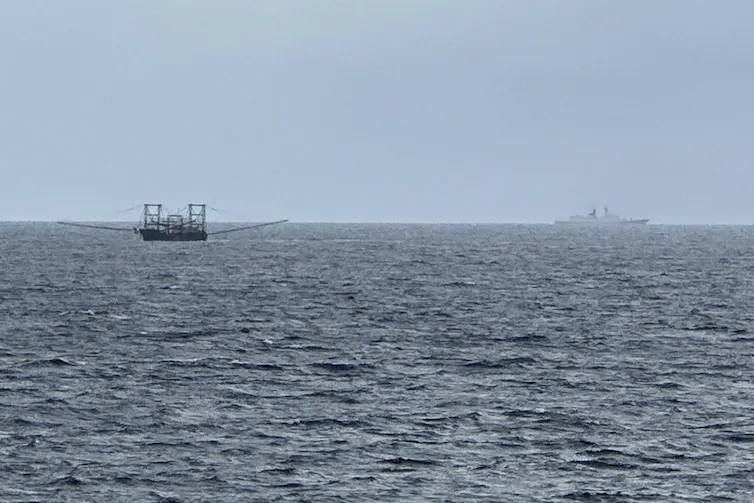
In the South China Sea, China has expanded maritime law enforcement under broad domestic categories, such as fisheries protection and anti-smuggling operations. These rely on a similar logic as other interdictions: using legal classification to justify coercive presence at sea. In the Gulf, Iran has already shown how tanker seizures can be framed as responses to sanctions or national security threats.
Amid the rise in interdictions, there is no universally accepted system for sanctions enforcement at sea. There is no shared tribunal, no inspection authority and no agreed mechanism for resolving disputes over vessel status or cargo legitimacy.
This matters because enforcement is expanding faster than governance. Naval forces are operating in a legal environment that is increasingly unclear, without the institutional structures that once constrained or standardized action.
The lack of institutional clarity
Maritime interdiction does not replace financial sanctions. Banks and insurers remain central to economic pressure, but they are no longer sufficient on their own. As a result, countries are increasingly layering physical enforcement onto financial restrictions, boarding ships not because financial tools have disappeared but because they no longer fully close enforcement gaps.
The risk is that this hybrid system develops without clear rules or consistent standards, increasing the potential for miscalculation and conflict at sea. If boarding practices become routine under broad legal interpretations, other countries are likely to adopt similar methods in different contexts. The key risk lies not in policy convergence but in setting precedents that blur the boundaries between law enforcement, coercion and commerce.
John Calabrese does not work for, consult, own shares in or receive funding from any company or organization that would benefit from this article, and has disclosed no relevant affiliations beyond their academic appointment.
Read These Next

Indian Gen Z ‘cockroach’ protesters aim to upend assumptions about democracy – and populism – in Mod
The protests challenge the government’s view of who “the people” are, what democracy means, and…
Offering cash for votes is quite common – but here’s why it doesn’t work
Money or other material benefits are often not enough to override a voter’s preferences and partisanship.
El Niño is threatening California’s fragile coast again – the 1982-83 El Niño opened eyes to the ser
The destructive 1982-83 El Niño, then the strongest on record, eroded cliffs, leaving homes hanging…