As renaissance fairs become big business, can they retain their counterculture roots?
To what extent has the line between playful community space and commercial spectacle been blurred?

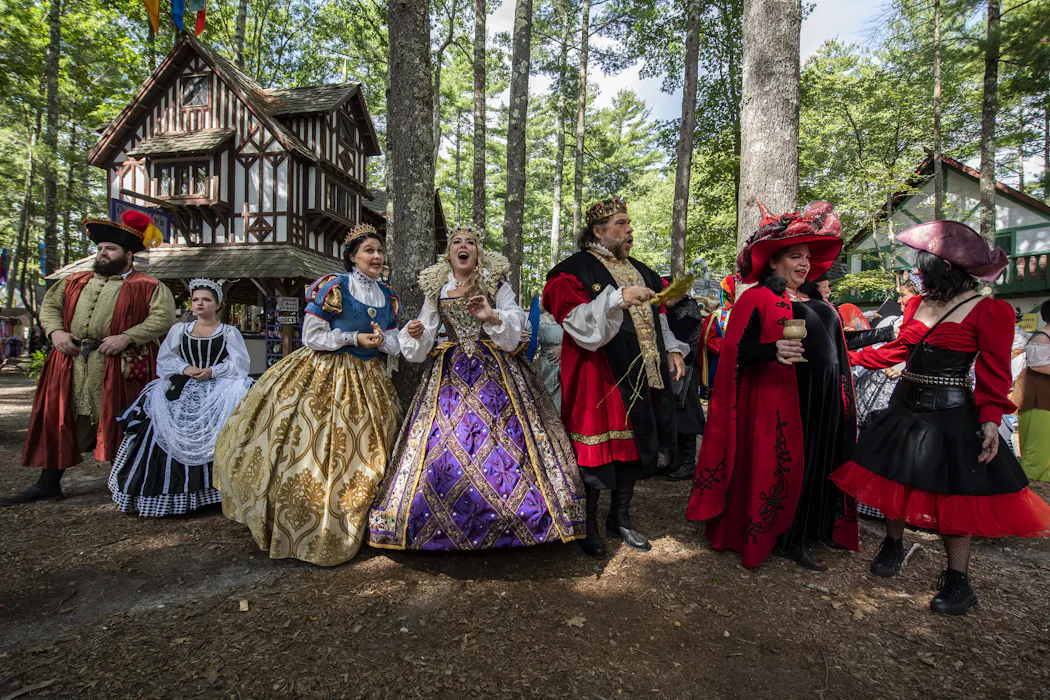
Within moments of entering the Newport Renaissance Faire, you are ushered to a group of fairies. They pass you a scroll and say, “You must seek out the Bone Man for the first hurdle in your quest.” As you navigate the fair, you find many men dressed in bones, both vendors and fellow attendees. When you find the correct Bone Man – an actor wearing what appears to be a mask made of human skull along with a crown constructed from deer antlers – he stamps your scroll. He then sends you to your next target: the Drunk Viking.
Following the directions of actors in the fair, you meet a variety of performers from many historical eras and fantastic realms, and stumble upon both merchants and merrymakers in your journey. It’s all part of the immersive experience that connects you with the other guests and staff, though many of the costumed staff members, speaking in faux Middle English, are also trying to sell you something.
Renaissance fairs were originally conceived as a creative refuge for artists sidelined by political repression during the Red Scare. Now, they sit at an uneasy crossroads between countercultural expression and commercial spectacle. Having grown into a nationwide industry with tiered tickets, branded merchandise and multimillion dollar valuations, the fairs can easily be seen as an offshoot of a corporate theme park.
As cultural geographers, we wanted to learn more about whether the spirit of the fairs has been changing. So for our recent study, we visited the Tennessee Renaissance Festival, Newport Renaissance Faire, Tennessee Medieval Faire and Tennessee Pirate Fest.
Once upon a time … not so long ago
Although renaissance fairs and festivals recreate the atmosphere of centuries past, the first formally recognized fair took place in May 1963 in Irwindale, California. A public school English and history teacher named Phyllis Patterson was the brains behind the event, which she dubbed the Renaissance Pleasure Faire.
For Patterson, the fair was a chance to celebrate the era’s countercultural values like free expression, experimentation with identity and creative play. It also served as a source of employment for those who had been pushed out of their careers in the film and entertainment industries after being blacklisted or graylisted as suspected communists.
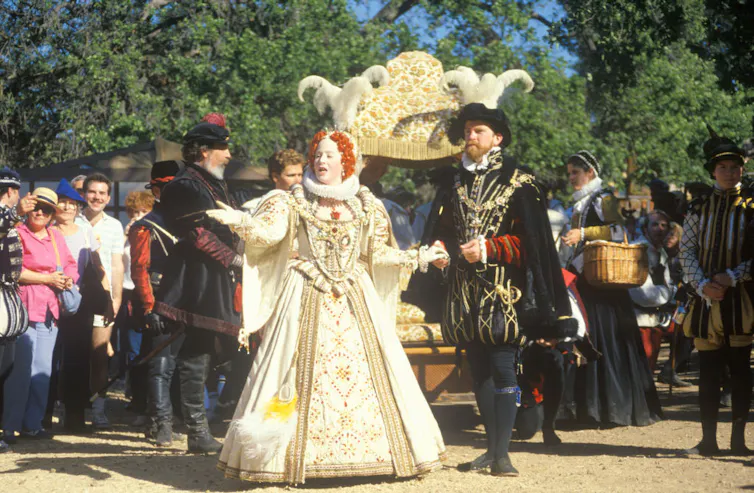
Patterson herself had refused to sign a Cold War–era loyalty oath required to work in California public schools. At the Renaissance Pleasure Faire, actors, educators and set designers could continue their craft, whether that meant designing costumes, creating characters, performing or writing.
From creative refuge to thriving business
Since those first events in Southern California, renaissance fairs have spread across the U.S., with some constructing permanent structures even though they’re only open seasonally, in the spring or fall. Built to resemble small villages, fair operators create towns-within-towns, fantasy lands where visitors can briefly step away from their routines and obligations.
Their popularity continues to grow, and what began partly as a creative refuge has grown into a thriving entertainment business.
The East Tennessee Renaissance Faire recently announced that it would be relocating after deciding that its original venue in Newport could no longer accommodate the swelling crowds: Within three years, the fair had grown from 600 to 6,000 attendees, spurring a move to a larger site in neighboring Sevierville. New fairs are sprouting up as well: The Chattanooga Renaissance Faire will host its inaugural season in spring 2026.
There are almost always entry fees – US$38 at the Tennessee Renaissance Festival and $53 at the Renaissance Pleasure Faire, for example – and many offer season passes.
Attendees often arrive in costume, but strict rules about adhering to a specific time period or setting rarely apply.
Some visitors dress as Tolkien-style elves, while others show up as Tudor nobles. Viking-clad participants walk alongside fairies and swashbuckling pirates. Some fairs have also developed their own themed weekends – with names like “Viking Victory,” “Fantasy and Folklore,” “Pirate Plunder” and “Celtic Celebration” – that weave history and fiction with few constraints. And those committed to their role will often address each other in playful faux-medieval speech, with greetings like “my lady” or “my lord.”
Vendors, often dressed in costume themselves, sell everything from cloaks, swords and crowns to contemporary jewelry and shampoos. Booths sell era-adjacent fare like Scotch eggs, ciders, mead and turkey legs, while modern cocktails like “The Shipwreck” and “The Blueberry Faerie” can also be had, with visitors paying the equivalent of stadium and arena concession prices.
Renaissance fairs have even spread to countries like Germany and France, reconnecting with their roots. The expansion into new venues – along with the development of offshoots such as pirate- and steampunk-themed festivals – point to profit margins that would have been unthinkable in the early days of the Renaissance Pleasure Faire.
But as with many ventures, the prospect of cashing in comes with complications.
The 2024 HBO Max series “Ren Faire” introduced viewers to the eccentrics and costume-clad vendors involved in the nation’s largest fair, the Texas Renaissance Festival in Todd Mission. The fight over its future involved lawsuits and, eventually, the court-ordered $60 million sale of the event’s property and assets.
King Richard’s Faire, which takes place in Carver, Massachusetts, and is the largest fair in New England, reportedly generates massive daily revenue while allegedly relying on widespread worker misclassification, leaving many performers earning below minimum wage without benefits. Even volunteer “villagers” work only for free admission, and both workers and attendees receive no compensation or refunds when the fair closes due to rain.
Seeking out a space of whimsy
Despite the creeping influence of profit motives, we concluded that renaissance fairs have always been – and continue to be – mostly about community.
Dressing as a fantastical version of yourself or your favorite character bonds you to others dressed up at the festival. Unlike popular Civil War or World War II reenactments where historical accuracy is paramount, renaissance fairs instead invite people to take part in shared, often mythologized ideas about history through performance, costume and play.
For example, each weekend, the Tennessee Renaissance Festival organizes jousts. Competitors and their horses meet at a permanent jousting pitch located at the back of the property. Each knight represents a noble house, and each section of the bleachers is assigned a knight to root for. Announcers explain the rules of each event, while also leading the crowds in chants and cheers. While the knights might fight under titles tied to historical lineages, they represent a jumble of eras and place. They also reject antiquated social norms by including women and ethnic groups who never would have been seen together on a jousting pitch.
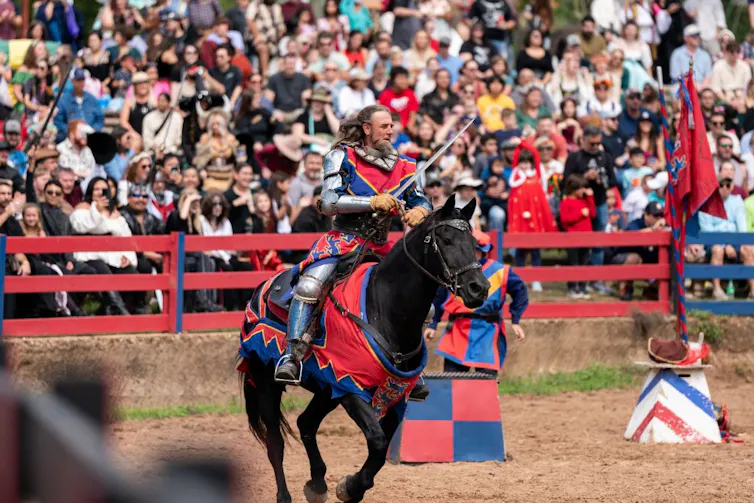
Here, fidelity to the facts is an afterthought; it actually might ruin the fun.
Beyond the jousting pitch, you can find the queen dictating a game of human chess. A rotating cast of performers play music, tell jokes, juggle and blow fire. Elsewhere, you might stumble across pixies teaching children how to make fairy homes or relax in a mermaid’s magical grotto.
There’s also a comforting simplicity in the narratives of this make-believe world. Ladies are almost always gentle and beautiful, while the men are brave and noble. All the villains are easy to spot – they’re always defeated.
In a real world characterized by political upheaval, information overload, invisible surveillance and shadowy villains, perhaps the fair, with its simple prism of good and evil, becomes a space of comfort – a curated cultural experiment that’s also an improvised escape.
In other words, renaissance fairs wield a quiet power: They forge communities that deliberately blur fantasy, history and everyday life with a wink. Vendors, performers and attendees alike can be Tudors, Vikings, hobbits, elves or mermaids for a day. Few actually believe in elves, or imagine their mock-Elizabethan speech is anything more than cheerful, mangled guesswork.
And that’s the point. There’s joy in pretending – just as there’s a universal pleasure in the weird, the whimsical and the absurd.
The authors do not work for, consult, own shares in or receive funding from any company or organization that would benefit from this article, and have disclosed no relevant affiliations beyond their academic appointment.
Read These Next

We studied 1,584 data centers – and found the buildings full of machines are tied to modest local jo
This employment boost took three to five years to show up, two researchers found after studying more…

What legal experts say about the Trump administration’s attempts to make a federal case out of state
A crucial US Senate election in Alaska is the latest target among many Trump administration efforts…

How Lula turned the tables on the right in Brazil and the US with his comeback presidential victory
Lula won through a resonant message and new outreach success on social media. But governing in the face…