One-way attack drones: Low-cost, high-tech weapons ‘democratize’ precision warfare
One-way attack drones have changed the face of the Russia-Ukraine war and give Iran a boost in countering US and Israeli forces.

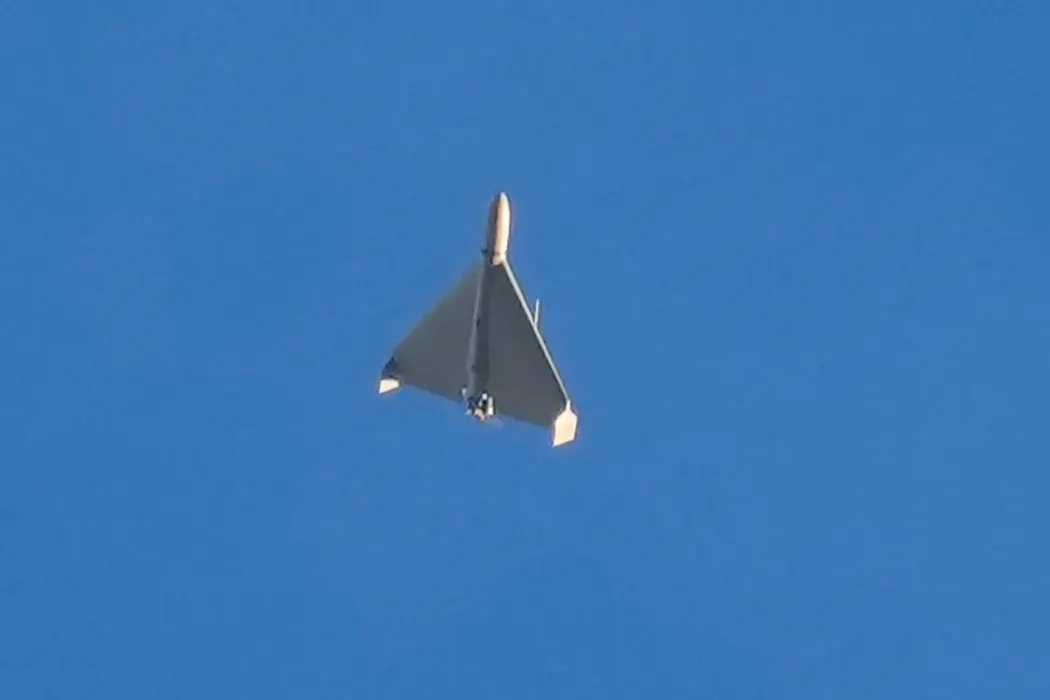
Wars in Ukraine and the Middle East have propelled drones into the headlines. The word “drone” now stretches to cover everything from hobbyist camera rigs available on Amazon to the Predator and Reaper systems the United States has relied on to fight terrorist organizations over the past 20 years.
A common ancestor in the animal kingdom can give rise, under sufficient environmental pressure, to distinct species that demand their own classification. Drones have undergone their own rapid speciation: the one-way attack drone, the medium-altitude, long-endurance and high-altitude, long-endurance drones, the collaborative combat aircraft drone – these share a lineage and a label, but in terms of cost, range and use, increasingly little else.
Nowhere is this variation more consequential than in the category of one-way attack drones: systems designed not to return home like an airplane, but to fly directly into a target and destroy it, like a bullet or a missile. Russia and Ukraine have fired millions of these at each other since 2022, and Iran has launched thousands at United States military bases and embassies, Israel and other countries in the Middle East in 2026.
The world is now in an era we call “precise mass.” In the past, military power was often determined by size – the number of knights, soldiers, guns or tanks, depending on the era, that an army had. Since the Cold War, advanced militaries have emphasized precise munitions, such as cruise missiles, gaining advantage with fewer but more accurately targeted weapons. Inexpensive but technologically sophisticated drones bring mass and precision together.
Commercial manufacturing, precision guidance and advances in artificial intelligence and autonomy have democratized the ability of militaries and militant groups to accurately strike their adversaries. This includes first-person-view, or FPV, drones – a type of one-way attack drone with interfaces like video games – that groups aligned with Iran are already using to target American forces in the Middle East.
One-way attack drones
One-way attack drones have featured most prominently in the war between Russia and Ukraine, and in the Middle East today. The first category of one-way attack drones is longer range and can travel hundreds or even thousands of miles to strike targets deep in an adversary’s territory. They are like extremely cheap cruise missiles – Iran’s Shahed-136 one-way attack drone, for instance, has a reported range of up to 1,250 miles (2,000 km) and costs between US$20,000 and $50,000 each. In comparison, America’s Tomahawk cruise missile costs $2 million each.
Russia acquired the Shahed technology almost immediately after Iran debuted it in 2022, creating its own version, the Geran-2, and has since used these drones to pummel Ukrainian cities and energy infrastructure. Most recently, the U.S. military has followed Russia’s lead and reverse-engineered its own version, the LUCAS, which debuted in the earliest days of Operation Epic Fury, the U.S. military operation against Iran that started on Feb. 28, 2026.
Since late February 2026, Tehran has fired thousands of one-way attack drones at targets across the Middle East. Iran’s one-way attack drones have hit buildings in Bahrain, Kuwait and the United Arab Emirates, and damaged the United States Embassy in Saudi Arabia. The UAE alone was targeted by nearly 700 Iranian drones in the war’s early days. Iran’s one-way attack drones have killed U.S. service members and destroyed critical American radar systems.
Because long-range, one-way attack drones are so slow, they are easier to shoot down than, say, a Tomahawk missile, but attackers can fire so many of them that they can overwhelm air defense systems.
The second category of one-way attack drones operates more like traditional artillery – typically from short distances, up to about 100 miles (160 km). Ukraine’s battlefield has showcased these systems extensively, where they generate 60%-70% of the casualties on the front lines.

FPV drones
One of the most common types of short-range, one-way attack drones is the FPV drone, sometimes built for a few hundred dollars each from commercial parts purchased online. In Ukraine, operators wearing video goggles fly FPV drones directly into Russian vehicles, fortifications and troops, and they feature guidance interfaces for remote operators that are not dissimilar to those of first-person video games.
FPV drones are not magic. Operating them requires a continuous data link between the operator and the drone, making them vulnerable to electronic jamming that can disrupt radio signals. To address this vulnerability, many Ukrainian FPV drones now use physical communication lines in the form of fiber-optic cables to avoid jamming, but the cables can be cut, and that limits the range of these systems. FPV drones with fiber-optic cables have ranges of about 12 miles (20 km). Effectively using FPV drones also requires skilled operators.
America and Israel’s war with Iran hit the pause button on April 7, but if it starts again and the U.S. deploys ground forces, they would likely face the kind of short-range, one-way attack drone barrages that have come to terrorize both Russian and Ukrainian forces alike.
The threat has proved so hard to stop that Ukraine has resorted to low-tech solutions: Hundreds of kilometers of roads are now covered with nets, donated by European fishermen and farmers. The nets stop FPV drones by tangling their propellers. Nets cover tanks and hospital courtyards and line supply routes and city streets. Ukraine’s government plans to install about 2,500 miles (4,000 km) of them on key roads by the end of 2026.

Iranian forces could similarly deploy one-way attack drones against American convoys, personnel or parked aircraft in ways that are difficult to defend against. Additionally, just as American adversaries such as ISIS and al-Qaida used video footage of attacks to try to scare the American public, Iran is likely to use FPV strike footage – the operator’s-eye view of the attack, easily edited and uploaded – to try to shape American attitudes.
In March 2026, an Iran-backed militia used FPV drones to strike a parked U.S. Army medevac Black Hawk helicopter and destroy an air defense radar at the Victory Base Complex near Baghdad. The attackers then released footage from the drone’s perspective as propaganda, blurring out the red crosses identifying the Black Hawk as a medevac aircraft.
The new reality
Short-range, one-way attack drones have redefined the front lines; long-range ones have changed what it means to wage war at strategic distances. Iran’s battlefield record – thousands of drones launched, air defenses nearing exhaustion across multiple targeted countries, American troops killed – demonstrates what a mid-tier military can achieve with precise mass.
Any military that fails to invest in these capabilities – and in the ability to defend against them – places itself at risk, including the U.S. military.
Michael C. Horowitz is a senior fellow with the Council on Foreign Relations. From 2022 to 2024 he was Deputy Assistant Secretary of Defense and Director of the Emerging Capabilities Policy Office at the United States Department of Defense. The views, thoughts, and opinions expressed in an article are solely those of the author and do not represent the official policy, position, or endorsement of any U.S. government department, agency, or branch of service
Lauren Kahn does not work for, consult, own shares in or receive funding from any company or organization that would benefit from this article, and has disclosed no relevant affiliations beyond their academic appointment.
Read These Next

Boo! Feeling scared on Halloween can be fun for children but can sometimes push their limits
A children’s literature author explains how some of her favorite Halloween-themed children’s books…

Ancestors all around – millions of dead people linger in Americans’ memories
The shadow population of deceased relatives is more than three times as large as today’s living population.
UN peacekeepers prepare to exit Lebanon after 70 years – leaving behind a worrying security vacuum
In August, the UN Security Council voted to end the decades-long peacekeeping mission in Lebanon. Blue…