Iran’s president appeals to Americans − but does his office still hold any real power?
Once a strong force after the Iranian Revolution, the office of the president slowly diminished over time as power centralized under the supreme leader.

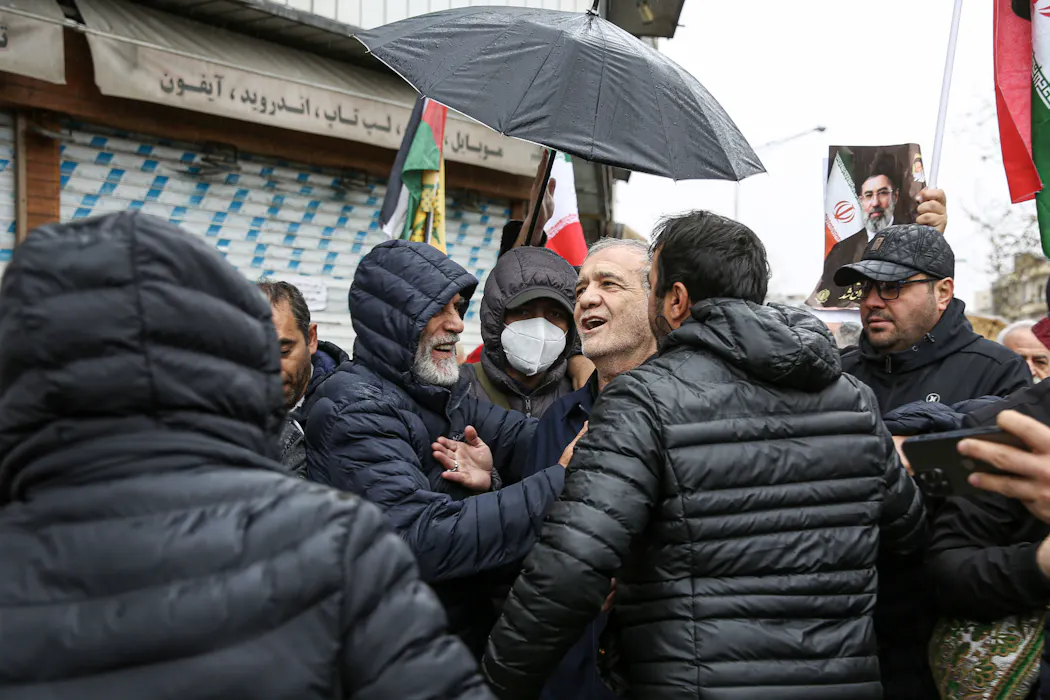
Iranian President Masoud Pezeshkian penned an open letter to “the people of the United States” on April 1, 2026, in which he implored Americans to “look beyond” misinformation that portrayed Iran as a threat to the world.
It was, perhaps, his most prominent intervention during the current conflict. Despite being the president of a country in the midst of crisis, Pezeshkian hasn’t had the highest of war profiles.
Criticized by conservatives at home for his conciliatory tone, the reformist politician has also been sidelined by Iran’s adversaries. Western media initially appeared more interested in the musings of Pezeshkian’s son, Yousef. President Donald Trump has barely mentioned Pezeshkian, other than in an oblique social media post on April 1 in which he claimed “Iran’s new regime president” had asked the U.S. for a ceasefire – something denied by Iran.
International attention has instead largely centered on the role of Iran’s supreme leader. First, it was about who would succeed Ali Khamenei after his killing in the first strikes of the war, and then what was known about his successor and son, Mojtaba Khamenei.
As a researcher of contemporary Iranian politics, I think this focus on the supreme leader over the president inadvertently confirms a trend in Iran that has been happening for years: the cementing of a political structure that increasingly resembles a centralized dictatorship.
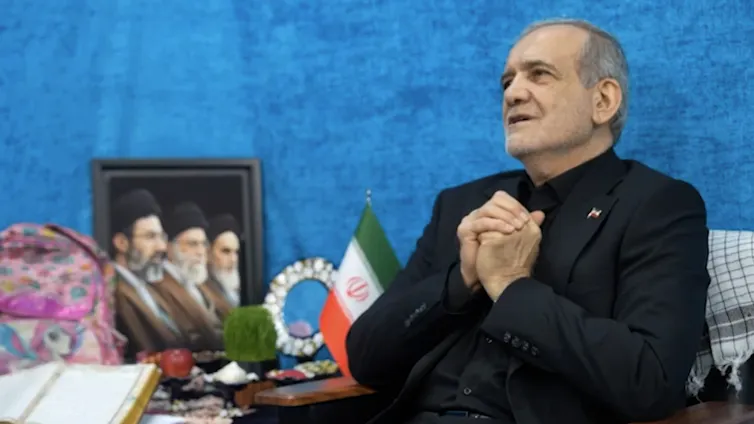
An uneasy balance
The concentration of power around one figure sits uneasily with one of the founding impulses of the 1979 revolution that ushered in the Islamic Republic. A wide spectrum of revolutionary actors – Islamists, leftists and secular nationalists – were involved in the ousting of the shah. But they shared at least one principle: the rejection of monarchy.
The idea that one generation could not determine the political future of the next was precisely what many revolutionaries, despite their internal differences, had fought against.
As such, the system that initially emerged in 1979 was neither a pure theocracy nor a conventional republic. The supreme leader would exercise ultimate religious and political authority, and an elected president was to embody the republican dimension of the state. This second part gave institutional form to the revolutionary promise that people, through elections, would periodically renew political authority.
In the first decade after the revolution, this balance functioned, albeit in a fragile and conflictual manner.
The authority of Ruhollah Khomeini, the Islamic Republic’s first supreme leader, coexisted with the presidency – most notably during the brief presidency of Abolhassan Bani Sadr. Elected in 1980, Bani Sadr quickly came into conflict with clerical factions over the direction of the revolution and the conduct of the Iran-Iraq war.
Accused of political incompetence, Bani Sadr was impeached by parliament in 1981 and subsequently fled into exile.
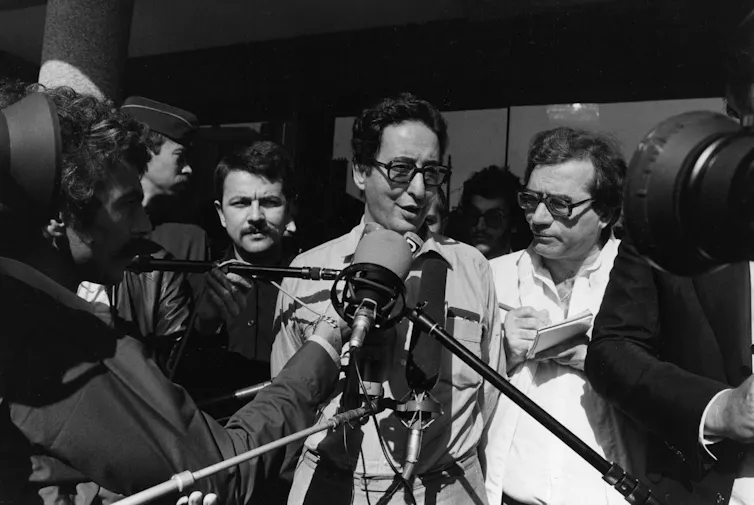
The presidency of his successor, Ali Khamenei, marked a period of relative alignment with the supreme leader. Operating under Khomeini’s authority, Khamenei operated less as an autonomous political force than as an instrument embedded within a broader clerical and revolutionary consensus.
The dynamic between president and supreme leader was further redefined by the 1989 constitutional revision following Khomeini’s death and the elevation of Khamenei from president to supreme leader. The post of prime minister was abolished, consolidating executive authority in the presidency. At the same time, the institutional and political supremacy of the supreme leader was strengthened.
The weakening presidency
The presidency of Mohammad Khatami, who was elected in 1997, demonstrated that the office could still function as a significant locus of power. As Khatami’s tenure showed, presidents were still able to shape public discourse and policy agendas, particularly in areas such as cultural policy, foreign relations and economic management.
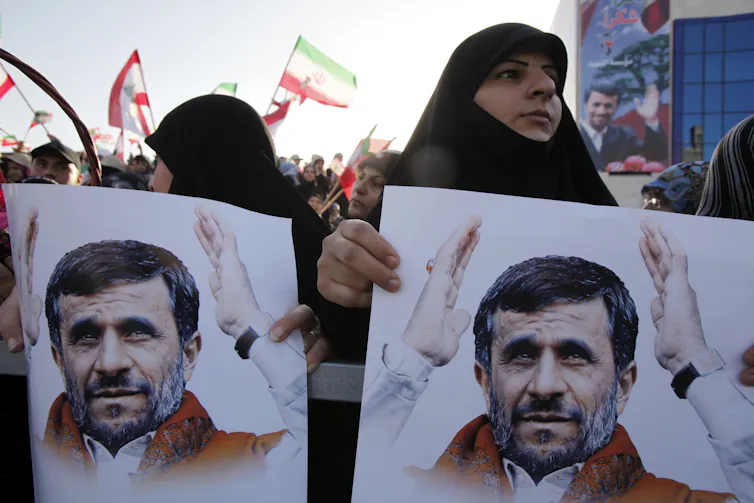
But a major turning point in the power of the office occurred in 2009 with the contested reelection of the hard-liner president, Mahmoud Ahmadinejad, amid widespread allegations of electoral fraud.
It led to mass demonstrations that became known as the “Green Movement.” The state responded with the repression of protesters, followed by a consolidation of the security apparatus – particularly the expanding influence of the Islamic Revolutionary Guard Corps around the supreme leader.
At the same time, it marked the beginning of Ahmadinejad’s falling out of favor. His populist rhetoric and attempts to build an independent political base led to confrontations with clerical authorities in the early 2010s. It also exposed the regime’s intolerance for even a relatively autonomous presidency.
It contributed to a power struggle between Ahmadinejad and Supreme Leader Ali Khamenei that became public in 2011 when the then-president sought to dismiss Intelligence Minister Heydar Moslehi – only to be overruled by Khamanei.
Ahmadinejad was subsequently excluded from the 2017 presidential race by the Guardian Council, a body handpicked by the supreme leader. In so doing, Khamenei made it clear that while the office of the presidency could remain, it would cease to function as an independent center of decision-making and power.
Since then, presidents have continued to be elected, but their capacity to reshape the political order has been diminished sharply.
The presidency of Hassan Rouhani briefly appeared to be an exception. His election in 2013, and the subsequent negotiation of the Joint Comprehensive Plan of Action, generated both domestic expectations and significant international attention.
Yet the durability of the agreement remained contingent on decisions taken beyond the presidency, both internationally and domestically. Its eventual unraveling during the first Trump administration confirmed suspicions among Iranian hard-liners around the supreme leader that reform, an independent power center in the presidency and diplomacy with the U.S. had been a mistake.
With even the limited form of democratic expression as embodied through an elected president suppressed, political disengagement has followed. Although voter turnout remained significant in the years immediately following 2009, a longer-term trend has seen people give up faith in elective politics in Iran. In the last election, held in 2024, just 39.9% of Iranians turned out to vote.
Consolidation of power
This diminishing of the role of the presidency and political legitimacy forms the background to any questions of succession now. But by reducing the political future of the country to the identity of future supreme leaders, observers risk normalizing the transformation of what was historically a contested and hybrid political system into one defined by a single office.
The bloody suppression of the January 2026 protests, the constraints imposed by wartime conditions and the increasing marginalization of elective institutions have all contributed to weakening the presidency.
The fallout of the current war may, of course, see a reorganization of political institutions in Iran. But for now, when Pezeshkian seeks diplomacy with Americans, the pertinent question is: Does his office still matter?
Roxane Razavi receives funding from the EHESS (PhD funding).
Read These Next
Chiricahua is the nation’s newest national park – what does that mean?
What comes next for Chiricahua, now that is has been officially redesignated as America’s 64th national…

An AI model’s false tip to Philadelphia police reveals how digital agents can do as they’re told and
An expert on AI governance explains why these rare mistakes may soon be common, and with much higher…
Offering cash for votes is quite common – but here’s why it doesn’t work
Money or other material benefits are often not enough to override a voter’s preferences and partisanship.