
From youth bulges to graying societies: The demographic dynamics that are upending the world
Population ebbs and flows are having geopolitical consequences.


Government-shaking protests in Bangladesh, Iran, Nepal and Sri Lanka – to name a few – have all in recent years been linked to what demographers call a “youth bulge.” Meanwhile, the economic slowdown in China and ballooning public debt in the United States are in part due to the two powers’ aging populations. In contrast, recent economic growth in Brazil, India and Vietnam reflects a “demographic dividend” of the economically active.
Demographic trends are fueling some of the events reshaping the world. But what exactly are these age-related phenomena, and why are they having such an impact now? I explored these issues in depth in my 2024 book “Demography and the Making of the Modern World.”
Below is a rundown on some of the main demographic dynamics that are changing the world.
Young populations
Having a high proportion of a population age 14 and under is something generally found in poorer countries, and it usually means a huge demographic drag on economic performance.
We see this in Angola, Niger and Somalia, all of which have between 45% and 50% in that age group — compared to around 17% in the United States.
Having such a large proportion of society in their early childhood means fewer workers are supporting a vast number of citizens not in the workforce – and that leads to reduced savings rates and slower economic growth.
Countries still at this early stage of the demographic transition from high to low birth rates often have limited economic opportunities.
The youth bulge
Baby booms, the result of high fertility rates, are inevitably followed by a “youth bulge.” This is defined as a country with a larger than average proportion of people ages 15 to 29.
This bulge is linked to an increase in political instability and the possibility of increased political violence.
Research has found that countries with more than 60% of their population under 30 are four times more likely to experience outbreaks of civil conflict.

So it is of little surprise that countries that have experienced mass political protests of late have a significant youth bulge. In Bangladesh, which saw its government toppled by mass protests in 2024, 53% of the population is under 30. Iran, where major protests in January were brutally repressed, has between 50% and 60% under 30. And in Sri Lanka, the site of major protests in 2022, 48% of the population is under 30.
This isn’t an entirely new phenomenon. The Arab Spring uprisings of 2011-12 owe much of their origin to a youth bulge in the Middle East. At the time, the portion of the population under 30 in Egypt, one of the epicenters of the uprising, was 60%-65%.
When economies cannot create enough jobs for a large youth cohort, unemployment among educated young people can cause widespread frustration and a sense of political marginalization, which can sometimes turn into violent methods to effect change.
Societies with high percentages of young people, both under 15 or in places with a youth bulge, can have other serious global knock-on effects. For example, while there are many reasons behind new immigration flows, an underlying driver of departures – from Africa and the Middle East in particular – is a lack of opportunity at home and the promise of better opportunities abroad for this burgeoning population.
The demographic dividend
As youthful countries age, a phenomenon called a “demographic dividend” can occur. That’s when a higher proportion of people in the more economically active 15-64 age group emerges.
From 1970 to 2000, the rapid economic growth of East Asian economies, Western Europe and the U.S. was tied to this demographic dividend.
Today, countries with demographic dividends such as Vietnam, with 70% of the population ages 15-64, have the opportunity for impressive growth rates.
And while sub-Saharan Africa has many problems now, partly as a result of a large population under 15, it can look forward to the potential of a huge demographic dividend in the future.
The aging population
The window of opportunity created by the demographic dividend does not last forever. As longer life expectancy kicks in, so too does the population age.
China has now aged out of its dividend, and Brazil’s is coming to an end. In China, the population over 65 will reach 28% by 2040 – more than double what it was just 15 years ago.
In super-aged countries, such as Japan and Italy, the 65-and-over population now accounts for 25%-30% of the total population.
And that can be a huge problem.
A graying population can dampen economic growth. In the U.S., people over 65 are the fastest-growing cohort, and they tend to be high-propensity voters who pressure the government to extend retirement benefits, leading to a massive flow of wealth transfer from the shrinking working population to the expanding number of retirees. In 1950, there were 16.5 workers for every beneficiary of Social Security in the United States. By 2023, this figure had fallen to 2.7 workers per beneficiary.

A second demographic dividend can occur if an aging population has enough savings and asset accumulation to pass on to younger generations. But this wealth transfer can increase inequality, as those who receive substantial inheritance will be better positioned than those who do not.
In most graying societies, there are often acrimonious debates about how governments should pay for the benefits for an increasingly elderly population from the wages of a reduced working-age population.
Solutions such as increasing retirement age, reducing benefits or imposing higher taxes come with political costs. President Emmanuel Macron’s government in France, for example, has been periodically threatened by popular protest against cuts in social welfare, especially retirement benefits.
At the latter stages of the transition, aging richer countries now require workers from overseas – but are coming up against a nativist backlash. A combination of slowing economies and new streams of immigrants are creating a volatile politics conducive to the rise of authoritarianism and xenophobia. In this way, the rise of a populist nationalism in the U.S. and across Europe is linked to an increasingly aging population.
The shrinking world
As birth rates fall, the shrinking of a nation’s population is often worrisome for political elites, who tend to see a large population as a source of power.
It explains the official encouragement of higher birth rates in China and Russia through pronatal policies such as tax breaks and fiscal incentives. Even the U.S. administration has mused how to increase birth rates.
But governments have little power when it comes to encouraging women to have more children.
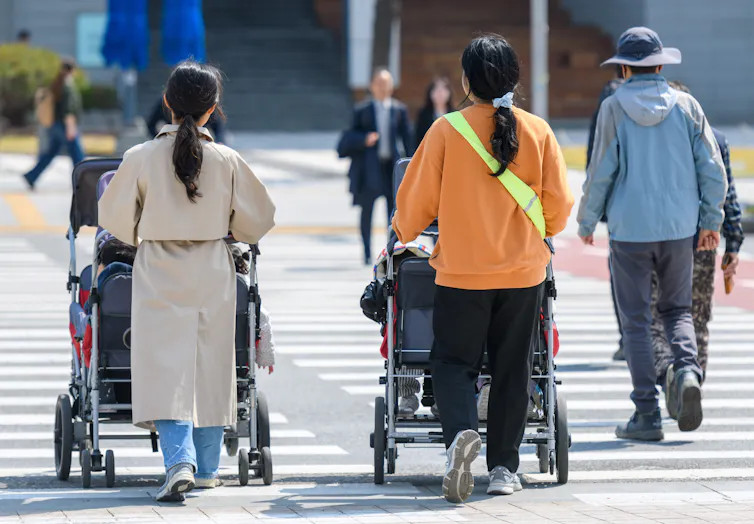
Population size can influence geopolitical rivalries. India is in the fortunate position of a demographic dividend that may last for several more decades. By 2100, the population of India is estimated to be roughly 1.5 billion; China’s is forecast to be 800 million. And that could change the dynamic between the two longtime rivals.
Meanwhile, Russia’s population continues to fall due to very low birth rates. This population crisis feeds into a post-imperial syndrome, where the decline of empire and power status invokes a sense of loss of self-importance that gives rise to resentment and an unwavering commitment to retain great power status.
How governments and societies adapt to population change is key: Demographic dividends can be squandered and aging populations can enrich societies, if played right. Demography is undoubtedly a vital force in contemporary events – but it is also not a predetermined destiny.
John Rennie Short does not work for, consult, own shares in or receive funding from any company or organization that would benefit from this article, and has disclosed no relevant affiliations beyond their academic appointment.
Read These Next

Are transgender sports bans really about protecting women? Survey data tells a different story
In a recent national survey, Americans with the most negative views of women were the biggest proponents…

Many vapes and e-cigarettes are now banned in Pennsylvania – here’s what Philly consumers and busine
Vape products from only six manufacturers can now be sold in Pennsylvania.

How candidates are (quietly) talking about climate change – 3 election strategies you’ll see across
Voters have a lot of weighty issues on their minds, but that doesn’t mean they aren’t worried about…