Israeli action in Lebanon risks repeating history’s mistakes — and torpedoing a historic moment for
The resumption of war between Hezbollah and Israel has raised the prospect of an occupation of southern Lebanon.

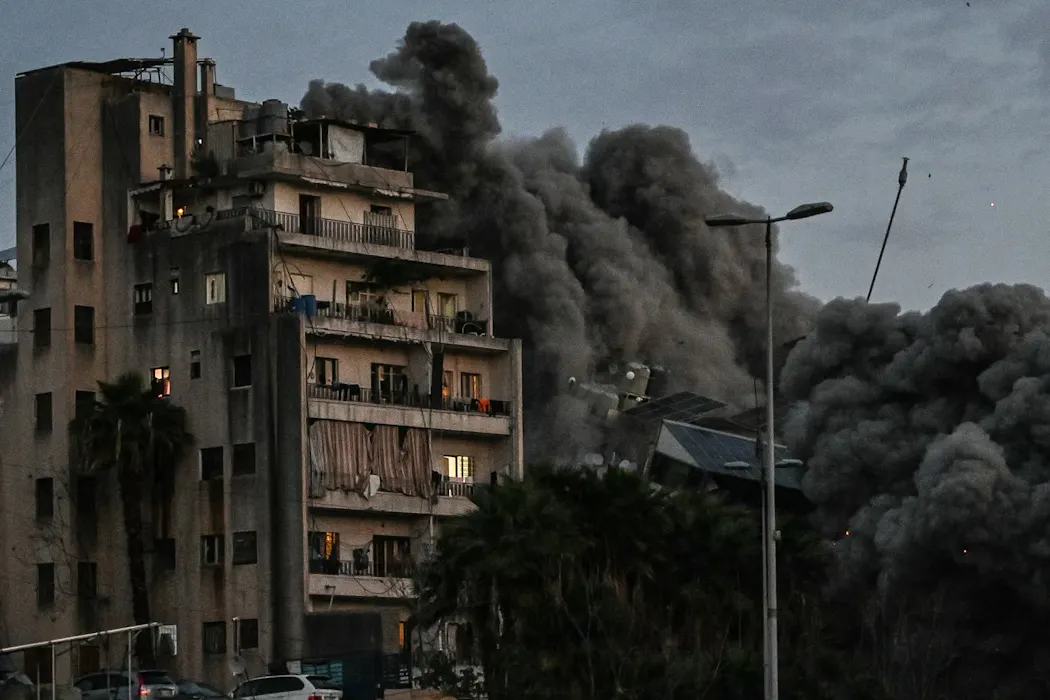
The current fighting between Israel and Hezbollah began as a side front in the U.S.-Israeli war with Iran. But it is fast becoming more central to Israel’s overall combat efforts and strategic objectives.
Since March 2, 2026 — when Hezbollah fired missiles into Israel in solidarity with Iran — Israel has bombarded Hezbollah’s strongholds across the country, called for the evacuation of the civilian population from south Lebanon in preparation for a ground invasion, and bombed bridges across the Litani River to prevent Hezbollah from transferring forces to the south. It has also struck in locations, particularly in central Beirut, that have long been thought safe from Israeli attacks on Hezbollah. All told, over a million Lebanese have been displaced and hundreds killed – including many civilians.
Public discussions in Israel now center around the possibility of a temporary occupation of south Lebanon and a military operation that would supposedly deal a final blow to Hezbollah.
As a historian of Lebanon and Israel relations, I have studied decades of successive military engagements by Israel that have attempted, and failed, to put an end to Lebanese-based armed groups that fight Israel. I see no reason why that past will not repeat itself should Israel reoccupy south Lebanon. Moreover, such an action risks preventing favorable conditions for a historic dialogue between the governments of the two countries, which are both united by a desire to disarm Hezbollah and strengthen Lebanon’s state capacities.
War, in four parts
Since the late 1960s, when Palestinian guerrillas began using Lebanon as a base to launch their armed struggle to liberate Palestine, Israel has accused the Lebanese government and its armed forces of not doing enough to prevent nonstate actors from using the country as a base to attack Israel.
In March 1978, three years into the Lebanese Civil War, Israel occupied south Lebanon for the first time in an effort to push back Palestinian militants from its northern border.
The failure of that operation became apparent when in June 1982, Israel invaded Lebanon again, this time all the way to Beirut. Israel’s overt objectives included not only the removal of Palestinian organizations from Lebanon but also the installment of an Israeli-friendly government that would conclude a peace deal.
That war gave birth to Hezbollah and led to 18 years of Israeli occupation of south Lebanon. During that period, Hezbollah engaged in insurgency warfare, fueled by religious zeal and supported by Iran. Through such actions, it forced Israel to finally withdraw from the country in May 2000.

In July 2006, “the Second Lebanon War,” according to Israel’s count, was launched as a result of Hezbollah’s cross-border operations and the killing of five Israeli soldiers, two of whom were abducted to Lebanon.
But that 34-day war only further enhanced Hezbollah’s position in Lebanon as a powerful armed militia, operating outside of government reach while at the same time — particularly since 2008 – actually being part of the government and having effective control over it.
United Nations Resolution 1701, which brought an end to the war, exposed the complex power reality inside Lebanon. Despite calling for the disarmament of Hezbollah, the Lebanese state was unable to carry out the provision.
Emboldened by the 2006 war and by its growing power inside Lebanon, Hezbollah’s military might and self-confidence only increased. It became the most important Iranian proxy in the so-called “axis of resistance,” posing a serious strategic challenge to Israel in the process.
Bowed but not entirely broken
Since then, the power of Hezbollah — both politically in Lebanon and as an offensive force — has been greatly diminished as a result of Israeli military actions since the Oct. 7, 2023, attacks by Hamas.
Hezbollah joined the war in solidarity with the Palestinian group out of conviction that Israel would be constrained in its response by concerns of Hezbollah’s offensive capabilities.
That proved to be a mistaken calculation. Israel significantly weakened the organization in military strikes and assassinations throughout late 2024.
The official ceasefire that concluded that war was similar to the provisions of U.N. Resolution 1701, including the call for Hezbollah’s disarmament.
This time, however, a new Lebanese government, formed in February 2025 after years of political paralysis and supported by the United States and France, capitalized on Hezbollah’s weakness and committed to regaining sovereign powers in the country.
Yet Hezbollah refused to succumb to the growing domestic pressure calling it to give up its arms. For its part, Israel continued to strike Hezbollah targets almost on a daily basis and occupy five strategic spots inside Lebanon, all similarly in violation of the ceasefire. In any other pre-ceasefire scenario, these actions would have likely triggered a war with Hezbollah.
Even before Israel’s killing of Iran’s supreme leader, Ayatollah Ali Khamenei, nudged Hezbollah into action, the ceasefire appeared to be on the brink of collapse.
At the same time – and unprecedentedly in Lebanon since the 1980s — open public debate has persisted concerning the possibility of reaching a normalization agreement with Israel.
This public debate has not been killed off by the resumption of war between Israel and Hezbollah. Rather, it is now compounded by formal requests by the Lebanese government to end the war through a negotiated agreement that could also lead to normalization with Israel. France has proposed leading Israeli-Lebanese negotiations to that end.

Negotiation tool or genuine threat?
It is possible that Israel’s threats of occupation are just a negotiation and pressure tool ahead of talks over any future Israeli-Lebanese deal.
But given the growing expansionist talk in Israel — both within and outside of government — there is a possibility the reoccupation threat is genuine.
This is also reinforced by the post-Oct. 7, 2023, political climate in Israel that favors brute force over diplomacy. Moreover, for more than two years, Prime Minister Benjamin Netanyahu’s personal and political interests have been to retain the state of emergency in Israel. The front in Lebanon provides another opportunity for him to do so, if and when the war with Iran ends.
Journalists and other political figures have pointed to the history of Israeli incursions into south Lebanon in suggesting that any occupation of Lebanese territory now might again lead the country to strategic failure.
But such arguments seemingly matter little to certain elements of the Israeli government. There has always been a marginal group among the Jewish settler movement that called for the permanent occupation of south Lebanon and its annexation to Israel, as part of their biblical interpretation of the borders of the promised land.
These voices are heard again now, certainly from the settler movement, but also from a few government officials, including from within Netanyahu’s Likud party itself.
Cycle of violence
Much of what will transpire between Lebanon and Israel depends on how the war on Iran ends. As the government in Iran and Hezbollah continue to fight what they see as an existential war for survival, they will likely do whatever it takes to stay in power.
In the case of Lebanon, this is an unprecedented moment where the majority of Lebanese want Hezbollah to give up its arms and the Lebanese government is willing to negotiate directly with Israel.
It might be a historic moment which, if not grabbed, could instead lead to a return of familiar patterns of continued and inconclusive cycles of violence. If so, that would only bring Lebanon closer to the brink and would benefit, again, those participants who place the concerns of Lebanon and the Lebanese state last.
Asher Kaufman does not work for, consult, own shares in or receive funding from any company or organization that would benefit from this article, and has disclosed no relevant affiliations beyond their academic appointment.
Read These Next

IceCube is built on decades of research into tiny ‘ghost particles’ – but it was the first to find n
IceCube looks for high energy neutrinos from space. It joins the ranks of complementary experiments…

These state supreme court races could decide abortion access and trans rights
Ohio, North Carolina and Michigan have open seats on their state supreme court, and these hotly contested…

AI can help with academic research but doesn’t always get it right – here are some tips to check the
AI is quickly changing. These tips from university librarians can help people keep pace with the shifts…