China’s muted response over war in Iran reflects Beijing’s delicate calculus as a concerned onlooker
Beijing has denounced US-Israeli action in Iran, but has not rushed to come to the aid of its regional ally.

China has perfected the role of concerned onlooker as the Middle East conflict spreads across the region.
With no direct role in the conflict and some 4,200 miles (6,800 kilometers) away from the action, Beijing has a little more breathing room to work out the calculus on how the U.S.-Israeli attack on Iran affects its interests. Yet the recent events nonetheless place China in a strategically uncomfortable position. The U.S. campaign is the most significant operation conducted by China’s main strategic, economic and military rival since the Iraq war, and it is unfolding across a region central to China’s energy security and commercial ambitions.
Yet Beijing’s response has been muted at best. As a longtime observer of China’s changing relationship with the Middle East, I see China’s calculated response as reflecting its limited leverage to control events as well as the transactional nature of its relationship with Iran.
A matter of principle?
The joint Israeli-U.S. operation runs counter to China’s long-held position on foreign intervention.
China formally opposes regime change and externally engineered political transitions as a matter of doctrine, viewing such actions as contrary to principles it treats as protective of both national sovereignty in general and its own domestic and territorial sensitivities in particular.
This doctrinal stance shaped Beijing’s early response. On Feb. 28, 2026, it joined Moscow in requesting an emergency United Nations Security Council session, expressed being “highly concerned” over the missile strikes, and urged respect for Iran’s territorial integrity and a cessation of hostilities.
Beijing paired diplomatic protest with precautionary measures, urging nationals in Iran to evacuate and warning citizens in Israel to strengthen their emergency preparedness.
This combination of public condemnation of the U.S.-Israeli strikes and rapid risk mitigation suggests China was more concerned with preparing for escalation rather than seeking to halt it.
A lukewarm friendship?
But should China lend more support to Iran, a country seen as an ally to Beijing and with which it has had growing ties?
Unlike in 2025’s brief Pakistan-India conflict, China has less of an obligation to stand alongside an ally. Pakistan has long been strongly allied with China, especially in regard to regional issues with India.
While Pakistan countered India in that May conflict with fighter jets and missiles supplied by China, Iran has less Chinese-made military hardware at its disposal.
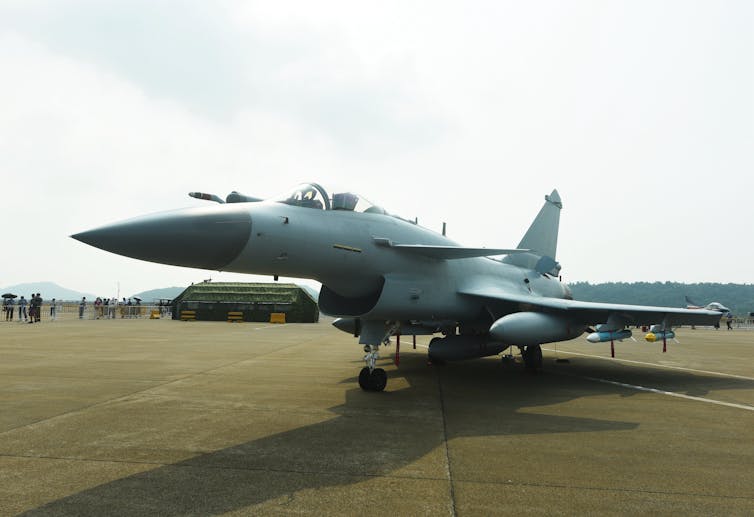
China has provided Tehran with selective military and dual-use support over time – including air defense systems, drone technology and surveillance assistance – but it has avoided formal security guarantees.
And unlike with the Pakistan-India conflict – which gave the West a rare glimpse of what China’s latest military hardware can do in live situations – China can now observe what its key rival can do.
With U.S. forces concentrated around Iran, Chinese satellites and other intelligence platforms have been actively observing U.S. and allied deployments near the Gulf of Oman.
Such intelligence is arguably more useful for China’s longer-term Indo-Pacific planning than for influencing the current conflict’s battlefield dynamics.
The pattern is consistent: support an ally within various limits, but avoid entanglement at all costs.
China doesn’t really see much obligation to help Iran now. What it does care about is projecting an image as an alternative global leader to the U.S. Iran as a focus of resistance to the West may theoretically fit within Beijing’s vision, but its destabilizing behavior is incompatible with it.
Despite rhetoric about “comprehensive partnership,” China has never made a decisive strategic bet on Tehran. Bilateral trade remains modest relative to China’s global portfolio. Oil imports from Iran are useful to Beijing, but replaceable. And Belt and Road Initiative investment flows more heavily toward Gulf nations such as Saudi Arabia and the United Arab Emirates — economies now exposed to Iranian retaliation.
A network under strain
The asymmetry is evident: Iran has long needed China far more than China has needed Iran.
In isolation, then, a weakened Iran – or even one with a leadership more aligned with the West – is not a major concern to China.
Yet it becomes consequential for China once you factor in the broader strategic environment surrounding many of China’s allies.
Russia remains mired in a grinding war of attrition in Ukraine. Pakistan and Afghanistan face escalating instability.
In the Western Hemisphere, the Trump administration has intensified its interventionist posture. On Jan. 3, 2026, U.S. forces launched Operation Absolute Resolve, a raid in Caracas that captured Venezuelan President Nicolás Maduro and his wife, removing him from power and transporting them to New York to face federal charges. Within weeks, Washington declared a national emergency with respect to Cuba, authorizing additional tariffs on imports from countries that supply oil to the island, as part of broader pressure linked to Havana’s alignment with governments Washington deems hostile.
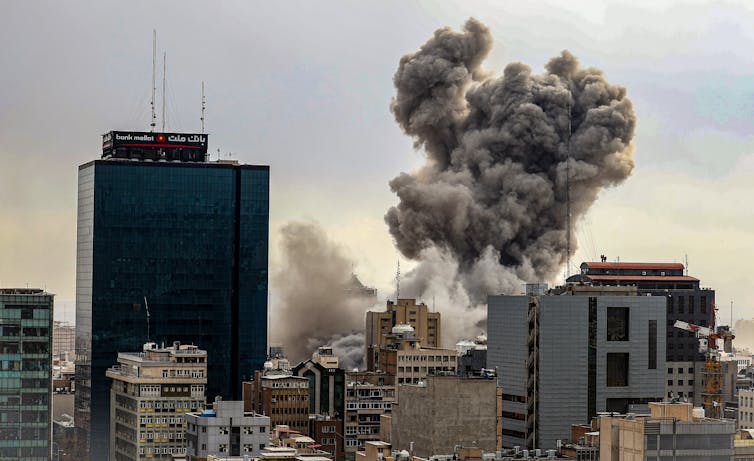
Now Iran — another partner often framed as part of China’s counterbalancing axis — is absorbing sustained U.S.–Israeli strikes that have shuttered the Strait of Hormuz and triggered retaliatory attacks across Gulf nations central to China’s trade, energy flows and expatriate presence.
What emerges is not a consolidated bloc with China at the center, but a network under strain.
Neither patron nor bystander
For Beijing, the combination of Iranian escalation and expansive U.S. objectives underscores hard limits. China lacks meaningful force projection in the region, offers no defense commitments and has consistently avoided the burdens of a security guarantor.
Nonintervention is, for China, not merely tactical caution; it has become a defining feature of Beijing’s diplomatic identity.
If the Iranian regime survives in weakened form, Beijing will likely calibrate limited, deniable support while avoiding overcommitment. If the regime falls, China would probably pursue pragmatic engagement with whatever authority emerges, safeguarding its economic interests in transactional fashion.
It is against this backdrop that the anticipated U.S.–China meeting in late March takes on greater significance. The Trump administration has indicated that talks would focus on trade, but whether the meeting proceeds — and under what atmosphere — is far from certain.
Only weeks ago, Donald Trump appeared politically weakened by a Supreme Court decision striking down many of his tariffs. Now, the optics are more complicated. Chinese President Xi Jinping would enter any discussion with the elephant of a large-scale U.S. military campaign in the room and at a moment when several of China’s strategic partners are struggling across multiple theaters.
As such, Beijing’s public denunciations of U.S. actions as “unacceptable” and calls for restraint highlight its discomfort with the concept of regime change. But the measured response ultimately underscores both its limited leverage over American military action and the increasingly transactional — and fragile — nature of its diplomatic partnerships.
China is neither Iran’s patron nor a passive bystander; it is a cautious opportunist operating within clear constraints, preserving flexibility while avoiding entanglement in a conflict it cannot control.
A version of this article was published on March 5, 2026, by the Middle East Institute.
John Calabrese does not work for, consult, own shares in or receive funding from any company or organization that would benefit from this article, and has disclosed no relevant affiliations beyond their academic appointment.
Read These Next

Why your boss matters more than remote or hybrid work when it comes to burnout and job satisfaction
A return to the office can mean very different things to different workers, which is why this debate…

AI can help with academic research but doesn’t always get it right – here are some tips to check the
AI is quickly changing. These tips from university librarians can help people keep pace with the shifts…
Missing ambassadors, inexperienced appointees – is Washington dropping the diplomatic ball?
Almost half of US ambassador jobs remain vacant. Meanwhile, political appointees are outnumbering career…