
Iran-US nuclear talks may fail due to both nations’ red lines – but that doesn’t make them futile
The US administration may sense that Iran is weak and ready to do a deal. But negotiations could be undone by intransigent red lines.

The latest rounds of nuclear talks between the U.S. and Iran are going well enough for now, according to the steady drip of public statements from the main parties involved.
“I think they want to make a deal,” said U.S. President Donald Trump on the eve of the latest round of discussions held in Geneva on Feb. 17, 2026. Iran’s foreign minister, Abbas Araghchi, noted progress over the “guiding principles” of the talks.
Such optimism was similarly on display during initial talks in Oman earlier in the month.
But as someone who has researched nonproliferation and U.S. national security for two decades and was involved in State Department nuclear diplomacy, I know we have been here before.
Optimism also existed in spring 2025, during five rounds of indirect talks that preceded the United States bombing of Iran’s nuclear infrastructure as part of a broader Israeli attack. Pointedly, Iran noted in February that a climate of mistrust created by that attack hangs over the efforts for a negotiated deal now.
And underpinning any pessimism over a deal now is the fact that talks are taking place with a backdrop of U.S. military buildup in the Persian Gulf region and counteraction from Iran, including the closure of the Strait of Hormuz for a live-fire drill.
Red lines
But it is more than mistrust that will need to be overcome. The positions of both the U.S. government and Iran have ossified since May 8, 2018 – the date when the first Trump administration withdrew the United States from the Obama-era Iran nuclear deal.
Iran continues to be unwilling to even discuss its ballistic missile program. This is a red line for them.
Yet the United States continues to demand limits to Iran’s ballistic missiles and the ending of Iran’s support of proxy fighters in the region be included in the nuclear talks, in addition to having Iran fully abandon enriching uranium – including at the low civilian-use level agreed on under the 2015 nuclear deal.
The talks are taking place amid a wider trend toward the end of what can be called the “arms control era.” The expiration of New START – which until Feb. 5, 2026, limited both the size and status of U.S. and Russian nuclear weapons and maintained robust verification mechanisms – together with the increasing willingness to engage in military actions to achieve political goals heightens the challenges for diplomacy.
Military brinkmanship
So why the apparent public optimism from the U.S. government?
Trump believes that Iran is in a weaker position than during his first term, following the largely successful Israeli attacks on Iran’s regional proxies as well as on Iran itself. The strategic capabilities of Tehran’s two main sponsored groups, Hamas and Hezbollah, are clearly diminished as a result of Israeli action.
The U.S. may also still feel it has the upper hand following the June 2025 Operation Rising Lion, in which Iran’s nuclear infrastructure was attacked in response to an International Atomic Energy Agency’s report that Iran’s stockpile of near-weapons grade enriched uranium surged by over 50% in the spring.
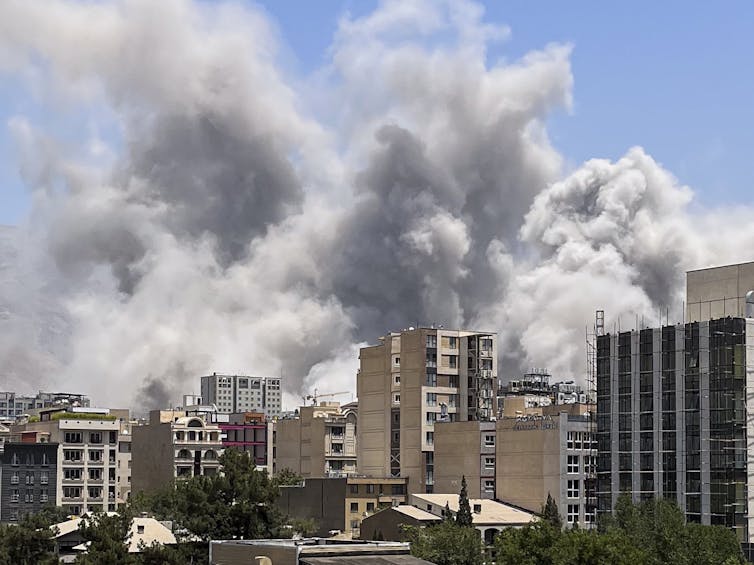
The reopening of talks now also comes in the immediate aftermath of Iran’s bloody crackdown on anti-government protests, leaving thousands of protesters dead.
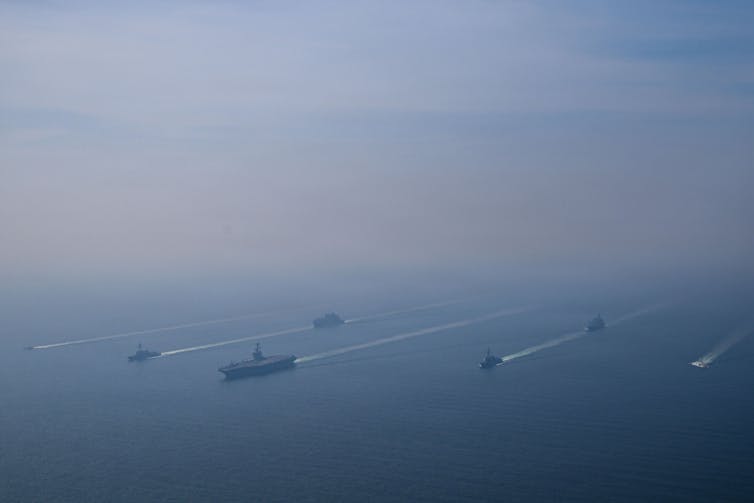
The USS Abraham Lincoln carrier group was deployed near Iranian waters in January as a signal to the protesters of U.S support. U.S. Secretary of State Marco Rubio has said that successful talks must include topics beyond Iran’s nuclear program, including the “treatment of (its) own people.”
Trump continues to consider military options against Iran, warning that “if they don’t make a deal, the consequences are very steep.”
Yet there is a danger that Washington may be overestimating its position.
While the United States maintains that Iranian nuclear sites were “obliterated” in the June attack, satellite imagery indicates that Iran is working to restore its nuclear program. And while Tehran’s proxies in Gaza and Lebanon are severely degraded, Iranian-supported militias in Iraq, including the Kataib Hezbollah, have renewed urgent preparations for war – potentially against the U.S. – and the Houthi rebels have threatened to withdraw from a ceasefire deal with the United States.
Moreover, Iran’s commitment to its ballistic missile program is stronger than ever before, with much of the infrastructure already rebuilt from Operation Rising Lion.
No returning to the 2015 deal
Iran maintains that the talks must be confined only to guarantees about the civilian purpose of its nuclear program, not its missile program, its support of regional proxy groups or its own human rights abuses.
And that is incompatible with the U.S.’s long-held position.
This disagreement ultimately prevented the U.S. and Iran from renewing the now-defunct 2015 political deal during the Biden administration. Signed by China, France, Germany, Russia, the U.K., the United States and Iran, the Joint Comprehensive Plan of Action (JCPOA) halted Iran’s development of nuclear technology and stockpiling of nuclear material in exchange for lifting multiple international economic sanctions placed on Iran. Ballistic missile technology and Iran’s proxy support for regional militias were not included in the original agreement due to Iran’s unwillingness to include those measures.
The parties to the Iran deal ultimately decided that a nuclear deal was better than the alternative of no deal at all.
There was a window for such a deal to be resumed in between the two Trump administrations. And the Biden administration publicly pledged to strengthen and renew the Obama-era nuclear deal in 2021.
But by then, Iran had significantly increased its nuclear technical capability during the four years that has passed since the JCPOA collapsed.
That increased the difficulty: Just to return to the previous deal would have required Iran to give up the new technical capability it had achieved for no new benefits.
The window closed in 2022 after Iran removed all of the International Atomic Energy Agency’s surveillance and monitoring under the deal and started enriching uranium to near weapons levels and stockpiling sufficient amounts for several nuclear weapons.
The IAEA, the U.N’s nuclear watchdog, currently maintains only normal safeguards Iran had agreed to before the JCPOA.
Even with the 2025 U.S. strikes, Iran currently has the ability to produce enough fissile material for a nuclear bomb within weeks to several months. This is up from over a year under the 2015 deal.
US and Iran talks today
Although most analysts doubt that Iran has developed the weaponization knowledge necessary to build a nuclear bomb – estimates vary from several months to about two years due to the lack of access to and evidence on Iran’s weaponization research – Iran’s technical advances reduce the value for the U.S. government of returning to the 2015 deal. Iran’s knowledge cannot be put back into Pandora’s box.
But talks do not necessarily need an end point – in the shape of a deal – for them to have purpose.
With the increased military brinkmanship, talks could help the U.S. and Iran step back from the edge, build trust and perhaps develop better political relations. Both sides would benefit from this stabilization: Iran economically, from being reintegrated into the international system, and the U.S. from a verifiable lengthening of the time it would take Iran to break out.
None of this is guaranteed.
When I worked in multilateral nuclear diplomacy for the U.S. State Department, we saw talks fail in 2009 regarding North Korea’s nuclear weapons program, after six years of on-and-off progress. The consequence of that failure is a more unstable East Asia and renewed interest by South Korea in developing nuclear weapons.
Unfortunately, the same dynamic appears here. The shape of a potential new deal is unclear. As time passes with no deal, both sides harden their negotiating starting points, making a deal less likely.
Military escalations may lead to a new willingness to compromise on the part of Iran or precipitate its decision to build nuclear weapons.
But even should the talks prove a failure, the effort to dampen the confrontational responses and heightening tensions would still be valuable in reducing the possibility of regional conflict.
Nina Srinivasan Rathbun does not work for, consult, own shares in or receive funding from any company or organization that would benefit from this article, and has disclosed no relevant affiliations beyond their academic appointment.
Read These Next
IceCube is built on decades of research into tiny ‘ghost particles’ – but it was the first to find n
IceCube looks for high energy neutrinos from space. It joins the ranks of complementary experiments…

Why your boss matters more than remote or hybrid work when it comes to burnout and job satisfaction
A return to the office can mean very different things to different workers, which is why this debate…

AI can help with academic research but doesn’t always get it right – here are some tips to check the
AI is quickly changing. These tips from university librarians can help people keep pace with the shifts…