What triumphalist narratives about Brazil’s high court and Bolsonaro imprisonment leave out
However, there is a more profound lesson we can learn from Brazil: Democracy depends on more than institutions.

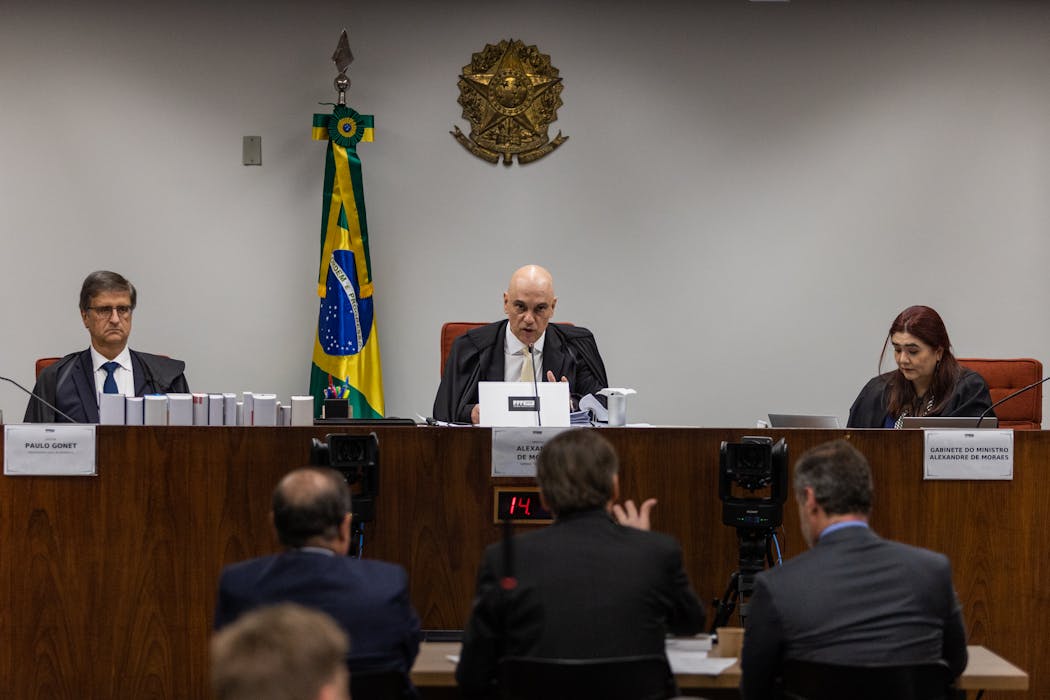
On Jan. 15, 2026, Brazilian Supreme Court Justice Alexandre de Moraes ordered that incarcerated ex-President Jair Bolsonaro be given a significant upgrade in his prison accomodations.
Perhaps not a headline-grabbing development abroad, the news was nonetheless the latest high-profile interaction between Moraes and Bolsonaro – two titans of modern Brazilian politics whose sparring has, in many ways, served as a proxy for the broader political trends that have convulsed the polarized nation.
Six months ago, the high court – with Moraes as its most powerful member – handed down a lengthy prison term to Bolsonaro for plotting a coup to stay in power after his 2022 election loss.
In convicting the far-right leader, the Supreme Federal Court of Brazil refused to bow to blowback from both Bolsonaro’s powerful domestic base and an external pressure campaign by the Trump administration. Indeed, many commentators and media outlets held up the court as being the singular force that successfully curbed Bolsonarism – and, in the process, saved democracy from that movement’s authoritarian project.
Yet as a professor of public law and expert on Brazil’s judiciary, I believe that narrative misses a deeper reality. While the Supreme Court played a decisive role in preventing Bolsonaro’s authoritarian ambitions in the form of a coup, its larger purpose was not necessarily to protect democracy. Rather, there is evidence suggesting that its purpose was to defend itself, its institutional power and its legitimacy in the eyes of the public.
In a small way, the court’s latest decision to upgrade Bolsonaro’s prison accommodation is itself emblematic of that approach. The move to a larger cell – with a living room, kitchen and bedroom – comes after repeated complaints from Bolsonaro over the conditions of his detainment. What his lawyers really want is for the sentence term to be reduced, or for their client to be moved into house arrest. In that light, Moraes’ order is an attempt to neuter such demands while reasserting the authority of the court.
The rise of Bolsonaro
Brazil knows the risks of authoritarianism well. After 20 years of military dictatorship, the country promulgated a new constitution in 1988. The document aimed at creating a fair, democratic and inclusive society. It guaranteed social rights, universal health care, education and a minimum wage sufficient to sustain families.
But over the following decades, the promise of that social project failed to materialize for most families. Corruption scandals dominated the headlines, public safety worsened, and millions felt left out of the country’s democratic gains. A younger generation that had never experienced dictatorship became disillusioned with politics and longed for change.
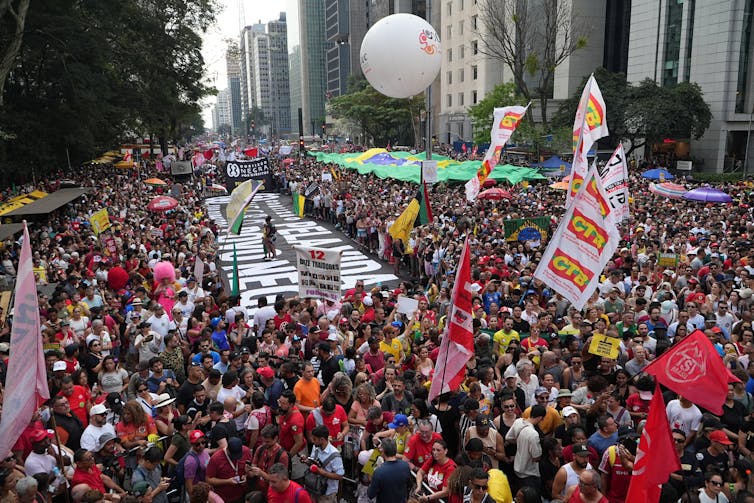
In 2018, this disillusionment paved the way for Bolsonaro, a former military officer who promised to bring back law and order. As president, Bolsonaro attacked the press, sowed distrust in the electoral system and positioned himself as the only honest option in a corrupt establishment that for him included the judiciary.
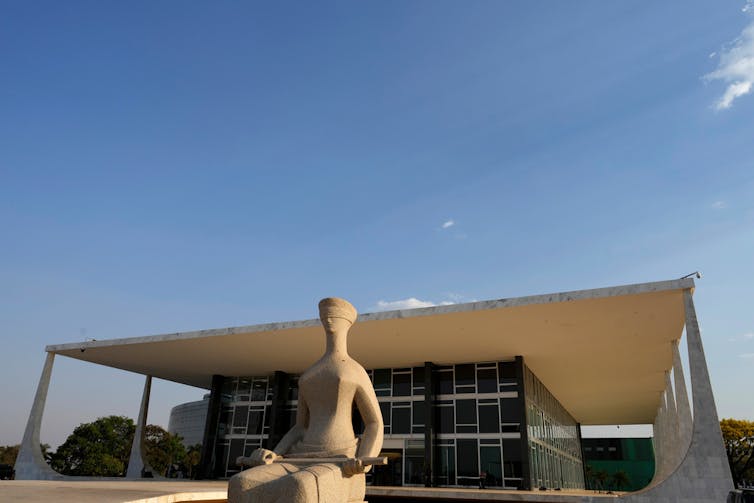
A powerful court protecting itself?
Although Bolsonaro directed particular animus at the judiciary, however, broader criticisms of the country’s highest courts didn’t come out of nowhere.
The criticism came from many quarters, from those complaining about its extreme power to those pointing at its exorbitant costs. Indeed, the country’s Congress continues to receive a still growing number of proposals to reform the judiciary system.
In 2008, Brazilian legal expert Oscar Vilhena Vieira, hardly a far-right ideologue, raised concerns about an expansive, unelected institution having so much influence in the policymaking process and politics of Brazil. He coined the term “Supremocracy” to describe this phenomenon of expansion of judicial power, which could lead to an imbalance in the separation of powers and judicial instability, since jurists cannot predict the next steps taken by the Brazilian Supreme Court.
Vieira warned that such a force, operating within a flawed political and institutional context, could create problems of legitimacy and compliance.
Almost 20 years later, the Supreme Federal Court’s power has continued to expand, leading to the intervention on the executive’s power during the COVID-19 pandemic, when the court ruled that states and municipalities had authority to implement their own policies, as long as supported by evidence provided by international agencies. This was a landmark moment because it effectively overrode the federal government’s attempt to centralize the pandemic response, sparking a national debate over whether the court was protecting the right to health or overstepping its bounds to strip the president of his administrative powers.
Bolsonaro directly threatened the authority of the Supreme Federal Court and rallied supporters on Sept. 7, 2021 – Brazil’s Independence Day. For the justices, not acting swiftly and decisively in responses held the risk of signaling weakness and could encourage future challenges to their own safety, institutional survival and control over the balance of powers.
How the court works
Justices of Brazil’s Supreme Federal Court are appointed by presidents and confirmed by the Senate to serve in a number of different functions until the age of 75 years old. On all constitutional matters, the court has ultimate authority, whether in cases brought by individuals or institutions, and has the final power of determining whether laws passed by the legislature are constitutional.
The court also has the power to judge federal authorities in criminal matters, even after the end of their mandates, if the crime is connected with their role. This is the case of Bolsonaro.
The court’s broad jurisdiction translates to tens of thousands of new cases every year and an extremely large budget. The court adds almost 1 billion reais — around US$ 190 million — a year to the federal budget, and the justices enjoy many perks, including housing assistance and visits abroad.
Controversially, it has also created opportunities for the justices’ family members. Justices recently ruled that nominating family members to public positions is constitutional, even though critics argue that nepotism can have a damaging effect on democracy.
The plot twist
The court’s assertiveness in regard to Bolsonaro – in line with previous actions – suggests to me that self-preservation is a major driver of the justices’ actions, rather than solely the result of any commitment to uphold democracy.
Certainly, it was a major achievement for Brazilian democracy to have, for the first time, tried and convicted high-ranking civilian and military coup plotters. But at the same time it allowed the court to flex, and perhaps also preserve, its powers.
Developments since Bolsonaro’s sentencing have led to fears that Brazil could be heading to an outcome that “ends in pizza,” as the Brazilian idiom has it. That is to say that it is a political scandal that ends without meaningful punishment.
In December 2025, part of the court and congressional leaders reached a behind-the-scenes agreement to reject amnesty for those involved in the failed coup of Jan. 8, 2023, in return for reduced sentences. In a clear nod to his base, President Luiz Inácio Lula da Silva signaled that he would not stand for any reduction in sentencing and vetoed the bill.
If a presidential veto is rejected by Congress, it could see Bolsonaro’s 27-year sentence reduced to just over two years in prison, according to reports.
Even short of a reduced sentence, Bolsonaro is already looking at a confinement lived out in relative luxury, compared with most criminals in Brazil’s prison system.
But that might serve the purpose of Brazil’s highest court — quieting a challenge to its authority, while making it clear who holds the key to any further tweak to his sentence.
Tassiana Moura de Oliveira has previously received funding from the CAPES Foundation.
Read These Next

Why the assault weapons debate is a culture debate
The Supreme Court’s decision to hear two assault weapons cases caps a multi-decade dispute over restricting…
What the law says about armed officers at polling places
What does the law say about armed officials at the polls? That’s one of four questions that a legal…

Leap seconds have helped keep clocks synchronized with Earth’s rotation, but their time may be over
If you think about leap years, it may seem like humans have a very odd way of measuring time. Sometimes,…