Chavismo has adapted before – but can Venezuela’s leftist ideology become US friendly and survive?
The ideology named after former Venezuelan leader Hugo Chávez became more authoritarian under Nicolás Maduro. Can the country’s new leader steer it back toward democracy?

When the Trump administration sent in a team of U.S. special forces on Jan. 3, 2026, to extract Venezuelan leader Nicolás Maduro, the operation fell short of full-scale regime change.
Despite years of U.S. antagonism toward Venezuela’s government, the broader political coalition that Maduro led was allowed to remain intact under the guidance of longtime Maduro ally Delcy Rodríguez. And it now seemingly has the tacit support of President Donald Trump – who has supported a transition to Maduro’s deputy over the option of pushing for opposition leader María Corina Machado to assume control.
As such, it marks a new phase, rather than an end, to the left-wing political ideology of Chavismo.
An ever-evolving Bolivarian revolution?
Now under its third stewardship in Rodríguez, Chavismo has already undergone change since being rolled out in Venezuela by Hugo Chávez.
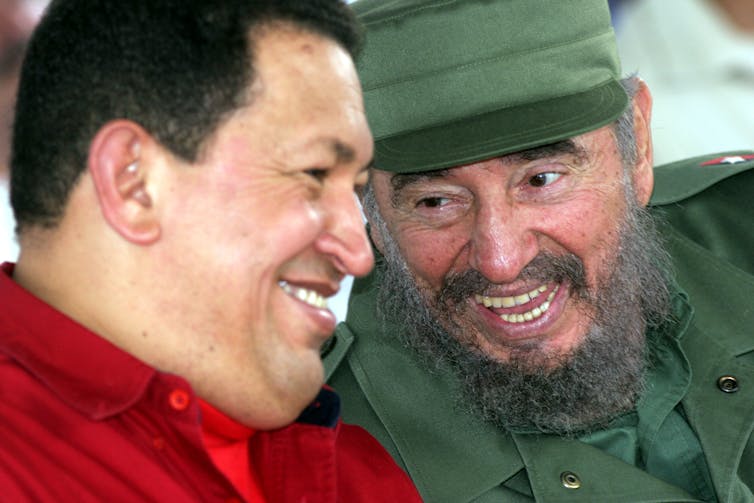
Chávez himself drew heavily on Fidel Castro’s Cuba in fomenting the ideology, which has ruled over Venezuela since Chávez came to power in a 1998 presidential election.
In particular, he borrowed from Cuba’s model of state controls and a blend of socialism, with a brand of Latin American nationalism and strident anti-imperialism. That included a wide-ranging platform of social welfare and programs to distribute land and money to the poor – financed by Venezuela’s vast oil reserves while the price of crude was high.
All of that is anathema to much of the political beliefs of the U.S Republican Party, particularly in Florida, and rubs up against both the MAGA wing and the coterie of anti-leftist foreign policy hawks that surround the president.
As such, the Trump administration’s willingness to give Chavismo a chance under Rodríguez is a startling difference from Dec. 19, 2025, when Sec. of State Marco Rubio gave a long explanation of why he thought Venezuela was “an illegitimate regime that openly cooperates with terrorist elements.”
Not just Maduro himself, note, but the “regime” itself.
As a former deputy head of the U.K. mission to Venezuela, I discussed politics with Chávez himself back in 1995. I had served in Portugal and the example of a left-wing Portuguese military ousting a right-wing dictator to promote a return to democracy was something that appealed to Chávez.
In opting to allow the Chavista former deputy to Maduro, Rodríguez, to take over the country rather than push for the immediate installation of María Corina Machado – whose proxy won the last Venezuelan election in 2024, according to international verification – Trump is betting that that a reformed Chavismo can uniquely provide the stability that is required to rebuild the Venezuelan oil industry. And that appears to be his immediate priority.
Rodríguez has succeeded, according to reports, in convincing Trump that immediate elections are not a priority, meaning that the Venezuelan people must wait further for their choices to made.
But Chavismo has gone through various iterations since the 1990s, and it might well do so now.
Chavismo’s evolution
At one point, Chavismo had been a more democratic venture. Chávez was elected in 1998 fairly, having been pardoned in 1994 for an earlier and unsuccessful illegal power grab. And at first Chávez seems committed to the idea of a democratic process. Moreover, like in Cuba after the revolution, he prioritized developing socialist programs in areas like health care and housing.
But how Chávez viewed the sustainability of his government changed markedly in 2002. That’s when the U.S. supported a coup attempt that challenged Chavez’s authority.
In surviving that coup attempt, he gained credibility with Cuba’s Fidel Castro who had at first doubted Chavez’ abilities.
Castro became his mentor in all policy decisions, particularly in helping craft his international profile.
At the time, Cuba was facing a more hawkish U.S. president on Latin American leftism in George W. Bush. So Chávez decided that Chavismo needed to become more anti-American, and the high price of oil enabled him to fund domestic and international largesse.
‘Competitive authoritarianism’
The system that the new Chávez presided over evolved gradually, and under Castro tutelage it became increasingly undemocratic.
Chávez was advised by the Cuban government on how to develop what critics have termed a system of “competitive authoritarianism.” This involved extending presidential terms, attacking the media and tweaking the constitution to further centralize power.
In a tried-and-tested authoritarian measure, Chávez packed the judiciary with loyalists, and turned the electoral commission into a rubber stamp for the incumbent government.
These measures proved the lynchpin of Maduro’s election fraud of 2024, when the courts refused to verify the QR codes of receipts produced by the opposition showing that they, not Maduro, had won.
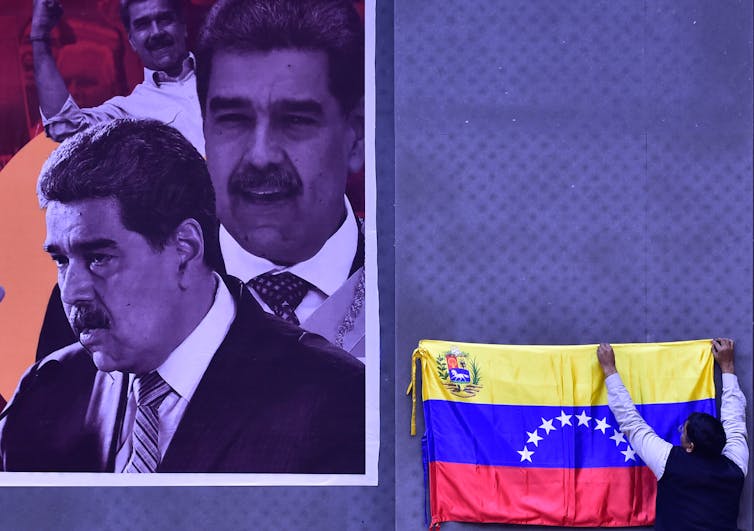
Under Maduro, Chavismo only got more repressive and authoritarian. Lacking the charisma of Chavez – who died in 2013 – and facing dwindling oil revenue with which to fund social and welfare programs, Maduro turned to the suppression of human and voting rights to maintain power as the country spiraled into the economic crisis and gang violence.
And to compensate for reduced oil revenues, Maduro turned to funding from drug and human trafficking, gold smuggling and, perhaps above all recently, crypto-trading.
A post-Trump makeover?
Rodríguez is no break from this Chavismo past, having served under both Chávez and Maduro.
Yet, she is apparently willing to work in cooperation with Washington. And the Trump administration has seemingly given her its blessing for now, evidenced most recently by a high-profile Jan. 15 visit to Caracas by the head of the CIA.
The basis of this apparent bargain is oil. Rodríguez has long experience of dealing with international oil companies – and her handling of oil production is reportedly a factor in her having been accepted by the U.S. administration.
The Chávez and Maduro governments advanced the state’s control of oil and other sectors, such as goldmining in Venezuela.
Under Rodriguez, it is likely to be reversed to appease Washington – opening up again to foreign companies and especially U.S. investment. Such a move would inevitably prove a wedge between Venezuela and Cuba.
Under Chávez and Maduro, Venezuela gave oil at heavily discounted prices to Cuba. In return, Cuban sent its doctors, advisers and security personnel.
This arrangement will likely be terminated under a new arrangement between Caracas and Washington. Its cessation would force Cuba to look for alternative oil supplies – probably from Mexico, Brazil and Colombia.
Yet Chavistas will likely be advising Cuba to do a similar deal with Trump. Cuba does not have oil, but it does have big nickel deposits and massive upside potential for U.S businesses in tourism. Cuba has only one 18-hole golf course, and years ago Trump, as a real estate developer, commissioned a study on building golf resorts on the island. Such deals might also save “Fidelismo.”
But where else might Chavismo go now? Will Rodríguez reverse the trend toward autocracy, and commit to future elections within a defined time period?
Will she also commit to dismantle “colectivos,” the militias of Chavismo that for years have suppressed opposition? And will she commit to returning the military to a national body, rather than the protector of one political movement?
Looking ahead, Trump’s prolonging of Chavismo is a political gamble in Florida – a state where many Latin Republican voters despise the system and any dealing with socialist governments. Trump ran in 2016 partly on a platform of opposing Obama’s deal with Cuba of 2014, claiming he would never deal with “socialist dictators.”
Can Chavismo survive?
The leaders of Chavismo have long been pragmatic negotiators, with a reputation among critics for breaking promises. In October 2023, for example, the Biden administration helped iron out the Barbados Agreement with Maduro and Venezuelan opposition groups, providing for free and fair elections in return for sanctions relief.
Yet the U.S. soon after accused Maduro of reneging on the deal by disqualifying the chosen opposition candidate, María Corina Machado. Now-acting President Rodríguez is still surrounded by all the stakeholders in Chavismo who concocted the scheme to deny the opposition’s victory – save, of course, Maduro himself.
Nonetheless, Chavismo had shown a strong instinct for survival. And Delcy Rodríguez has learned what many others leaders have: Chavismo can succeed in flattering, or at least appeasing, Trump. She has also learned that Trump appears more interested in oil than in restoring democracy.
Paul Webster Hare does not work for, consult, own shares in or receive funding from any company or organization that would benefit from this article, and has disclosed no relevant affiliations beyond their academic appointment.
Read These Next
AI is changing pilgrims’ journeys, but sacred journeys have always adapted to new technology
From the printing press to smartphone apps, technology has continually transformed the experience of…

These state supreme court races could decide abortion access and trans rights
Ohio, North Carolina and Michigan have open seats on their state supreme court, and these hotly contested…
Why can’t people regenerate limbs like salamanders?
Understanding how certain animals can regenerate entire organs and limbs could help heal injuries in…