
Chile elects most right-wing leader since Pinochet – in line with regional drift, domestic tendency
José Antonio Kast, who has run for the presidency several times, successfully seized on widespread dissatisfaction over issues like crime and immigration.


Chileans have elected the most right-wing presidential candidate since the end of the Augusto Pinochet dictatorship over three and a half decades ago.
In a runoff held on Dec. 14, 2025, José Antonio Kast, a Republican Party ex-congressman and two-time former presidential candidate, won just over 58% of the vote, while his opponent, Jeannette Jara, the left-wing labor minister of current President Gabriel Boric, won nearly 42%.
Approximately 15.6 million Chileans were eligible to vote in the first presidential election to take place with mandatory voting and automatic voter registration.
As a result of those new election rules, which went into place in 2022, an estimated 5 million to 6 million new voters went to the polls. These voters – found to be largely younger, male and lower-middle class – are seen as lacking a strong ideological identity and rejecting politics altogether.
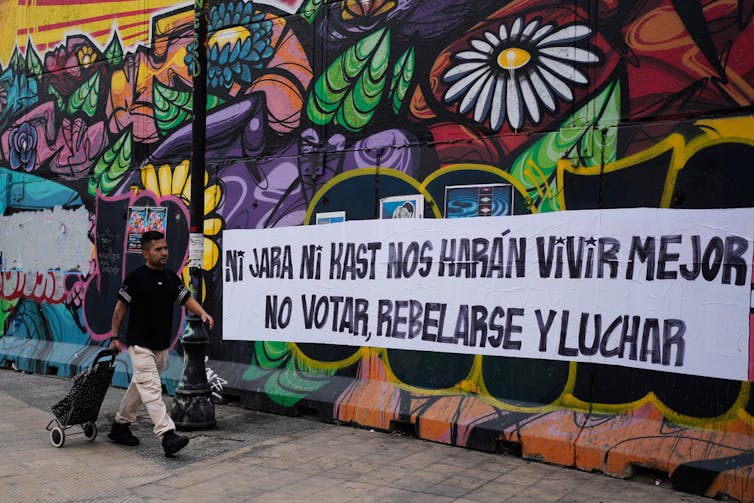
The verdict delivered by Chile’s voters puts it in line with a broader right-wing regional shift – most recently in Bolivia – that has reversed the “pink tide” of left-leaning governments in the past two decades. But as a historian of modern Latin America and Chile, I believe Chile’s election also reflects the important local context of years of increasing disenchantment with the political system.
Amid Chile’s expanded electorate, the primary issues of voter concern during this campaign were crime and immigration. An October 2025 poll specifically found delinquency to be the top issue, with immigration, unemployment and health care also marking high.
Though Chile has one of the lowest crime rates in Latin America, high-profile cases of organized crime have shaken the nation in recent years. Homicides increased between 2018 and 2022 and have decreased slightly since then. Immigration has also risen significantly, with a large number of immigrants coming to Chile having fled economic and political crises in Venezuela, as well as in Peru, Haiti, Colombia and Bolivia. The foreign-born population in Chile rose from 4.4% in 2017 to 8.8% in 2024.
The key constitutional context
Many commentators have highlighted the stark polarization of this election, with a Communist Party labor minister campaigning against the arch-conservative Kast, who has lauded the Pinochet dictatorship under which his deceased older brother once served. But there is more to the story.
Some observers have drawn comparisons between Kast and other far-right Latin American leaders like Nayib Bukele in El Salvador, Javier Milei in Argentina and Jair Bolsonaro in Brazil. But Chile is not merely following the same far-right playbook of its neighbors.
In the weeks leading up to the runoff in Chile, both candidates moved toward the center. Jara vowed to expand the prison system to combat rising crime, while Kast – who had previously threatened expulsion of undocumented migrants – softened his tone to say they would be “invited” to leave.
Moreover, Kast learned from his previous failed attempts at the presidency by speaking less about his controversial or more socially conservative positions. For example, he played down opposition to abortion under any circumstances. Chilean voters, in contrast, overwhelmingly approve of the limited abortion rights that were passed by Congress in 2017.
Yet beyond the campaign trail messaging, the results also reflect a structural fact of Chilean politics that mirror political realities of other parts of Latin America, and even globally. In every presidential election since 2006, Chileans have voted out the incumbency to swing to the opposing side of the political spectrum. With candidates barred from consecutive presidential terms, the pendulum has swung back and forth since the alternating presidencies of socialist Michelle Bachelet – 2006-2010 and 2014-2018 — and conservative Sebastián Piñera – 2010-2014 and 2018-2022.

Boric, a former left-wing student leader, took office in 2022 following a wave of upheaval and popular protests over inequality in 2019-2020. In what was a historic moment, the country voted to begin a process of rewriting its Pinochet-era constitution, which entrenched neoliberal economic policies and limited the government’s capacity to confront inequality. The constitutional convention was made up of directly elected citizens, many of them from grassroots movements.
Yet in a stunning reversal, the progressive constitution – which would have protected rights to nature, Indigenous rights and social rights – was roundly defeated in a plebiscite in 2022. Just over a year later, voters similarly rejected a second attempt to rewrite the constitution, albeit under a process that conservative parties helped shape.
Boric’s approval ratings, already low, suffered from this failed constitutional process. More than the right-wing elections elsewhere in the region, this national context helps to explain Chile’s own conservative turn.
The ever-present discontent of voters
Even as the pendulum has swung back and forth in recent Chilean presidential elections, there are deeper continuities across the different Chilean governments in the 21st century. Important among them is generalized voter discontent with the political system.
This has traditionally been expressed in popular protests, such as the student movements of 2006 and 2011 and the Estallido Social – or Social Uprising – of 2019-2020 that were the largest protests since the return to democracy in 1990 and helped propel Boric to power. Public discontent was also expressed in the overwhelming vote to rewrite the constitution, which passed with 78% of the vote in 2020.

Even though the constitutional process was ultimately rejected by voters, this underlying discontent has not gone away.
One of the recent signs of discontent with the political choices on offer was in the first round of voting on Nov. 16: The third-place candidate was not one of the veteran politicians on the right, but Franco Parisi, a populist economist who has not set foot in Chile in years and who called on his supporters to intentionally vote null – or “spoil” their votes. Discontent has taken many forms – outrage about inequality and neoliberalism in 2019-2020, or unease about economic precarity and crime in the current election. But it has persisted, even as Chile’s political system remains stable.
Some observers have pointed out that, unlike in many places around the world, Chile’s democratic norms are holding strong. The fact that power continues to pass peacefully despite major ideological differences is significant, particularly in light of the long struggle for democracy during the Pinochet regime. Kast’s style, for what it’s worth, is not as bombastic as that of U.S. President Donald Trump or Argentina’s Milei.
Still, his apparent politeness belies what many fear is a coming erosion of rights: the rights of women to bodily autonomy; the rights of individuals] to due process; the rights of workers to dignified conditions. These may well be up for negotiation under the new administration.
Kast, a staunch Catholic and father of nine, is opposed to abortion under any circumstances and has even attempted to ban the morning-after pill. He was a supporter of Pinochet up until the regime’s end, campaigning for the “yes” vote in 1988 that would have seen eight more years for the authoritarian leader after 15 years already in power. Kast has likewise vowed to slash public spending and deregulate the economy, a clear echo of the Pinochet years.
Despite the momentous shift heralded by Kast’s election, though, it is unlikely to change one of the principal challenges of Chile’s democracy in the 21st century: voter discontent and disenchantment. There has been a consistent trend for the government in power to lose popular support and face strong headwinds in Congress from the opposition. For all the celebration happening right now for Kast and his supporters, it is hard to see that changing once the new government takes office in March 2026.
Andra B. Chastain receives funding in 2025-26 from a Fulbright-García Robles research grant in Mexico. She has previously received funding for research in Chile from the Social Science Research Council and the PEO Foundation.
Read These Next

Why fuel prices may go higher still
Seven months into the US conflict with Iran, with no clear end in sight, the global oil market has now…

Generous paternal leave policies improve maternal and newborn health, family finances and workplace
Leave for the non-birthing parent after a new baby arrives gives the family an opportunity to bond.

What was the original first-person shooter? Two largely forgotten computer games from the 1970s ushe
The games created a new way of experiencing video games by building a 3D world in which events could…