How crime in Brazil drags down the economy and heaps economic pain on the nation’s poor
The percentage hit on Brazil’s GDP could be in the double digits.

Brazil’s “criminal economy” does not appear on any national balance sheet. Yet the cost of violence, contraband, tax evasion and environmental crime can be measured in the tens of billions of dollars every year and serves as a major drag on Brazil’s economic growth and stability.
Attempts to quantify this burden go back at least a decade. An influential 2017 study by the Inter-American Development Bank estimated that crime and violence consumes roughly 3.4% of gross domestic product across Latin America and the Caribbean, with Brazil among the worst-affected countries. A later assessment by Brazil’s own Institute for Applied Economic Research put the annual cost of violence alone at 5.9% of GDP.
Such figures are usually calculated by looking at the cost of violence and crime on the lost earnings of people killed or incarcerated through crime, the medical costs of dealing with the aftermath of violence, the increased cost of security, and the value of damaged or stolen property.
But headline figures still miss much of what never shows up in ledgers. They rarely capture the welfare cost of a homicide, the long-term earnings lost when a teen drops out of school because his neighborhood is dangerous, or the investment that never materializes because a company fears extortion or theft.
As such, some researchers contend that even a 5.9% estimate should be seen as a lower bound on the cost of violence.
In fact, a recent analysis of official statistics and private surveys suggest that once indirect losses are fully accounted for, crime may be shaving around 11% off Brazil’s annual GDP. I believe the real cost could be even higher.
Beneath these totals lies an enormous underground economy that both feeds and conceals illegality. The Underground Economy Index estimates that unregistered or informal activity accounted for 17.8% of Brazil’s GDP in 2022, or around US$313 billion.
Not all of that is criminal. For many microbusinesses, an informal economy is a survival strategy. But such a vast cash-based economy offers ideal cover for smuggling, tax fraud, counterfeit goods and money laundering, making enforcement vastly more complex.
From contraband to cargo theft
Illicit commerce now mirrors the formal economy in scale and diversity. A recent survey by the National Forum Against Piracy and Illegality found that contraband, falsification and piracy cost Brazil roughly $86 billion in 2024, including $60 billion in lost sales for legitimate companies and $25 billion in unpaid taxes.
Tobacco, clothing, fuel, electronics and pharmaceuticals were among the hardest-hit sectors. Economists caution that such figures, based on self-reported industry losses, are imprecise; however, they do underscore how deeply illegal trade has penetrated mainstream markets.
Brazil’s logistics sector offers a particularly stark illustration of how crime acts as a hidden surcharge on everyday goods. According to data compiled by the National Association of Cargo Transport and Logistics, the national haulage association, Brazil recorded 10,478 cargo thefts in 2024, with estimated losses of $221 million.
When the cost of fuel-related thefts and fraud are added, the annual losses rise to $5.34 billion. These crimes, concentrated along major freight corridors in the southeast of the country, force companies to invest in trackers, armored convoys and route changes – costs that ripple through supply chains and ultimately into final prices.
The new environmental criminal frontier
Brazil’s criminal economy also burrows into its rivers and forests. A landmark study by the Choices Institute, a Brazilian think tank, documented that between 2015 and 2020, the country traded 229 tons of gold with signs of illegality, nearly half of total production over that period.
Much of this “suspect” gold appears to originate from Indigenous territories or environmental protection areas in the Amazon. That volume is worth tens of billions of dollars, providing a ready vehicle for laundering proceeds from other illicit markets while starving the treasury of royalties and taxes.
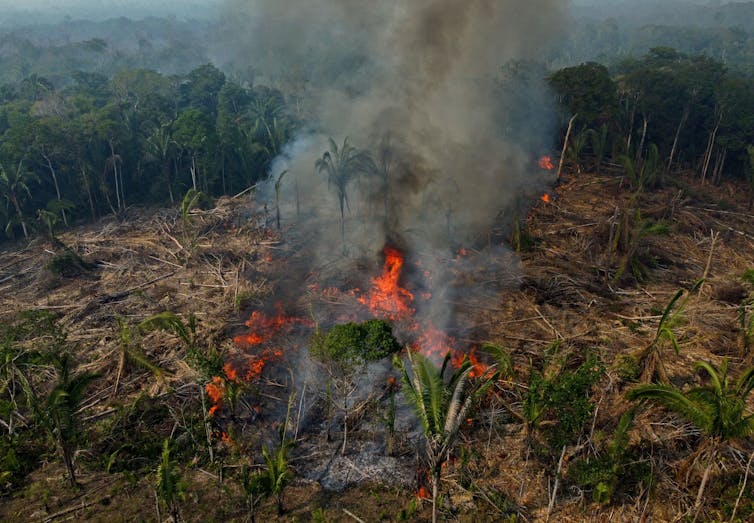
The environmental ledger may be the most underappreciated of all. The MapBiomas Alerta project confirmed 74,218 deforestation alerts – which give authorities a heads-up on potential logging, fires or land clearance activity – in 2020 across Brazil, covering nearly 5370 square miles (13,900 square kilometers). An analysis of those alerts found that nearly all bore signs of illegality. These trends have not changed.
Deforestation in the Amazon not only eliminates trees, but it also drains the economy. A recent study by the Climate Policy Initiative estimates that Brazil’s Itaipu and Belo Monte hydroelectric plants together lose around 3,700 to 3,800 gigawatt-hours of potential generation each year because deforestation has weakened the “flying rivers” that carry moisture from the forest to the rest of Brazil.
That lost energy, enough to provide power to roughly 1.5 million people, translates into more than $184 million in foregone revenue annually.
Lawlessness is a regressive tax
No single study can capture the entirety of Brazil’s criminal economy. Still, putting together the most conservative official numbers yields a rough balance sheet.
And even a cautious estimate would put the total cost at around $239 billion to $275 billion annually – or 12% to 14% of Brazil’s GDP, by my estimate.
These costs of crime are a hidden regressive tax, falling hardest on poor Brazilians who are more exposed to violence, more dependent on public services and less able to hedge against inflation or instability.
And every dollar lost to corruption, contraband or illegal deforestation is a dollar that cannot be invested in schools, hospitals or clean energy.
Countering crime
There are, however, tentative signs that lawmakers and authorities are beginning to act on this calculus. The Finance Ministry has asked Congress to accelerate a package of bills that sharpen the definition and treatment of companies that bake systematic tax evasion into their business model, and to arm prosecutors and tax authorities with stronger tools to overcome the convoluted financial structures that shield them.
The creation of a permanent unit to fight organized crime within the Justice Ministry, bringing together federal tax authorities, federal police, public prosecutors and state-level task forces, also points to a growing recognition that criminal entities operating within the formal economy can only be reached if fiscal, financial and criminal laws are applied in a coordinated way.
In parallel, national authorities have signaled an intention to negotiate a new cooperation framework with Washington centered on information-sharing around money laundering, arms trafficking and large-scale tax fraud – embedding the fight against organized crime more explicitly in bilateral economic talks.
And recent enforcement actions offer a glimpse of what a more systemic approach looks like in practice. In August 2025, [federal and state police] cracked down on a national criminal network that used a fintech “shadow bank” and at least 40 investment funds to launder illegal transactions involving roughly 1,000 gas stations from 2020 to 2024.
Then, in November, Brazilian authorities executed 126 search and seizure warrants in five states and secured judicial orders to freeze more than $1.8 billion in assets relating to criminal activities.
These measures suggest that Brazil’s institutions – and the lawmakers who shape them – are beginning to treat crime not as an unavoidable backdrop to economic life, but as a macroeconomic distortion that can, and should, be confronted head-on.
This is a translation of an article for The Conversation Brazil. The Portuguese language version can be found here.
Dr. Robert Muggah is affiliated with the Igarapé Institute and SecDev.
Read These Next
If Philadelphia Eagles quarterback Jalen Hurts can get dangerous blood clots, so can you – here’s ho
In the US, up to 900,000 people are affected by severe blood clots each year, and over 60,000 die from…

I composed music about infertility and pregnancy loss, then performed it in a Pittsburgh hospital
1 in 4 known pregnancies in the US ends in loss. A composer explains how those numbers, along with doctors’…
50 years later, Amory Lovins’ soft energy path meets electrification
Five decades ago, he charted two paths for energy use in the US. His soft path rightly emphasized efficiency…