
From evil to upheaval and beyond: How the ‘axis’ metaphor shaped modern geopolitics
Using ‘axis’ to describe a grouping of countries tends to link them to a sordid past – but not always.

The plural of “axis” is “axes,” apparently. And foreign policy types with axes to grind have been making good use of this other meaning, too.
Earlier this year, academic Walter Russell Mead warned in his Wall Street Journal column of the threat from the “axis of revisionist powers” – namely China, Russia, North Korea and Iran.
The same grouping has gone by other names, too: the “axis of upheaval” and “axis of autocracies” among them.
As a scholar of international relations, I know that framing any coalition or grouping as an “axis” does more than merely describe — it does some serious geopolitical work. The term summons the memory of the original “axis,” that of the Axis powers of World War II.
What it attempts to do is cast any named grouping of countries as similarly dangerous, duplicitous or degenerate. To call a group of nations an “axis” is to situate them in a lineage of villainy, transforming today’s rivalries into an echo of that original alliance.
The origins of the ‘axis’
The naming of today’s “axes” tends to come out of think tanks and foreign policy institutions of the U.S. But the origin story begins not in Washington, but in Rome.
In 1936, Italy’s fascist leader, Benito Mussolini, proclaimed that a “Rome–Berlin Axis” would divide Europe, constituting a geopolitical line around which other countries would orbit.
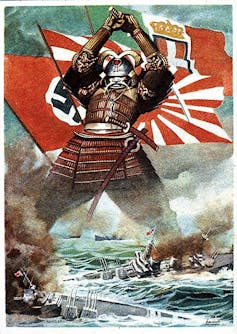
By the time of World War II, the term “Axis powers” had come to refer to the military coalition of Germany, Italy and Japan. In that historical context, the word “axis,” from the perspective of nations outside that group, carried connotations of unity, threat and evil from the offset.
The term fell largely into disuse with the Axis powers’ defeat in 1945.
That was until U.S. President George W. Bush famously revived the word after the Sept. 11 attacks. The “axis” he referenced in his 2002 State of the Union address wasn’t an existing alliance. Rather, he was creating one in the public imagination: an “axis of evil.”
The three countries Bush named in that group – Iran, Iraq and North Korea – had little in common, beyond Washington’s suspicion. Yet by linking them under a single, ominous label, Bush transformed three separate challengers into a unified menace.
The phrase “axis of evil” was never meant to map reality; it was meant to shape it by fusing disparate adversaries into a single moral and strategic category.
From one metaphor to another
From Bush’s revival, the idea of axes took on a life of its own. Al-Zahf Al-Akhdar, a Libyan daily newspaper, retorted that in reality, Bush’s targets comprised an “axis of resistance.”
Iranian leaders and their allies picked that term up and reworked it to apply to a network of aligned armed movements across the Middle East, including the Houthis in Yemen, Hezbollah in Lebanon and Hamas in the Gaza Strip.
What had been a Western accusation was transformed into a badge of honor for those who defined themselves as resisting American hegemony and Israeli occupation.
But it was the Russian invasion of Ukraine in 2022 that revived the use of “axis” in the imagination of Washington analysts.
In a 2024 article for Foreign Affairs, former U.S. foreign policy officials Andrea Kendall-Taylor and Richard Fontaine warned of an “axis of upheaval” dedicated to “overturning the principles, rules and institutions that underlie the prevailing international system.”
The four countries in this “axis” – China, Iran, North Korea and Russia – have little formal coordination. But the phrase captured something about mood and moment: the sense that the world is tilting toward multipolar rivalry and systemic friction.
Words that make worlds
Calling a coalition an “axis” is never a neutral act – it is a political label.
It can transform separate grievances into one unified struggle, or it can reduce a complex relationship to an “us versus them” or “good versus evil” frame.
The effect is double-edged. On the one hand, such language can be useful for mobilizing public opinion and bringing a sense of threat into focus. On the other, it makes categories more rigid and diplomacy harder. Once a nation has been put on an “axis” list, engagement can become morally freighted, and compromise can be framed as appeasement.
The “axis of evil” label, for instance, helped make possible the 2003 invasion of Iraq, but it made talks with Iran and North Korea politically toxic for many years.
Whether “evil,” “resistance” or “upheaval,” each variant of the “axis” metaphor tells us something about the way that political language constructs the world it describes.
When we talk about an “axis,” we are not just mapping alliances in the world. We are also helping to define the moral geography of global politics — and deciding who stands inside the circle of legitimacy, and who stands outside it.
This article is part of a series explaining foreign policy terms commonly used but rarely explained.
Andrew Latham does not work for, consult, own shares in or receive funding from any company or organization that would benefit from this article, and has disclosed no relevant affiliations beyond their academic appointment.
Read These Next

What was the original first-person shooter? Two largely forgotten computer games from the 1970s ushe
The games created a new way of experiencing video games by building a 3D world in which events could…

From lab to life: Why translating AI advances to the real world is a major challenge
All the training data in the world can’t account for every possibility when AI systems interact with…

The medieval world had its own ‘deepfakes’ – church officials cited a fake imperial decree for centu
The forged document was used as leverage to try to expand papal control throughout the Italian peninsula.