
Guinea-Bissau’s military takeover highlights the nation’s sorry history of coups and a deepening cri
The takeover was the 11th successful coup d'etat in Africa since just 2020, and the latest destabilizing event in a country long plagued by governance challenges.

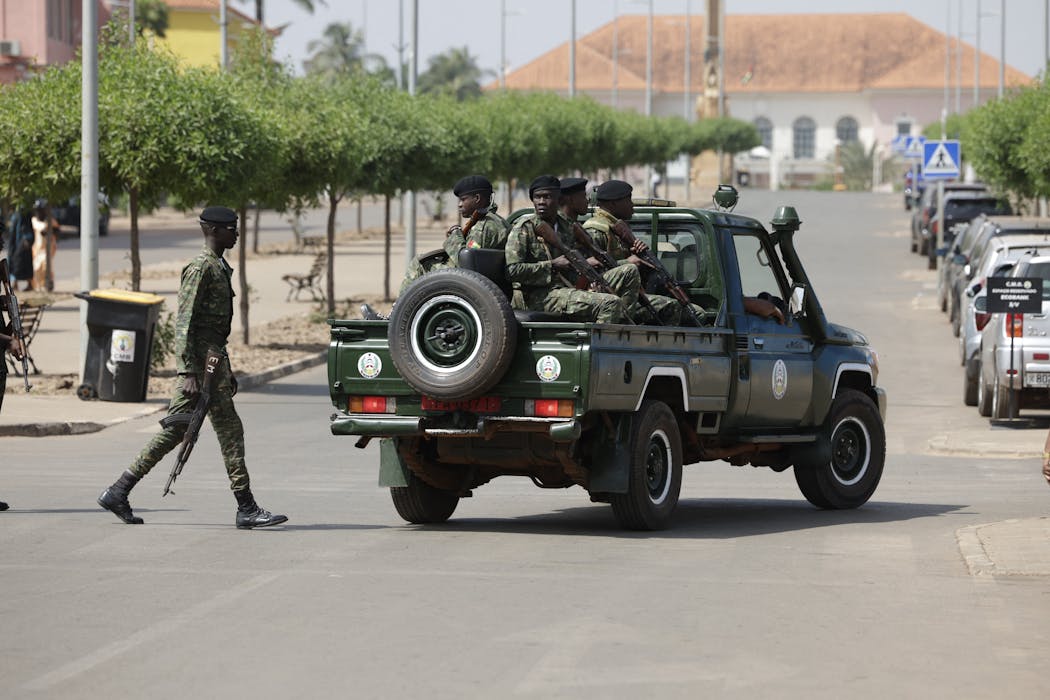
Army generals in Guinea-Bissau seized power on Nov. 26, 2025 – the eve of a scheduled official declaration of the winner in the West African nation’s presidential election.
Alleging a destabilization plot by unnamed politicians and drug lords, the military suspended the electoral process and blocked the results of a contest that both the now former president, Umaro Sissoco Embaló, and the opposition candidate had claimed victory in.
General Horta Inta-a, the head of the presidential guard, was subsequently sworn in as “transitional” leader and Ilídio Vieira Té, a close Embaló ally, was appointed prime minister. The timing of the development and Embaló’s connection to the new government figures have led domestic opposition groups and some West African political leaders to claim the coup was staged to facilitate Embaló’s continued rule by proxy.
Whatever the veracity of such claims, the events point to both a deepening regional crisis of democracy and the inability of Guinea-Bissau to escape its coup-prone history. Indeed, as a scholar who has compiled and updated a dataset of coup types and documented their history in Guinea-Bissau since its independence from Portugal in 1974, I believe the country is caught in a classic coup trap whereby poverty and coups d’etat are mutually reinforcing.
The Sahel coup belt keeps expanding
The events in Guinea-Bissau reflect a so-called polycrisis for countries in and around the Sahel belt, sandwiched between North Africa and sub-Saharan Africa. This region has, since 2020, become the global epicenter of both terrorism and coups – so much so that it is sometimes dubbed the Sahel “coup belt”.
The events in Guinea-Bissau, which is located just south of the Sahel region, represent the 11th successful coup in Africa since 2020 – and the second successful one in 2025 after the military takeover in Madagascar in October following a wave of Gen Z protests.
Indeed, nearly three-quarters of all coup attempts in the world since 2020 have taken place in West Africa or the Sahel. The region accounts for an even higher share of successful coups since 2020. This unprecedented cluster of coups comes in a region that accounts for less than 10% of both Africa’s population and the number of states in the world.
The Sahel region is responsible for around 75% of recent coups

There have been many reasons for the various coups in the Sahel since 2020. Takeovers in Mali, Burkina Faso and Niger, for example, were driven in part by growing terrorist insurgencies, Russian disinformation and rising anti-French sentiment.
By contrast, data from the conflict monitoring organization Armed Conflict Location and Event Data, or ACLED, shows very little conflict or protest in Guinea-Bissau leading up to the coup. Instead, events appear to lie in political opportunism in the wake of an election marred by flaws and allegations of illegitimacy.
Guinea-Bissau’s ‘coup trap’
Before the latest military takeover, Guinea-Bissau was already the fourth-most coup-prone state in sub-Saharan Africa, having suffered five failed coup attempts and three successful ones since 1974. Coups toppled the single-party regime of the African Party for the Independence of Guinea and Cape Verde in 1980, the authoritarian regime of Kumba Yala in 2003 and overthrew democracy and installed an indirect military regime in 2012. Meanwhile, a failed coup attempt in 1998 sparked the country’s only civil war.
Since 2020, Guinea-Bissau had suffered one bona fide coup attempt, in February 2022, in addition to a mutiny in late 2022 that Embaló condemned as a coup attempt. The coup of November 2025 was itself foreshadowed by an alleged coup plot that was revealed at the end of October, when a number of senior officers were arrested.
All of that suggests a feature of this type of instability: Coups beget more coups. In fact, seven of the nine nations that have suffered successful coups since 2020 had already suffered a successful coup within the previous 20 years.
And whereas nearly 30% of nations with coups since 2005 suffered a coup again between 2020 and 2025, states that lacked a recent coup history – even poor countries in Africa – were much less likely to suffer a coup after 2020.
Coup as a feature, not a bug
Following the 2022 coup attempt in Guinea-Bissau, Embaló had moved to consolidate the government under his leadership and reduce constraints on the executive. Indeed, data on three key dimensions of democracy shows that electoral contestation, voter participation and executive constraints have all declined significantly in Guinea-Bissau since.
The Varieties of Democracy project, which surveys experts to measure different levels of democracy, declared in 2022 that Guinea-Bissau had become an “electoral autocracy” – a term to denote governments that are elected through unfair and fraudulent means and go on to rule in an authoritarian manner.
The nation has continued to slide into autocracy since then.
Embaló used an alleged coup plot in December 2023 as a pretext to dissolve the opposition-dominated legislature. The country has not had a sitting legislature since.
Earlier in 2025, Embaló went back on his promise to step down at the end of his first term and instead announced he was running for a second term. Given that Embaló had barred the main opposition party from running, many feared he might try to steal the election, if necessary, much like Paul Biya is alleged to have done in nearby Cameroon in October 2025.
Not a ‘good coup,‘ but a ‘veto coup’
When asked about recent coups in Africa, Rwandan President Paul Kagame insisted that some coups – those that oppose corruption and bad governance – are “good coups.” Though scholars have debated how frequent so-called good coups have been in Africa, there is little doubt that the recent case better fits the classic pattern of a so-called “veto coup,” meant to prevent the winner of the election from taking office.
Indeed, the presence of prominent Embaló allies in the interim Guinea-Bissau government lends credence to opposition cries of foul play. The new government’s promise of democratic elections in a year should likewise be treated with skepticism. The promised electoral timetable has not been kept in any other recent coup case in the Sahel, where juntas remain entrenched.
As such, even if Guinea-Bissau was becoming increasingly autocratic already, the latest takeover is likely a cure worse than the disease. Whether the international community that has condemned the coup – from the United Nations to the African Union to the Economic Community of West African Nations – is willing or able to take credible steps to help guide Guinea-Bissau back to constitutional rule looks uncertain, given the recent example of other coup-hit nations across the continent.
John Joseph Chin does not work for, consult, own shares in or receive funding from any company or organization that would benefit from this article, and has disclosed no relevant affiliations beyond their academic appointment.
Read These Next

Menopause is a major health milestone, yet health records barely track it - new research
Capturing data about the timing and symptoms of menopause could help address many unanswered questions…

What was the original first-person shooter? Two largely forgotten computer games from the 1970s ushe
The games created a new way of experiencing video games by building a 3D world in which events could…

College rankings, like those of US News and World Report, remain influential, despite their many fla
College rankings can be consequential for less prestigious and less wealthy schools, giving them visibility…